India’s Growth Model Latest News
- A recent analysis highlights structural weaknesses in India’s growth model and rising middle-class vulnerability.
India’s Growth Model and Poverty Reduction
- India’s economic growth over the last decade has been widely recognised for its success in reducing poverty.
- The proportion of people living below the World Bank’s lower middle-income poverty line has declined significantly from over 50% a decade ago to nearly 30% in recent estimates.
- This reduction has been driven by a combination of economic growth and the expansion of welfare programmes. Key enabling factors include:
- Improved delivery of welfare schemes such as subsidised food and direct benefit transfers.
- Expansion of financial inclusion through banking access.
- Strengthening of last-mile governance mechanisms.
- However, while poverty reduction is evident, it does not fully capture the broader picture of economic well-being.


Limits of Poverty-Based Measurement
- Traditional poverty metrics rely on a threshold approach.
- They classify individuals as either poor or non-poor based on whether their income crosses a fixed line. This method has two key limitations:
- It does not capture the quality of life above the poverty line.
- It ignores income volatility and economic insecurity.
- A World Bank perspective suggests shifting towards a “well-being spectrum” approach.
- This approach evaluates how far individuals are from achieving a reasonable standard of living rather than simply whether they are above or below a threshold.
Rise of a Vulnerable Middle Class
- India’s growth has led to a situation where many people have moved out of poverty but have not achieved economic stability.
- This has resulted in the emergence of a “vulnerable middle class”.
- These households are characterised by:
- Low and uncertain incomes.
- Limited savings and high exposure to shocks.
- Restricted access to quality education and healthcare.
- Crossing the poverty line, therefore, often marks entry into vulnerability rather than stability.
Structural Issues in Employment and Income
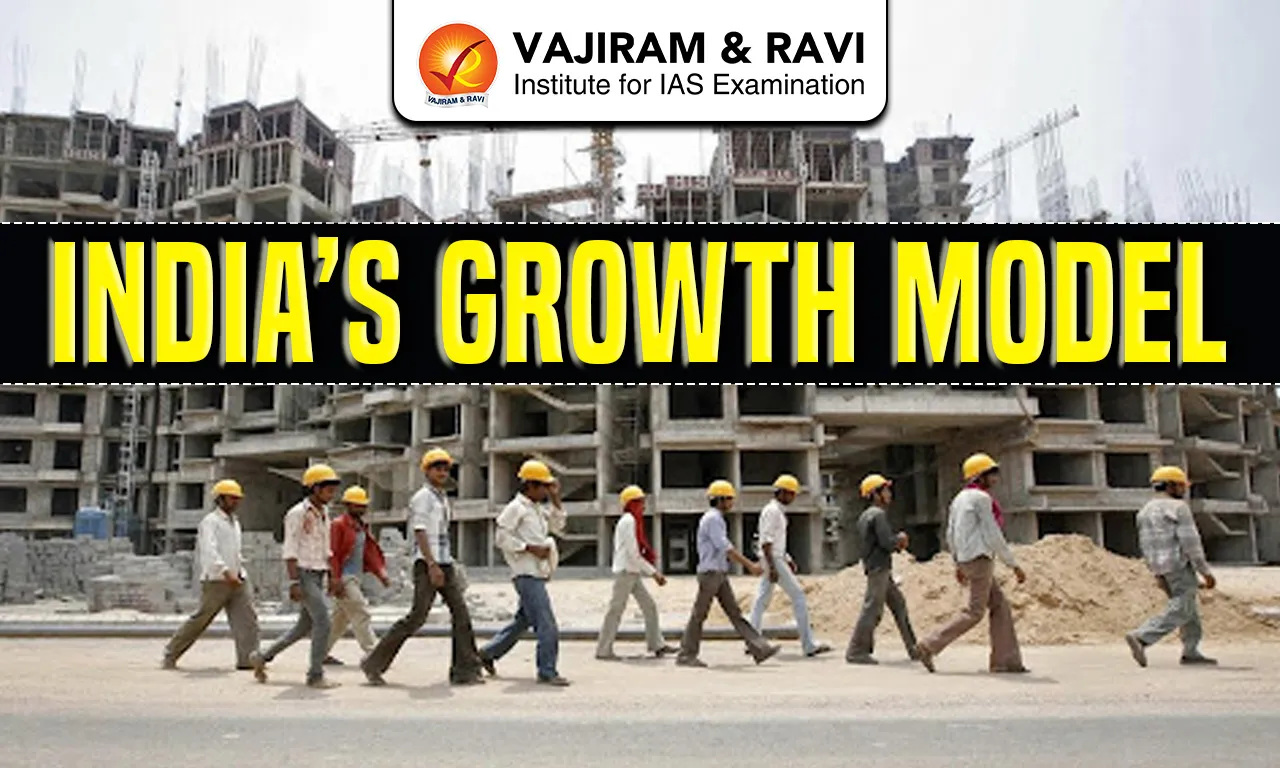
- India’s growth model reveals a disconnect between output expansion and employment generation.
- Growth has been concentrated in sectors that are capital-intensive or limited in labour absorption.
- Key structural concerns include:
- Less than 10% of workers are in formal employment with social security.
- Around 94% of informal workers earn below Rs. 10,000 per month.
- Real wages have remained largely stagnant despite productivity gains.
- This indicates that economic growth has not translated into stable income growth for the majority.
Sectoral Imbalances and Labour Shift
- A major concern is the weak performance of the manufacturing sector.
- Manufacturing has not expanded sufficiently to absorb the growing labour force. Between 2016 and 2021, the sector reportedly lost around 24 million jobs.
- As a result, many workers have moved back into agriculture.
- Agriculture employs nearly 46% of the workforce.
- It contributes only about 18% of total output.
- This mismatch reflects low productivity and limited income growth.
- The average farm household income remains modest, indicating persistent economic insecurity.
Inequality and Concentration of Wealth
- While a large section of the population remains vulnerable, income and wealth concentration at the top have increased.
- The top 1% accounts for over 22% of national income.
- A small group of billionaires holds a significant share of national wealth.
- This divergence highlights that growth benefits are unevenly distributed.
- It also reinforces the idea that poverty reduction alone is not sufficient to ensure equitable development.
Indicators of Economic Fragility
- Several indicators point towards growing economic fragility.
- Youth unemployment is around 45%.
- Graduate unemployment is close to 29%.
- This suggests that education is not translating into employment opportunities.
- Household financial stress is also increasing.
- Financial savings have declined to around 5% of GDP.
- Household debt has risen, often driven by consumption needs.
- Human development indicators further reinforce this concern.
- India has high levels of child wasting and stunting, indicating long-term constraints on productivity and mobility.
Policy Implications and Way Forward
- India’s development challenge is evolving. The focus must shift from merely reducing poverty to enabling upward mobility.
- Key policy priorities include:
- Expanding labour-intensive manufacturing and MSMEs.
- Strengthening skill development aligned with market needs.
- Improving wage growth and linking it to productivity.
- Expanding social security for informal workers.
- Adopting broader measures of welfare beyond poverty lines.
- These steps are essential to convert economic growth into inclusive and sustainable development.
Source: TH

 Last updated on Sep, 2026
→ UPSC 2027 Notification will be released on 13 January 2027 at upsconline.nic.in.
→ Check out the latest UPSC Syllabus here.
→ Download UPSC Model Answers for Mains 2026
→ UPSC Mains Question Paper 2026 is out now for Essay & GS Paper 1, 2, 3 & 4.
→ UPSC Calendar 2027 has been released.
→ Enroll in Vajiram & Ravi’s UPSC Mains Test Series 2027 for structured answer writing practice, expert evaluation, and exam-oriented feedback.
→ Join Vajiram & Ravi’s UPSC Mentorship Program 2027 for personalized guidance, strategy planning, and one-to-one support from experienced mentors.
→ Go through the UPSC Mains Previous Year Papers to enhance your preparation.
→ UPSC has released UPSC Toppers List 2025 with the Civil Services final result on its official website.
→ Also check Best UPSC Coaching in India
India’s Growth Model FAQs
Q1. What is the key achievement of India’s growth model?+
Q2. What is meant by a vulnerable middle class?+
Q3. Why is India’s growth considered structurally weak?+
Q4. What is the limitation of poverty-based metrics?+
Q5. What is the key policy focus required ahead?+
Tags: india's growth model mains articles upsc current affairs upsc mains current affairs