Byzantine Empire Latest News
Researchers have identified a fortified hilltop complex in southeastern Spain as a rare Byzantine stronghold established by soldiers and clergy in the late sixth century.
About Byzantine Empire
- It traces its beginnings to the year 330 CE, when Emperor Constantine split the Roman Empire into a western and eastern half.
- It was the eastern half of the Roman Empire that survived for nearly 1,000 years after the western half of the empire collapsed.
- It is often called the Eastern Roman Empire or simply Byzantium.
- It was based at Constantinople (modern-day Istanbul), and at its peak it controlled territory stretching from southern Spain to Syria.
- Strategically located on the Bosphorus Strait, Constantinople quickly rose to become Europe’s most significant urban hub.
- Throughout their history, the Byzantines rarely controlled Rome and spoke mainly Greek. Despite this, the people of Byzantium continued to refer to themselves as “Romans,” .
- Their broader empire was considered to be a “Roman” empire even though it rarely controlled Rome.
- The Byzantine Empire flourished and experienced a “golden age” during the reign of Justinian (A.D. 527 to 565), during which the empire’s territories extended into Western Europe, and the emperor’s builders constructed the Hagia Sophia, a great cathedral that still stands and is now used as a mosque.
- The governance of the Byzantine Empire was marked by the absolute authority of emperors, who were seen as divinely appointed rulers.
- The Byzantines developed their own political systems, religious practices, art, and architecture.
- However, the empire faced numerous challenges, including territorial losses to emerging Muslim powers and internal religious schisms that eventually led to the split between the Roman Catholic and Eastern Orthodox Churches.
- Decline:
- After Justinian’s death, the Byzantine Empire weakened and lost territory.
- In 1204, during the Crusades, the Byzantines were betrayed when crusaders from the west sacked Constantinople in an attempt to gain money.
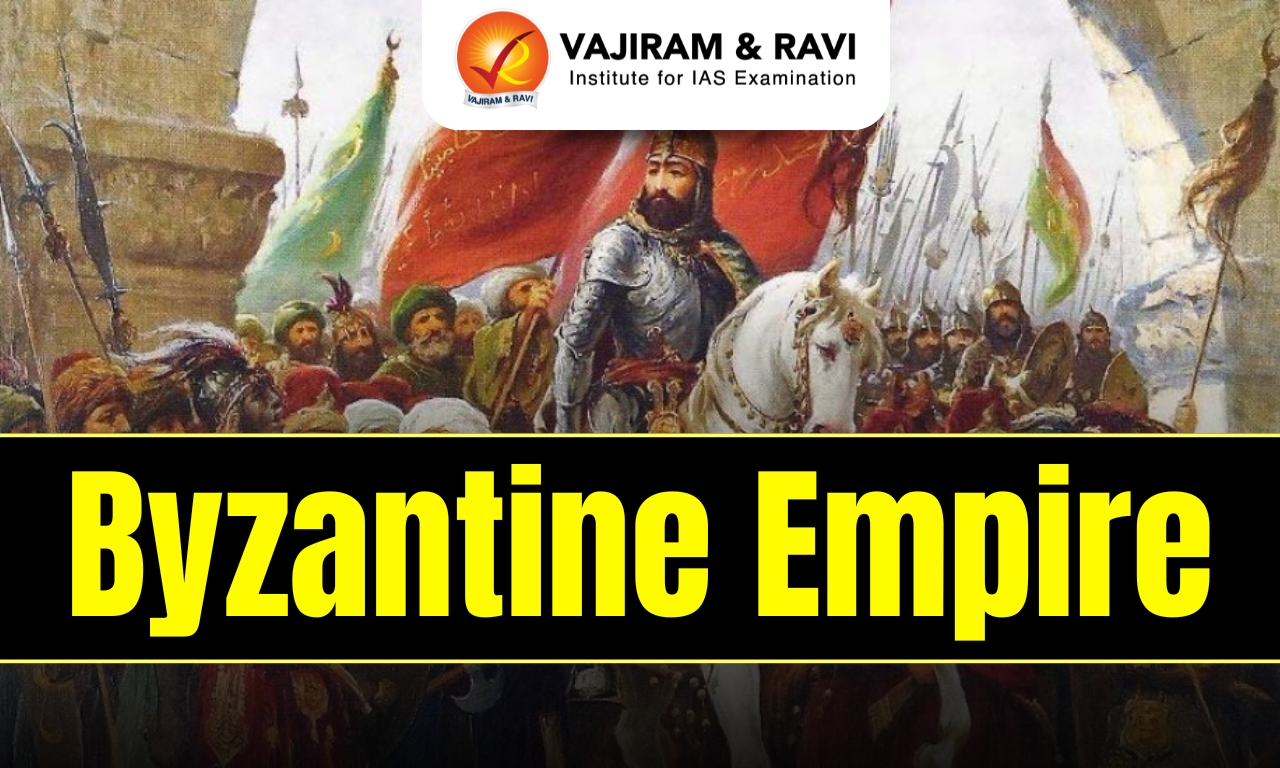
- The Byzantine Empire eventually fell when Constantinople was conquered by the Ottoman Empire in 1453 CE following a siege.
- The Byzantine Empire was the longest-lasting medieval power, and its influence continues today, especially in the religion, art, architecture, and laws of many Western states, Eastern and Central Europe, and Russia.
Source: EARTH


 Last updated on Oct, 2026
→ UPSC 2027 Notification will be released on 13 January 2027 at upsconline.nic.in.
→ Asian Games 2026 are being held in Aichi-Nagoya, Japan, from 19 September to 4 October.
→ Check Nobel Prize 2026 Winners List here.
→ Download PIB PRiSM Monthly Magazine 2026 here.
→ Check UPSC Monthly Current Affairs Magazine The Recitals here.
→ Check out the latest UPSC Syllabus here.
→ Download UPSC Model Answers for Mains 2026
→ UPSC Mains Question Paper 2026 is out now for Essay & GS Paper 1, 2, 3 & 4.
→ UPSC Calendar 2027 has been released.
→ Enroll in Vajiram & Ravi’s UPSC Mains Test Series 2027 for structured answer writing practice, expert evaluation, and exam-oriented feedback.
→ Join Vajiram & Ravi’s UPSC Mentorship Program 2027 for personalized guidance, strategy planning, and one-to-one support from experienced mentors.
→ Go through the UPSC Mains Previous Year Papers to enhance your preparation.
→ UPSC has released UPSC Toppers List 2025 with the Civil Services final result on its official website.
→ Also check Best UPSC Coaching in India
Byzantine Empire FAQs
Q1. How did the Byzantine Empire originate?+
Q2. What is another name for the Byzantine Empire?+
Q3. Which city was the capital of the Byzantine Empire?+
Q4. Which language was mainly spoken in the Byzantine Empire?+
Q5. Which empire conquered Constantinople in 1453?+
Tags: byzantine empire prelims pointers upsc current affairs upsc prelims current affairs