


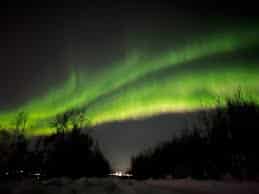
About Auroras:
- How is it formed? The sun is ejecting charged particles from its corona, creating solar wind. When that wind slams into Earth’s ionosphere, the aurora is born.
- In the Northern Hemisphere, the phenomenon is called the northern lights (aurora borealis), while in the Southern Hemisphere, it’s called the southern lights (aurora australis).
- The hemispheric asymmetry of the aurora is due in part to the sun’s magnetic field interfering with Earth’s magnetic field.
- The usually observed green and red auroras happen between 100 kilometres and 250 kilometres above the surface of the planet due to an excited state of atomic oxygen.
What is Carbon Dioxide Aurora?
- When charged particles crash into the planet’s atmosphere, they interact with many different atoms and molecules. Carbon dioxide is one of them.
- While the gas is known for acting as a greenhouse gas due to its presence in the lowest part of the atmosphere, trace parts of carbon dioxide also exist in the atmosphere at the edge of space.
- When carbon dioxide molecules about 90 kilometres above Earth become excited during an aurora, they emit infrared radiation.
- This leads to more infrared radiation than is typically observed in the planet’s atmosphere.
Q1) What is Sun’s corona?
The Sun’s corona is the outermost layer of the Sun’s atmosphere, extending millions of kilometers into space. It is visible as a halo of light during a total solar eclipse or with specialized instruments, such as coronagraphs, that block out the bright disk of the Sun. The corona is composed of extremely hot, ionized gas or plasma.
Source: Satellites capture auroras associated with carbon dioxide


 Last updated on Oct, 2026
→ UPSC 2027 Notification will be released on 13 January 2027 at upsconline.nic.in.
→ Check Nobel Prize 2026 Winners List here.
→ Download PIB PRiSM Monthly Magazine 2026 here.
→ Check UPSC Monthly Current Affairs Magazine The Recitals here.
→ Check out the latest UPSC Syllabus here.
→ Download UPSC Model Answers for Mains 2026
→ UPSC Mains Question Paper 2026 is out now for Essay & GS Paper 1, 2, 3 & 4.
→ UPSC Calendar 2027 has been released.
→ Enroll in Vajiram & Ravi’s UPSC Mains Test Series 2027 for structured answer writing practice, expert evaluation, and exam-oriented feedback.
→ Join Vajiram & Ravi’s UPSC Mentorship Program 2027 for personalized guidance, strategy planning, and one-to-one support from experienced mentors.
→ Go through the UPSC Mains Previous Year Papers to enhance your preparation.
→ UPSC has released UPSC Toppers List 2025 with the Civil Services final result on its official website.
→ Also check Best UPSC Coaching in India








