About Graded Response Action Plan (GRAP):
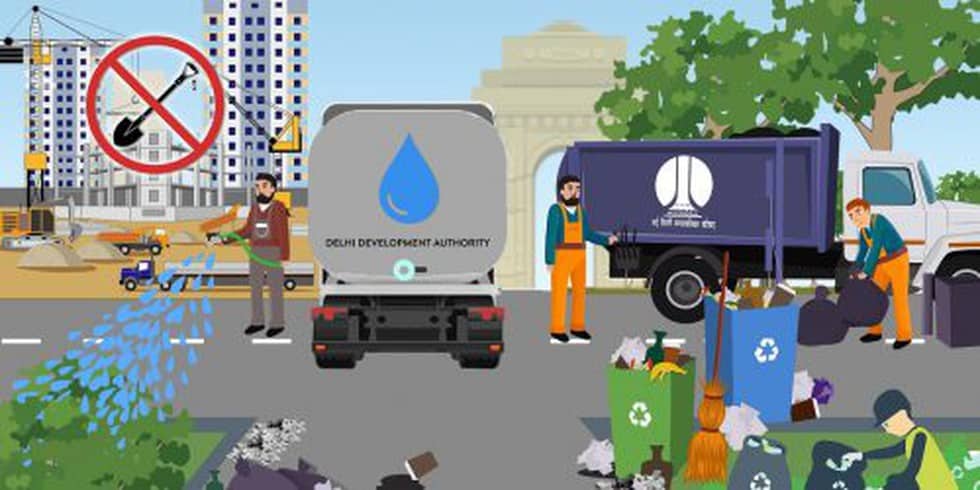
- GRAP is a framework designed to combat air pollution in the Delhi-NCR region.
- It was introduced as an emergency response mechanism, and its implementation is triggered when the Air Quality Index (AQI) reaches “poor” levels.
- GRAP is particularly important during the winter months when air quality tends to plummet.
- Who implements GRAP?
- The Commission for Air Quality Management (CAQM) in NCR and adjoining areas oversees the implementation of GRAP.
- It collaborates with the Ministry of Environment, Forest and Climate Change (MoEFCC).
- The CAQM has constituted a sub-committee for the operationalization of the GRAP.
- This body includes officials from the CAQM, member secretaries of pollution control boards of Uttar Pradesh, Delhi, Haryana, Rajasthan, the Central Pollution Control Board, a scientist from the IMD, one from the IITM, and a Health Advisor.
- The sub-committee is required to meet frequently to issue orders to invoke the GRAP.
- The orders and directions of the CAQM will prevail in case of any conflict between directions issued by the State governments and the CAQM.
- Different stages of GRAP: GRAP consists of four stages, each with targeted actions to be taken by the necessary authorities and agencies. These are the following:
- Stage I: “Poor” air quality (Delhi AQI: 201-300)
- Stage II: “Very Poor” air quality (Delhi AQI: 301-400)
- Stage III: “Severe” air quality (Delhi AQI: 401-450)
- Stage IV: “Severe+” air quality (Delhi AQI > 450)
What is the Air Quality Index (AQI)?
- AQI is issued by government agencies to gauge air pollution levels and communicate risks to the public.
- It indicates how air pollution can affect health, with higher AQI values indicating more severe health concerns.
- The AQI is calculated based on air pollutant concentrations over a specific period, and the results are categorised into ranges with corresponding health advisories.
- According to the AQI scale, the air quality check between 0 and 50 is “Good“, 51 and 100 “Satisfactory“, 101 and 200 “Moderate“, 201 and 300 “Poor“, 301 and 400 “Very Poor”, 401 and 450 “Severe” and over 450 as “Severe +”.
Q1: What is the Commission for Air Quality Management (CAQM)?
The CAQM is a statutory body established under the Commission for Air Quality Management in National Capital Region (NCR) and Adjoining Areas, Act 2021. It undertakes action for the prevention and control of Air pollution in Delhi-NCR & Adjoining Areas which impacts the air quality of the National Capital Territory (NCT) of Delhi. The Commission is required to coordinate its actions on monitoring of air quality with the government of Delhi and the adjoining states, which includes Punjab, Haryana, Rajasthan, and Uttar Pradesh.
Source: Delhi-NCR Activates Stage 1 Of Anti-Pollution Plan: What It Means


 Last updated on Oct, 2026
→ UPSC 2027 Notification will be released on 13 January 2027 at upsconline.nic.in.
→ Check Nobel Prize 2026 Winners List here.
→ Download PIB PRiSM Monthly Magazine 2026 here.
→ Check UPSC Monthly Current Affairs Magazine The Recitals here.
→ Check out the latest UPSC Syllabus here.
→ Download UPSC Model Answers for Mains 2026
→ UPSC Mains Question Paper 2026 is out now for Essay & GS Paper 1, 2, 3 & 4.
→ UPSC Calendar 2027 has been released.
→ Enroll in Vajiram & Ravi’s UPSC Mains Test Series 2027 for structured answer writing practice, expert evaluation, and exam-oriented feedback.
→ Join Vajiram & Ravi’s UPSC Mentorship Program 2027 for personalized guidance, strategy planning, and one-to-one support from experienced mentors.
→ Go through the UPSC Mains Previous Year Papers to enhance your preparation.
→ UPSC has released UPSC Toppers List 2025 with the Civil Services final result on its official website.
→ Also check Best UPSC Coaching in India