Microplastics Latest News
A first-of-its-kind study commissioned by the Delhi government has detected microplastics in groundwater samples across the Capital.
About Microplastics
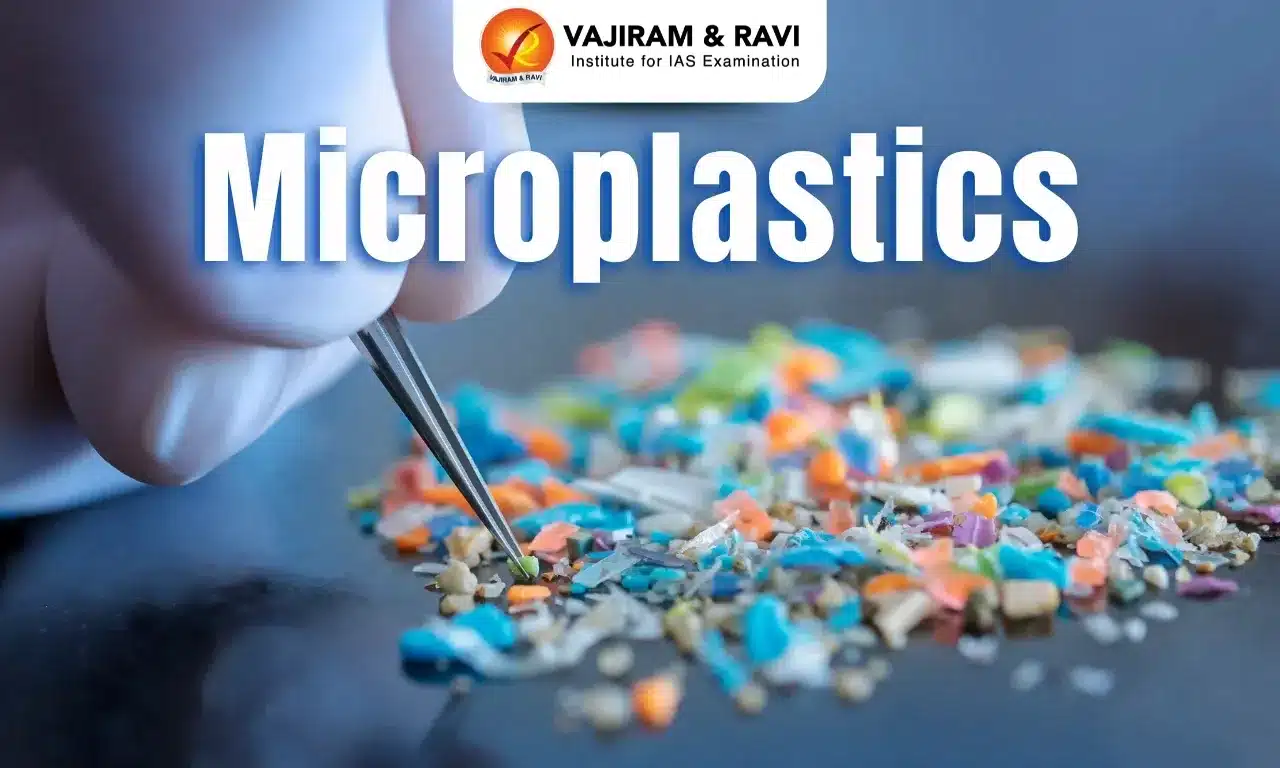
- Microplastics are small pieces of plastics, usually smaller than 5 mm.
- They are persistent, very mobile and hard to remove from nature.
- There are two categories of microplastics: primary and secondary.
- Primary microplastics are tiny particles designed for commercial use, such as cosmetics, as well as microfibers shed from clothing and other textiles, such as fishing nets.
- They enter the environment directly through any of various channels—for example, product use, unintentional loss from spills during manufacturing or transport, or abrasion during washing.
- Secondary microplastics are particles that result from the breakdown of larger plastic items, such as water bottles.
- This breakdown is caused by exposure to environmental factors, mainly the sun’s radiation and ocean waves.


Microplastics Impacts
- Once in the environment, microplastics do not biodegrade and tend to accumulate and persist.
- They can be ingested by marine organisms, leading to potential harm to aquatic life and bioaccumulation along the food chain.
- They can also carry toxic chemicals and pollutants, posing additional risks to organisms and ecosystems.
Microplastics FAQs
Q1. What is the main source of microplastics?
Ans. Where do primary microplastics come from? Microplastics come from synthetic textiles, city dust, tires, road markings, marine coatings, personal care products and engineered plastic pellets.
Q2. What countries have banned microplastics?
Ans. The Netherlands was the first country to introduce a ban on microbeads in cosmetic products in 2014. Several countries, including Australia, Canada, Italy, Korea, New Zealand, Sweden, the UK and the US have followed suit.
Q3. Is microplastics banned in India?
Ans. There is currently no regulation of microbeads in India , although the plastic waste management rules are regularly amended and there are some bans on single use plastic
Source: TH

 Last updated on Oct, 2026
→ UPSC 2027 Notification will be released on 13 January 2027 at upsconline.nic.in.
→ Asian Games 2026 are being held in Aichi-Nagoya, Japan, from 19 September to 4 October.
→ Check Nobel Prize 2026 Winners List here.
→ Download PIB PRiSM Monthly Magazine 2026 here.
→ Check UPSC Monthly Current Affairs Magazine The Recitals here.
→ Check out the latest UPSC Syllabus here.
→ Download UPSC Model Answers for Mains 2026
→ UPSC Mains Question Paper 2026 is out now for Essay & GS Paper 1, 2, 3 & 4.
→ UPSC Calendar 2027 has been released.
→ Enroll in Vajiram & Ravi’s UPSC Mains Test Series 2027 for structured answer writing practice, expert evaluation, and exam-oriented feedback.
→ Join Vajiram & Ravi’s UPSC Mentorship Program 2027 for personalized guidance, strategy planning, and one-to-one support from experienced mentors.
→ Go through the UPSC Mains Previous Year Papers to enhance your preparation.
→ UPSC has released UPSC Toppers List 2025 with the Civil Services final result on its official website.
→ Also check Best UPSC Coaching in India