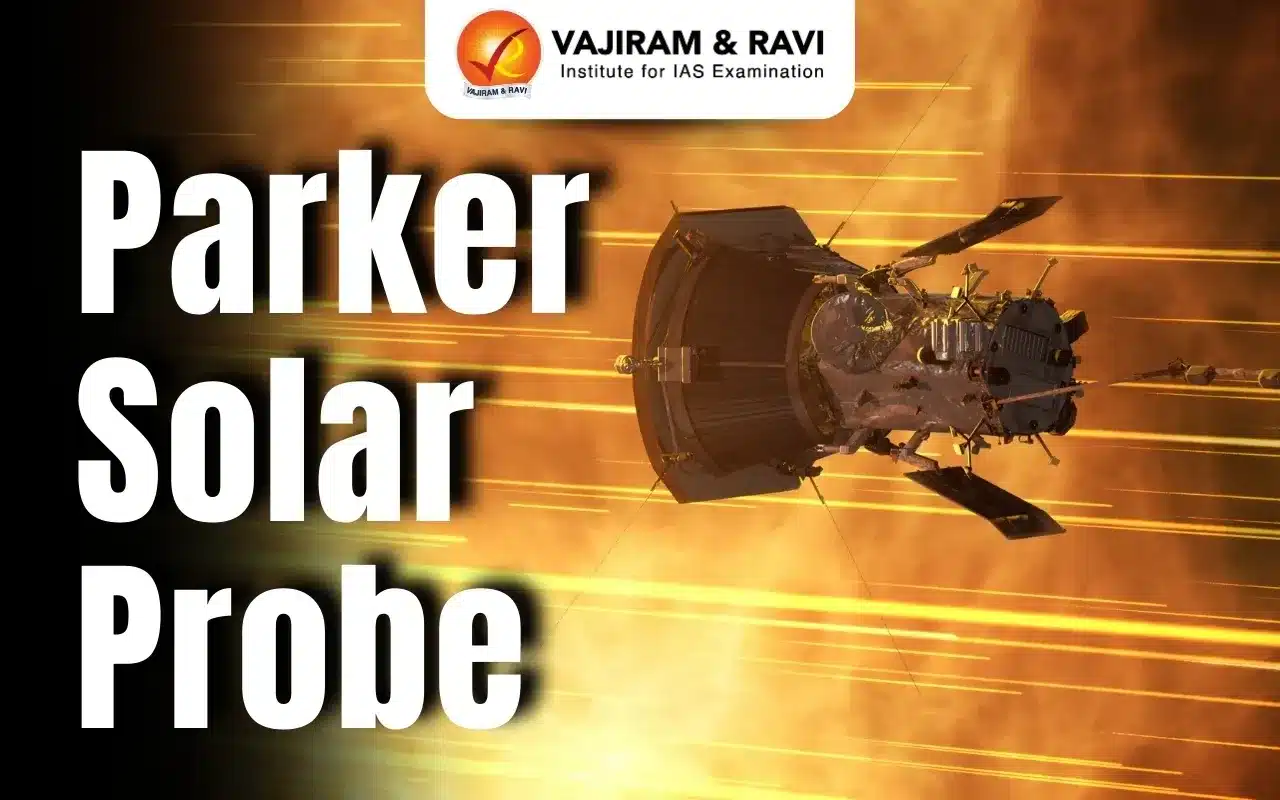
Parker Solar Probe Latest News
Parker Solar Probe: Mission to ‘Touch’ the Sun
Why in the News?
- On March 22, 2025, NASA’s Parker Solar Probe approached the Sun more closely, reaching 6 million km from its surface.
- The probe, launched in 2018, has set the record for being the closest spacecraft to the Sun and will continue making 24 close approaches to study solar activity.


About the Parker Solar Probe
- Launched by NASA on August 12, 2018, from Cape Canaveral, Florida.
- Designed to study the Sun’s corona, solar wind, and magnetic field to understand space weather and its effects on Earth.
- Moves in a highly elliptical orbit, using Venus’ gravity assist to spiral gradually closer to the Sun.
- Speed: The fastest human-made object, reaching 692,000 km/hr.
- Closest approach: It will come as close as 3.83 million miles (6.16 million km) from the Sun’s surface, about 7 times closer than any previous spacecraft.
Key Features of Parker Solar Probe
|
Feature |
Details |
|
Heat Shield |
A 4.5-inch-thick (11.43 cm) carbon-composite shield, capable of withstanding temperatures of 1,377°C (2,500°F). |
|
Scientific Instruments |
– FIELDS: Measures electric & magnetic fields in the corona. |
|
Faraday Cup |
An external instrument made of molybdenum alloy that directly measures solar wind ions & electrons in extreme heat. |
|
Mission Duration |
Designed to complete 24 orbits around the Sun, with a mission extending into the 2030s. |
Scientific Breakthroughs from Parker Solar Probe
- Discovery of “Magnetic Switchbacks”: The probe found sudden reversals in the solar wind’s magnetic field, which might help explain how the solar wind accelerates.
- Detection of Dust-Free Zones: Contrary to earlier beliefs, the probe found dust-free pockets near the Sun, altering our understanding of solar system dust distribution.
- First ‘Touch’ of the Sun (2021): In April 2021, the probe entered the Sun’s corona, crossing the Alfvén surface—a boundary beyond which solar wind escapes into space.
Comparison: Parker Solar Probe vs. Aditya-L1 (India’s Solar Mission)
|
Feature |
Parker Solar Probe |
Aditya-L1 (ISRO) |
|
Launched by |
NASA (2018) |
ISRO (2023) |
|
Mission type |
In-situ study (flies into the corona) |
Remote observation (placed at Lagrange Point L1) |
|
Closest approach |
6.1 million km from the Sun |
1.5 million km from Earth |
|
Main objective |
Study coronal heating, solar wind, and magnetic fields |
Study solar flares, CMEs, and magnetic storms |
|
Scientific payloads |
4 major instruments |
7 instruments including coronagraph |
Parker Solar Probe FAQs
Q1. What is the Parker Solar Probe?
Ans. The Parker Solar Probe is a NASA spacecraft launched in 2018 to study the Sun’s outer atmosphere (corona) and solar wind. It is the closest spacecraft to the Sun.
Q2. Why is the Parker Solar Probe significant?
Ans. It helps scientists understand solar activity, space weather, and its impact on Earth, satellites, and astronauts.
Q3. What is the mission objective of the Parker Solar Probe?
Ans. The mission aims to study the Sun’s corona, solar wind acceleration, and magnetic fields to improve space weather predictions.
Q4. How close will the Parker Solar Probe go to the Sun?
Ans. The probe will travel within 6.16 million km of the Sun’s surface, enduring extreme temperatures up to 1,377°C.
Q5. How does the Parker Solar Probe survive extreme heat?
Ans. It has a 4.5-inch-thick carbon-composite heat shield that protects it from the Sun’s intense heat and radiation.
Source: TH

 Last updated on Oct, 2026
→ UPSC 2027 Notification will be released on 13 January 2027 at upsconline.nic.in.
→ Check Nobel Prize 2026 Winners List here.
→ Download PIB PRiSM Monthly Magazine 2026 here.
→ Check UPSC Monthly Current Affairs Magazine The Recitals here.
→ Check out the latest UPSC Syllabus here.
→ Download UPSC Model Answers for Mains 2026
→ UPSC Mains Question Paper 2026 is out now for Essay & GS Paper 1, 2, 3 & 4.
→ UPSC Calendar 2027 has been released.
→ Enroll in Vajiram & Ravi’s UPSC Mains Test Series 2027 for structured answer writing practice, expert evaluation, and exam-oriented feedback.
→ Join Vajiram & Ravi’s UPSC Mentorship Program 2027 for personalized guidance, strategy planning, and one-to-one support from experienced mentors.
→ Go through the UPSC Mains Previous Year Papers to enhance your preparation.
→ UPSC has released UPSC Toppers List 2025 with the Civil Services final result on its official website.
→ Also check Best UPSC Coaching in India