The Ministry of Electronics and Information Technology (MeitY) is advancing Additive Manufacturing (AM) in India through the National Strategy for Additive Manufacturing (NSAM). The strategy has supported 56 start-ups, trained more than 1.54 lakh individuals and helped develop 65 India-specific technologies. The government is now planning NSAM 2.0 to accelerate innovation, strengthen domestic manufacturing and improve India’s competitiveness in the global 3D printing industry.
What is Additive Manufacturing?
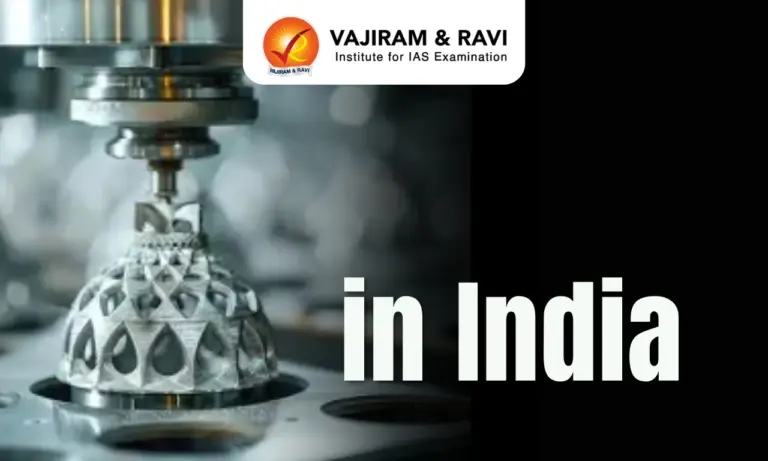
Additive Manufacturing (AM) is a manufacturing process in which three-dimensional objects are created by adding materials layer by layer using a digital design. Commonly known as 3D printing, it uses computer-generated models to produce objects from materials such as plastics, metals, ceramics and composites.
How Does Additive Manufacturing Work?
Additive manufacturing converts a digital design into a physical object through the following steps:
- Digital design: A 3D model is created using Computer-Aided Design (CAD) software or a 3D scanner.
- File preparation: The design is converted into a suitable digital file, such as an STL file.
- Slicing: Slicing software divides the model into thin horizontal layers and generates instructions for the printer.
- 3D printing: The machine deposits, fuses or solidifies material layer by layer according to the digital instructions.
- Post-processing: The printed object is cleaned, finished, treated or tested to make it suitable for its intended use.


Materials Used in Additive Manufacturing
Additive manufacturing supports different materials depending on the product and its intended application.
- Thermoplastics: Materials such as ABS, PLA and polycarbonate are used for prototypes, consumer products and engineering components.
- Metals and alloys: Stainless steel, titanium, aluminium and other metals are used in aerospace, defence, automotive and medical applications.
- Ceramics: Alumina, zirconia and other specialised ceramics are used in industrial and healthcare applications.
- Composites: Fibre-reinforced materials help produce lightweight and durable components.
- Biomaterials: Specialised biocompatible materials are used in applications such as customised implants, bone grafts and research into tissue engineering.
Applications of Additive Manufacturing in India
Additive manufacturing is expanding across strategic industries by supporting customised production, rapid prototyping and the development of complex components.
- Space and aerospace: Additive manufacturing enables the production of lightweight rocket engines and complex aerospace components. In May 2024, Agnikul Cosmos launched Agnibaan SOrTeD, featuring a single-piece, 3D-printed semi-cryogenic rocket engine.
- Defence: The Indian Army has adopted 3D-printed construction for specialised structures, including a two-storey dwelling unit in Ahmedabad. The technology is also being explored for protective structures and maintenance, repair and overhaul (MRO) applications.
- Healthcare: AM enables the production of patient-specific implants, medical devices and bone grafts. Indigenous manufacturing can improve access to specialised medical products and reduce dependence on imports.
- Electronics: Researchers are developing 3D-printed electronic components, including batteries, antennas, capacitors and other devices. The Indian Institute of Science (IISc) has also demonstrated additively manufactured photonic integrated circuit blocks.
- Construction: 3D construction printing can produce buildings and other structures with reduced material waste and potentially shorter construction times. Low-carbon materials can further improve environmental performance.
- Energy: Additive manufacturing is being explored for energy-storage technologies, including concrete-based supercapacitors, as well as specialised components for renewable energy systems.
- Automotive and industrial manufacturing: The technology supports rapid prototyping, customised parts, complex designs and on-demand production of components.
National Strategy for Additive Manufacturing (NSAM)
The National Strategy for Additive Manufacturing (NSAM) was launched by the Ministry of Electronics and Information Technology in February 2022 to establish a strong domestic ecosystem for 3D printing and digital manufacturing.
Aligned with Make in India, Atmanirbhar Bharat and Viksit Bharat, the strategy promotes collaboration between government institutions, industries, start-ups and academic organisations.
Key Objectives of NSAM
- Global market share: Capture 5% of the global additive manufacturing market.
- Economic contribution: Add nearly US$1 billion to India’s GDP.
- Technology development: Develop 50 India-specific additive manufacturing technologies covering materials, machines, processes and software.
- Start-up promotion: Support the creation of 100 new additive manufacturing start-ups.
- Product development: Develop 500 new products using additive manufacturing.
- Skill development: Train 1 lakh people in additive manufacturing-related skills.
- Industrial adoption: Build capabilities across 10 existing and emerging manufacturing sectors.
What is NSAM 2.0?
NSAM 2.0 is the proposed next phase of India’s National Strategy for Additive Manufacturing. It aims to move beyond ecosystem development towards large-scale industrial adoption, commercialisation and globally competitive manufacturing.
Its proposed priorities include:
- Research and innovation: Accelerate research, intellectual property generation and the development of indigenous technologies.
- Affordable manufacturing: Improve access to cost-effective 3D printers, materials and related technologies.
- Start-up development: Expand support for Indian additive manufacturing start-ups and help commercialise their innovations.
- Defence applications: Strengthen the use of additive manufacturing across India’s defence ecosystem.
- Digital integration: Improve collaboration and connectivity between research institutions, industries and manufacturing centres.
- Electronics supply chain: Strengthen domestic capabilities in additive manufacturing for electronics and advanced components.
- Sustainability: Promote pilot projects linked to sustainable development and resource-efficient production.
- International cooperation: Encourage joint research, technology partnerships and the development of common standards.
Government Initiatives Supporting Additive Manufacturing
Several government-led initiatives are helping develop skills, infrastructure and innovation in additive manufacturing.
- Atal Tinkering Labs (ATLs): These school-level innovation laboratories provide students with practical exposure to technologies such as 3D printing, robotics and the Internet of Things (IoT).
- Development and Deployment Centres: Specialised centres support research, product development, training and access to additive manufacturing facilities.
- National Additive Manufacturing Symposium (NAMS): Organised by MeitY, NAMS brings together policymakers, researchers, industries, start-ups and academic institutions to discuss technology development and industrial adoption.
- National Strategy for Additive Manufacturing: NSAM provides the policy framework for developing indigenous technologies, skilled workers and domestic manufacturing capabilities.
- Emerging Science, Technology and Innovation Conclave (ESTIC): The 2026 edition is scheduled for 27–29 October at Bharat Mandapam, New Delhi, with emerging technologies such as additive manufacturing among its areas of focus.
Benefits of Additive Manufacturing
- Reduced material waste: Materials are added where required, helping reduce waste compared with many conventional manufacturing processes.
- Design flexibility: Complex shapes and internal structures can be produced with fewer manufacturing constraints.
- Customised production: Products such as medical implants can be tailored to individual requirements.
- Faster prototyping: Designers can test and modify prototypes without creating expensive production tooling for every design change.
- Local manufacturing: Parts can be produced closer to where they are needed, potentially reducing transportation and supply-chain delays.
- Lower inventory requirements: Digital designs and on-demand production can reduce the need to store certain spare parts.
- Import substitution: Indigenous production of specialised components can reduce dependence on foreign suppliers.
- Support for innovation: Start-ups, research institutions and small manufacturers can develop new products with greater design flexibility.
Challenges of Additive Manufacturing in India
Despite its potential, India faces several challenges in scaling additive manufacturing across industries.
- High initial costs: Industrial 3D printers, specialised materials and related equipment can be expensive.
- Dependence on imports: Some advanced machines, high-performance materials and critical components are still sourced from international suppliers.
- Limited skilled workforce: Wider adoption requires professionals trained in digital design, materials science, machine operation and quality control.
- Quality and standardisation: Printed products need reliable testing, certification and consistent manufacturing standards, particularly in aerospace, defence and healthcare.
- Limited mass-production suitability: Some AM processes are slower or more expensive than conventional methods for producing large quantities of standardised products.
- Material limitations: Not every material or component can be manufactured economically or reliably using existing 3D printing processes.
- Intellectual property concerns: Digital design files can create challenges related to ownership, unauthorised copying and product security.
- Industry adoption gaps: Small and medium enterprises may lack the investment, technical expertise and infrastructure needed to adopt advanced manufacturing technologies.
Way Forward
India needs to move from research and pilot projects towards reliable, commercially viable and large-scale additive manufacturing.
- Strengthen domestic R&D: Invest in indigenous printers, advanced materials, software and industrial-grade manufacturing processes.
- Improve affordability: Develop shared facilities, manufacturing clusters and financial support mechanisms to help smaller businesses adopt the technology.
- Expand skill development: Strengthen industry-linked training, technical education and hands-on exposure to 3D printing.
- Develop common standards: Establish robust testing, certification and quality-assurance systems for critical applications.
- Promote industry collaboration: Connect start-ups, manufacturers, research institutions and government agencies to accelerate commercialisation.
- Prioritise strategic sectors: Focus on aerospace, defence, healthcare, electronics and energy, where customised and complex components offer significant value.
- Encourage sustainable production: Promote material efficiency, recyclable feedstocks and low-carbon manufacturing methods wherever technically and economically feasible.

 Last updated on Oct, 2026
→ UPSC 2027 Notification will be released on 13 January 2027 at upsconline.nic.in.
→ Check Nobel Prize 2026 Winners List here.
→ Download PIB PRiSM Monthly Magazine 2026 here.
→ Check UPSC Monthly Current Affairs Magazine The Recitals here.
→ Check out the latest UPSC Syllabus here.
→ Download UPSC Model Answers for Mains 2026
→ UPSC Mains Question Paper 2026 is out now for Essay & GS Paper 1, 2, 3 & 4.
→ UPSC Calendar 2027 has been released.
→ Enroll in Vajiram & Ravi’s UPSC Mains Test Series 2027 for structured answer writing practice, expert evaluation, and exam-oriented feedback.
→ Join Vajiram & Ravi’s UPSC Mentorship Program 2027 for personalized guidance, strategy planning, and one-to-one support from experienced mentors.
→ Go through the UPSC Mains Previous Year Papers to enhance your preparation.
→ UPSC has released UPSC Toppers List 2025 with the Civil Services final result on its official website.
→ Also check Best UPSC Coaching in India
Additive Manufacturing in India FAQs
Q1. What is additive manufacturing?+
Q2. What is the National Strategy for Additive Manufacturing (NSAM)?+
Q3. What are the main objectives of NSAM?+
Q4. What is NSAM 2.0?+
Q5. Which sectors use additive manufacturing in India?+
Tags: additive manufacturing additive manufacturing in india