What’s in today’s article?
- Why in news?
- Adi Shankaracharya
- Who was Adi Shankaracharya?
- Mandhata island
- News Summary: Adi Shankaracharya statue at Omkareshwar
- How was the project conceptualised?
- What are the features of the project?
- What are the other projects?
Why in news?
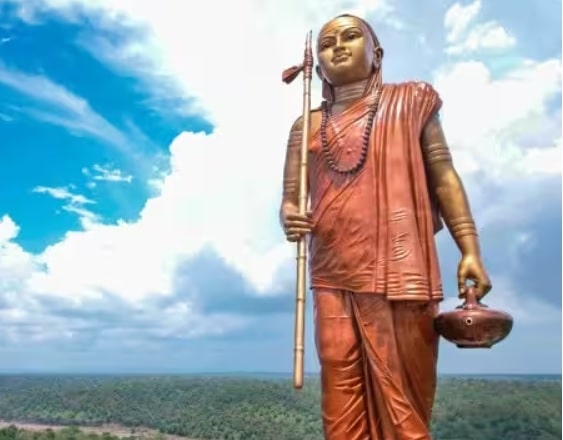
- Madhya Pradesh Chief Minister unveiled the 108-foot-tall ‘Statue of Oneness’ of Adi Shankaracharya at Omkareshwar.
- The statue depicts Shankaracharya as a 12-year-old child when he is said to have visited Omkareshwar.
- Omkareshwar is the temple town located on the Mandhata island of Khandwa district.
- It will form an important tourism circuit, along with Ujjain, Maheshwar and Mandu religious towns.
Who was Adi Shankaracharya?
- About
- Adi Shankara, who is believed to have lived between 788 and 820 AD, was born in Kerela’s Kaladi, situated on the bank of the Periyar River.
- He became a sanyasin at an early age and left his Brahmin household, where he is said to have made his way to Omkareshwar.
- Here, he studied under his guru Govinda Bhagavatpada.
- Proponent of Advaita Vedanta
- Adi Shankaracharya became a proponent of Advaita Vedanta, challenging prevailing philosophical traditions – including Buddhism and Jainism.
- Advaita Vedanta is a school of Hindu philosophy that teaches non-duality, or the absence of separation between the subject and object.
- Adi Shankaracharya became a proponent of Advaita Vedanta, challenging prevailing philosophical traditions – including Buddhism and Jainism.
- Notable works of Adi Shankaracharya
- He is said to have authored 116 works. The most notable among them are:
- Commentaries (Bhashyas)
- Brahma Sutras Bhashya – Shankaracharya wrote commentaries on the Brahma Sutras, also known as the Vedanta Sutras, which are foundational texts for the Vedanta school of philosophy.
- Upanishad Bhashyas – He wrote commentaries on several major Upanishads, including the Isa Upanishad, Katha Upanishad, and Chandogya Upanishad, among others.
- Bhagavad Gita Bhashya – Shankaracharya provided a commentary on the Bhagavad Gita, one of the most important texts in Hindu philosophy.
- Prakarana Granthas (Introductory Texts):
- Vivekachudamani: This work explores the concept of discrimination between the eternal and the non-eternal and is considered one of Shankaracharya’s masterpieces.
- Upadeshasahasri: It consists of a thousand verses and offers teachings on Advaita Vedanta.
- Atma Bodha: A concise treatise on self-realization, it outlines the path to understanding the true nature of the self.
- Stotras (Devotional Hymns):
- Nirvana Shatakam: Also known as Atma Shatakam, this hymn delineates the realization of the self as distinct from the body and mind.
- Bhaja Govindam: A devotional composition emphasizing the importance of devotion and spiritual practice in one’s life.
- Commentaries on Sanatana Dharma:
- Dakshinamurti Stotra: A hymn to Lord Dakshinamurti, it explains the significance of the guru in one’s spiritual journey.
- Travel and Teachings:
- Shankaracharya is also known for his extensive travels across India to engage in philosophical debates and establish monastic centers (mathas) in various parts of the country.
- These mathas continue to propagate Advaita Vedanta teachings to this day.


Mandhata island
- The Mandhata island, nestled on the Narmada River, is home to two of the 12 Jyotirlingas: Omkareshwara (located on the south side of the island) and Amareshwara.
- The area is close to Mahakaleshwara Jyotirlinga at Ujjain, located 110 km to the northwest.
- The island is dotted with Shaivite, Vaisnavite, and Jain temples dating back to the 14th and 18th centuries.
News Summary: Adi Shankaracharya statue at Omkareshwar
How was the project conceptualised?
- In February 2017, CM Shivraj Singh Chouhan announced the construction of a 108-foot-tall Adi Shankaracharya statue, a Shankar Museum, and the Acharya Shankar International Institute of Advaita Vedanta.
- The metal for building the statue was collected from people across more than 23,000 grama panchayats.
- Larsen and Toubro was awarded an Engineering Procurement, and Construction (EPC) contract to construct the Statue of Oneness.
- The Statue of Oneness is intended to endure for more than 500 years, while the museum building is designed to have a service life of 100 years.
What are the features of the project?
- The multi-metal Adi Shankaracharya statue is installed atop Mandhata Parvat hill, facing southwards towards the Narmada River.
- This statue stands atop a 54-feet pedestal, supported by a 27-feet lotus petal base which is made of red stone.
- The idol weighs 100 tons and has been installed on a 75-foot-high platform.
- It is made up of bronze that contains 88% copper, 4% zinc and 8% tin and its internal structure is made up of high-quality steel.
- At the base of the statue is the Shankar Stambh, which features wooden domes and stone pillars with carvings depicting 32 stories related to Acharya Shankar.
What are the other projects?
- Ekatma Dham will include the Advaita Lok museum.
- The Ekatma Dham will feature a mosaic of architectural styles, including Nagara, Dravidian, Oriya, Maru-Gurjara, Hoysala, North Indian-Himalayan, and Kerala styles.
- Acharya Shankar International Institute of Advaita Vedanta is being built to promote the study and understanding of Advaita Vedanta.
Q1) What is Advaita Vedanta?
Advaita Vedanta is a school of Hindu philosophy that teaches non-duality, or the absence of separation between the subject and object.
Q2) Where does Narmada River originate?
The Narmada River originates from the Amarkantak Plateau in Madhya Pradesh, India.
Source: Madhya Pradesh CM unveils Adi Shankaracharya statue at Omkareshwar: Its story, significance | Sankaracharya.org

 Last updated on Oct, 2026
→ UPSC 2027 Notification will be released on 13 January 2027 at upsconline.nic.in.
→ Asian Games 2026 are being held in Aichi-Nagoya, Japan, from 19 September to 4 October.
→ Check Nobel Prize 2026 Winners List here.
→ Download PIB PRiSM Monthly Magazine 2026 here.
→ Check UPSC Monthly Current Affairs Magazine The Recitals here.
→ Check out the latest UPSC Syllabus here.
→ Download UPSC Model Answers for Mains 2026
→ UPSC Mains Question Paper 2026 is out now for Essay & GS Paper 1, 2, 3 & 4.
→ UPSC Calendar 2027 has been released.
→ Enroll in Vajiram & Ravi’s UPSC Mains Test Series 2027 for structured answer writing practice, expert evaluation, and exam-oriented feedback.
→ Join Vajiram & Ravi’s UPSC Mentorship Program 2027 for personalized guidance, strategy planning, and one-to-one support from experienced mentors.
→ Go through the UPSC Mains Previous Year Papers to enhance your preparation.
→ UPSC has released UPSC Toppers List 2025 with the Civil Services final result on its official website.
→ Also check Best UPSC Coaching in India