AI Hallucinated Judgments Latest News
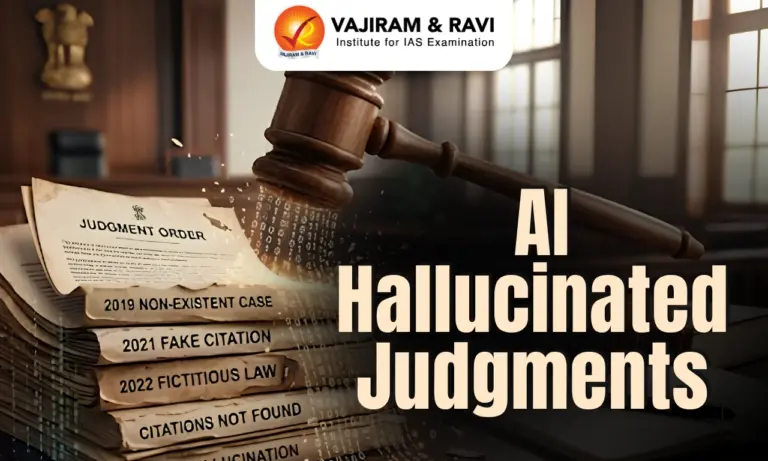
- Recently, the Supreme Court struck down a National Company Law Tribunal (NCLT) order. The order had relied on six court judgments as precedents.
- All six turned out to be problematic. Three judgments did not exist at all. The other three either didn’t say what the tribunal claimed, or belonged to a different case entirely.
The Case Background
- In 2013, a company called Essel Infraprojects promised to repay a loan if another company failed to. This kind of promise is called a “corporate guarantee.”
- The loan itself was for Rs 200 crore. It was given by Jammu and Kashmir Bank to a different company, Pan India Utilities Distribution Company Ltd.
- Later, Pan India Utilities failed to repay the loan. Since Essel had promised to pay on its behalf, the bank came after Essel under the Insolvency and Bankruptcy Code (IBC).
- Under this law, if a company cannot pay its debts, it can be taken to a special court for resolution. This is exactly what the bank did.
- Essel did not argue that the loan existed or that it had gone unpaid. Those facts were not in dispute. Instead, Essel argued something different: it said it was no longer responsible for this guarantee at all.
Why did Essel say this?
- In 2014, the company had gone through a restructuring. Part of its business was separated out (this is called a “demerger”), and then merged into another company (this is called an “amalgamation”).
- This restructuring was approved by the Bombay High Court. Essel claimed that when this happened, its old responsibility — including the guarantee — had passed on to the new company.
- So, Essel argued, it was no longer the one who should be held responsible.
Tribunal’s Judgement
- The tribunal handling the case, called the NCLT (National Company Law Tribunal), did not accept this argument. In 2024, it rejected Essel’s defence and allowed the bank’s case to proceed.
- Essel then appealed to a higher tribunal, the NCLAT (National Company Law Appellate Tribunal). But in September 2025, the NCLAT agreed with the NCLT’s decision.
- Importantly, the NCLAT did not check whether the case references (citations) used by the NCLT were even real.
- This became a major problem later, since those citations turned out to be fake or wrongly quoted.


The Fake Citations
- Three judgments simply didn’t exist:
- ICICI Bank Ltd v Urban Infrastructure Real Estate Ltd (2019)
- V S Dempo & Co Ltd v Reliance Communications Ltd (2021)
- Sarbjit Singh v Union Bank of India (2022)
- Two judgments were real, but the quoted passages were not found anywhere in them:
- Everest Kento Cylinders Ltd v Union of India (2015)
- Canara Bank v N G Subbaraya Setty (2018)
- The sixth judgment cited was actually a different case altogether. The tribunal called it State Bank of India v Shree Ram Urban Infrastructure Ltd, but it was really M Subramaniam v S Janaki. The quoted passage wasn’t in either judgment.
- Importantly, neither party’s lawyers had cited these judgments. J&K Bank told the Supreme Court that its counsel never referred to them.
- The tribunal appears to have generated these citations through its own AI-assisted research.
What the Supreme Court Said
- The SC bench used strong language. They compared AI hallucination in judicial work to a toxic gas leak — “invisible, insidious, and catastrophic by the time anyone notices.”
- They warned that relying on AI could make judges dependent on it and erode independent judicial reasoning over time.
- The court held that even “an iota” of fake or hallucinated material in a decision is enough to set it aside.
- A decision built on fabricated case law, the bench said, “is no decision at all.”
Wider Directions Issued
- The Supreme Court asked the Bar Council of India to set up a committee. This committee will study how AI is being used in litigation across courts.
- The court also warned that lawyers citing AI-generated case law without verification could face professional misconduct proceedings.
- For now, the NCLT will decide the insolvency petition afresh. Both parties have been told to maintain status quo until then.
Not the First Such Incident
- The same bench had faced a similar problem in February 2026, in Gummadi Usha Rani v Sure Mallikarjuna Rao.
- There, an Andhra Pradesh trial court had relied on four fake AI-generated judgments.
- The High Court had merely issued “a word of caution.” This time, the Supreme Court took a much harder line, calling such reliance not just an error but potential “misconduct” with legal consequences.
Conclusion
- This case marks a serious warning from India’s top court on AI use in judicial decision-making. It shows that AI hallucination isn’t just a drafting inconvenience — it can invalidate an entire legal order.
- The Supreme Court has made clear that courts and lawyers alike carry a duty to verify every citation, and that unchecked AI use in law can silently corrode the foundation of judicial reasoning itself.
- With the Bar Council now examining the issue formally, this ruling is likely to become a key reference point for how AI tools are regulated within India’s legal system going forward.

 Last updated on Oct, 2026
→ UPSC 2027 Notification will be released on 13 January 2027 at upsconline.nic.in.
→ Check Nobel Prize 2026 Winners List here.
→ Download PIB PRiSM Monthly Magazine 2026 here.
→ Check UPSC Monthly Current Affairs Magazine The Recitals here.
→ Check out the latest UPSC Syllabus here.
→ Download UPSC Model Answers for Mains 2026
→ UPSC Mains Question Paper 2026 is out now for Essay & GS Paper 1, 2, 3 & 4.
→ UPSC Calendar 2027 has been released.
→ Enroll in Vajiram & Ravi’s UPSC Mains Test Series 2027 for structured answer writing practice, expert evaluation, and exam-oriented feedback.
→ Join Vajiram & Ravi’s UPSC Mentorship Program 2027 for personalized guidance, strategy planning, and one-to-one support from experienced mentors.
→ Go through the UPSC Mains Previous Year Papers to enhance your preparation.
→ UPSC has released UPSC Toppers List 2025 with the Civil Services final result on its official website.
→ Also check Best UPSC Coaching in India
AI Hallucinated Judgments FAQs
Q1. What are AI Hallucinated Judgments and why are they a concern?+
Q2. Why did the Supreme Court set aside the NCLT order in the AI Hallucinated Judgments case?+
Q3. What directions did the Supreme Court issue regarding AI Hallucinated Judgments?+
Q4. What lessons do AI Hallucinated Judgments offer for the legal profession?+
Q5. Why are AI Hallucinated Judgments significant for AI governance?+
Tags: AI Hallucinated Judgments mains articles upsc current affairs upsc mains current affairs