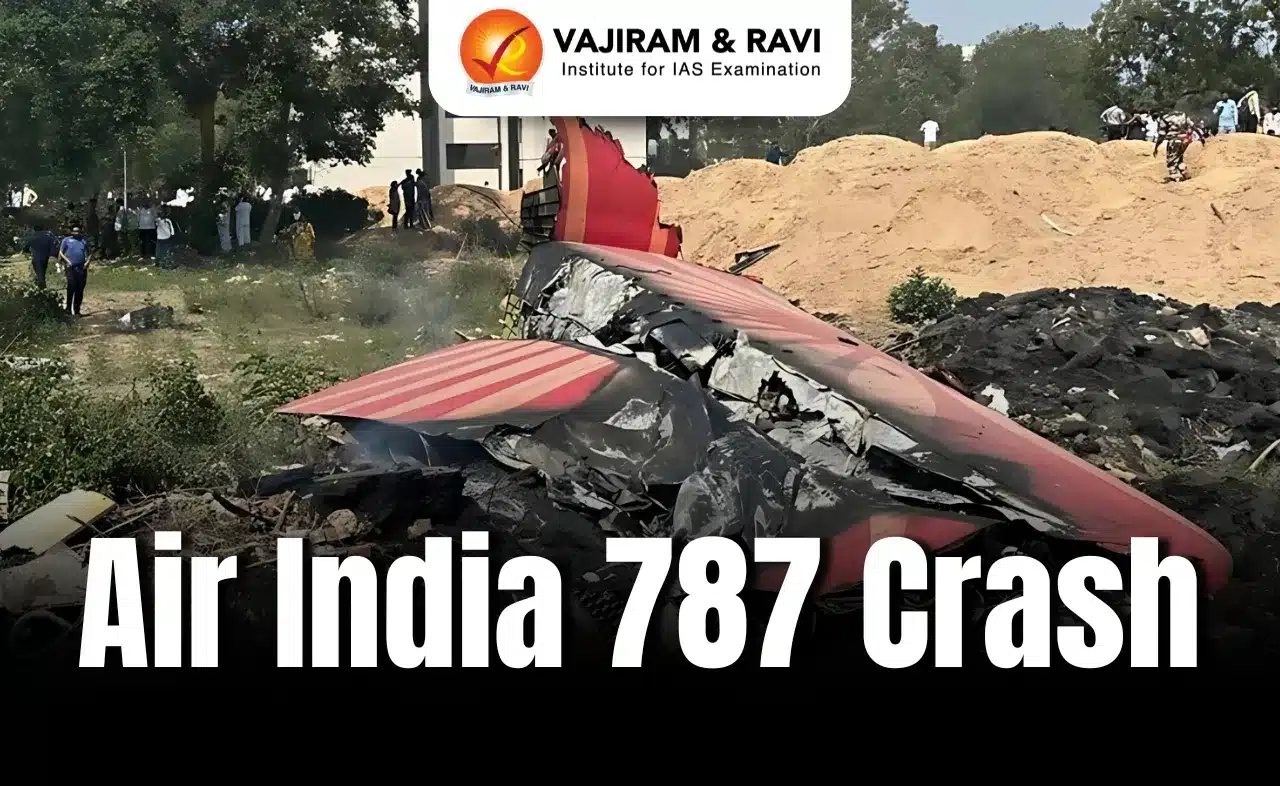
Air India 787 Crash Latest News
- An Air India Boeing 787 Dreamliner flying from Ahmedabad to London Gatwick crashed shortly after takeoff, with 242 people on board. The crash occurred in Meghani Nagar, a densely populated area near Ahmedabad airport, sending thick black smoke into the sky.
- The cause of the crash was not immediately known. Most aviation accidents typically happen during takeoff or landing phases.
Boeing 787 Dreamliner
- Boeing introduced the 787 in 2007 as a next-generation, long-haul jet, building on the success of its 777 predecessor to offer a more fuel-efficient variant.
- The first commercial Boeing 787 took flight in 2012. The aircraft involved in recent crash entered Air India’s fleet in 2014.
- The crash intensifies scrutiny on Boeing, which has faced global criticism since the two 737 Max crashes in 2018 and 2019.
Features of Boeing 787
- Structure: Made from carbon fibre composite, lighter than traditional aluminium bodies.
- Fuel Efficiency: Consumes 25% less fuel than older models.
- Comfort: Spacious cabins, large windows, improved cabin pressure and humidity.
- Variants: 787-8, 787-9, and 787-10.
Safety Concerns and Investigations
- US Federal Aviation Administration (FAA) Scrutiny: Multiple investigations into Boeing 787 production practices.
- Whistleblower Allegations
- Sam Salehpour (2024): Claimed fuselage sections were improperly fastened, posing long-term safety risks.
- John Barnett (2019): Accused Boeing of using substandard parts; found dead in 2024 under suspicious circumstances.
- Incidents:
- 2013: Global grounding due to lithium-ion battery fires.
- 2024: Latam Airlines 787 plunged mid-flight due to human error.


Why Most Plane Crashes Occur During Takeoff and Landing
- Data has shown that most crashes take place during landing, takeoff, or the phases immediately before/after these two events.
Statistics
- As per the IATA Data (2005–2023):
- Landing phase: 53% of all accidents
- Takeoff phase: 8.5%
- Approach (before landing): 8.5%
- Initial climb (after takeoff): 6.1%
- Rejected takeoffs: 1.8%
- Boeing Data (2015–2024):
- Takeoff + initial climb: 20% of fatal accidents & fatalities, despite only 2% exposure
- Climb phase: 10% of fatal accidents, 35% of fatalities
- Final approach + landing: 47% of accidents, 37% of fatalities
- Cruise phase: Only 10% of fatal accidents, <0.5% of fatalities, despite 57% exposure
Takeoff and Landing Are the Riskiest Phases
- Low and Slow Factor
- Aircraft fly at low altitude and speed during these phases, leaving little time for corrective action.
- At cruising altitude, even with engine failure, planes can glide for minutes. On the ground or just after takeoff, pilots have seconds.
- Increased Stress on Engines
- Engines work hardest during takeoff, increasing the likelihood of failure.
- Pilot Workload
- Landings are technically demanding, involving complex real-time decisions based on aircraft weight, wind, and speed.
- Stall Risk
- Wing stalls are more likely during takeoff due to excessive nose-up angles, leading to lift loss.
- A wing stall occurs when an aircraft’s wing suddenly loses lift, which is the force that keeps it flying.
- This happens when the angle of attack — the angle between the wing and the oncoming air — becomes too steep.
- When a pilot pulls the aircraft’s nose up too sharply (like during a steep takeoff), the angle of attack increases.
- If this angle becomes too large (usually more than 15–20 degrees), the airflow over the wing becomes turbulent and detaches.
- As a result, lift drops suddenly, and the plane can lose altitude or even fall.
- Wing stalls are more likely during takeoff due to excessive nose-up angles, leading to lift loss.
- Environmental Hazards
- Bird strikes, turbulence, and adverse weather are more common at low altitudes.
- Flying Is Still the Safest Mode of Transport
- ICAO Data: Accidents per million departures dropped from 4.9 (2005) to 1.9 (2023).
- Fatalities Declining: Fatal accident numbers fluctuate annually but trend downward due to safer aircraft, better-trained pilots, and advanced simulators.
- Improved Safety Protocols: Modern aviation benefits from better materials, engineering, weather forecasting, and strict safety regulations.

 Last updated on Oct, 2026
→ UPSC 2027 Notification will be released on 13 January 2027 at upsconline.nic.in.
→ Check Nobel Prize 2026 Winners List here.
→ Download PIB PRiSM Monthly Magazine 2026 here.
→ Check UPSC Monthly Current Affairs Magazine The Recitals here.
→ Check out the latest UPSC Syllabus here.
→ Download UPSC Model Answers for Mains 2026
→ UPSC Mains Question Paper 2026 is out now for Essay & GS Paper 1, 2, 3 & 4.
→ UPSC Calendar 2027 has been released.
→ Enroll in Vajiram & Ravi’s UPSC Mains Test Series 2027 for structured answer writing practice, expert evaluation, and exam-oriented feedback.
→ Join Vajiram & Ravi’s UPSC Mentorship Program 2027 for personalized guidance, strategy planning, and one-to-one support from experienced mentors.
→ Go through the UPSC Mains Previous Year Papers to enhance your preparation.
→ UPSC has released UPSC Toppers List 2025 with the Civil Services final result on its official website.
→ Also check Best UPSC Coaching in India
Air India 787 Crash FAQs
Q1. What caused the Air India 787 crash?+
Q2. What are key features of the Boeing 787 Dreamliner?+
Q3. What are the crash statistics by flight phase?+
Q4. What is a wing stall and why is it dangerous?+
Q5. Is flying still considered safe despite this crash?+
Tags: air india 787 crash mains articles upsc current affairs upsc mains current affairs