


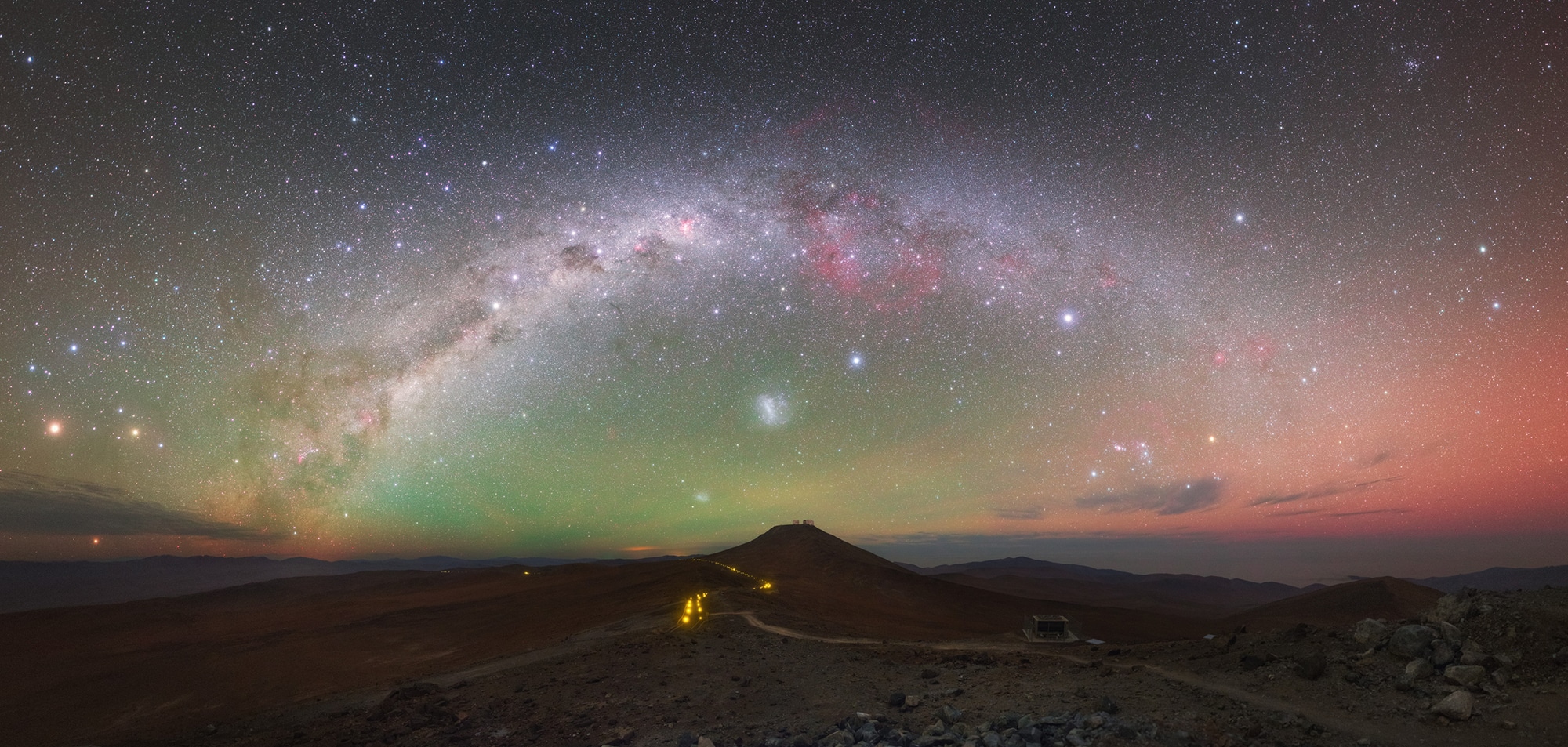
About Airglow
- Airglow is the natural “glowing” of the Earth’s atmosphere.
- It happens all the time and across the whole globe.
- The phenomenon is similar to auroras, but where auroras are driven by high-energy particles originating from the solar wind, airglow is energized by ordinary, day-to-day solar radiation.
- Unlike the aurora, airglow does not exhibit structures such as arcs and is emitted from the entire sky at all latitudes at all times.
- There are three types of airglow: dayglow, twilightglow, and nightglow.
- Each is the result of sunlight interacting with the molecules in the atmosphere, but they have their own special way of forming.
- The most common airglow colors are green, red, and blue. However, other colors also occur.
- Dayglow:
- o It forms when sunlight strikes the daytime atmosphere.
- o Some of the sunlight is absorbed by the molecules in the atmosphere, which gives them excess energy. They become excited.
- The molecules then release this energy as light, either at the same or slightly lower frequency (colour) as the light they absorbed. This light is much dimmer than daylight, so we can’t see it by eye.
- Twilight glow:
- It is essentially the same as dayglow, but only the upper atmosphere is sunlit.
- The rest of the atmosphere and the observer on the ground are in darkness.
- So, unlike day glow, twilightglow is actually visible to us on the ground with the naked eye.
- Nightglow:
- The chemistry behind nightglow is different. There is no sunlight shining on the nighttime atmosphere. Instead, a process called “chemiluminescence” is responsible for the glowing atmosphere.
- Sunlight deposits energy into the atmosphere during the day, some of which is transferred to oxygen molecules (e.g. O₂).
- This extra energy causes the oxygen molecules to rip apart into individual oxygen atoms. This happens particularly around 100km in altitude.
- However, atomic oxygen isn’t able to get rid of this excess energy easily, so it acts as a “store” of energy for several hours.
- Eventually, the atomic oxygen does manage to “recombine”, once again forming molecular oxygen. The molecular oxygen then releases energy, again in the form of light.
Q1) What is an aurora?
The sun is ejecting charged particles from its corona, creating solar wind. When that wind slams into Earth’s ionosphere, the aurora is born. In the Northern Hemisphere, the phenomenon is called the northern lights (aurora borealis), while in the Southern Hemisphere, it’s called the southern lights (aurora australis). The hemispheric asymmetry of the aurora is due in part to the sun’s magnetic field interfering with Earth’s magnetic field.
Source: NASA Shares Stunning Image Of Earth’s ‘Airglow’ Taken From International Space Station


 Last updated on Oct, 2026
→ UPSC 2027 Notification will be released on 13 January 2027 at upsconline.nic.in.
→ Check Nobel Prize 2026 Winners List here.
→ Download PIB PRiSM Monthly Magazine 2026 here.
→ Check UPSC Monthly Current Affairs Magazine The Recitals here.
→ Check out the latest UPSC Syllabus here.
→ Download UPSC Model Answers for Mains 2026
→ UPSC Mains Question Paper 2026 is out now for Essay & GS Paper 1, 2, 3 & 4.
→ UPSC Calendar 2027 has been released.
→ Enroll in Vajiram & Ravi’s UPSC Mains Test Series 2027 for structured answer writing practice, expert evaluation, and exam-oriented feedback.
→ Join Vajiram & Ravi’s UPSC Mentorship Program 2027 for personalized guidance, strategy planning, and one-to-one support from experienced mentors.
→ Go through the UPSC Mains Previous Year Papers to enhance your preparation.
→ UPSC has released UPSC Toppers List 2025 with the Civil Services final result on its official website.
→ Also check Best UPSC Coaching in India








