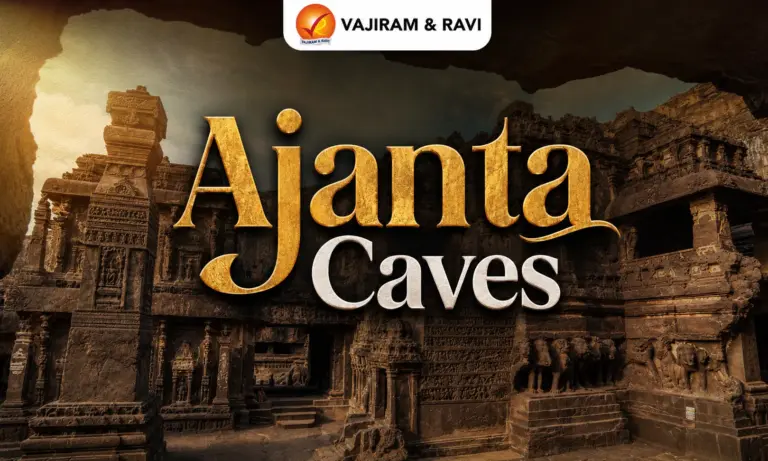
The Ajanta Caves are a group of ancient Buddhist rock-cut caves in Maharashtra. They are known for their architecture, sculptures, paintings and inscriptions, which provide valuable information about the religious, social and cultural life of ancient India.
About Ajanta Caves
The Ajanta Caves are a group of ancient Buddhist rock-cut caves in Maharashtra, carved into a basalt cliff along the Waghora River.
- They are located in the Sahyadri hills of the Deccan Plateau, near Lenapur village in Soyagaon taluka of Maharashtra.
- The caves form a horseshoe-shaped escarpment about 75 metres high along the left bank of the Waghora River.
- The site was close to an ancient trade route connecting the ports of western India with cities in the Deccan and therefore served as a resting place for merchants and travellers.
Ajanta Caves History and Patronage
The Ajanta Caves were not built by a single ruler or during a single period. They developed over several centuries in two main phases.
- The first phase took place under the Satavahanas, around the 2nd to 1st centuries BCE.
- The second phase took place under the Vakatakas, especially during the reign of King Harishena, in the 5th and 6th centuries CE.
- Cave 1 is associated with the patronage of Harishena, while Cave 16 was donated by his minister Varahadeva.
- Cave 17 was donated by Upendragupta, a Vakataka feudatory who ruled the Risika region.
- The caves served as viharas, where Buddhist monks lived, studied and meditated, and chaityagrihas, which were used for worship and congregation.
- The caves also served as a monsoon retreat for monks, who had to stop travelling during the rainy season.
- Merchants and pilgrims using the nearby trade route are also believed to have used the caves as resting places.


Ajanta Caves Architecture
The Ajanta Caves are an example of rock-cut architecture, where the structures were carved directly into the basalt cliff rather than built separately.
- Craftsmen used chisels and hammers to remove the rock and create halls, cells, pillars and sculptures.
- The architecture also imitates wooden structures, with stone beams, rafters and roof ribs carved to resemble wooden forms.
- The complex has 30 caves, including five chaityagrihas and the remaining viharas.
- The five chaityagrihas are Caves 9, 10, 19, 26 and 29. They have a vaulted ceiling, apsidal end and rows of pillars, with a stupa at the centre of the apse as the main object of worship.
- Their facades have a distinctive horseshoe-shaped chaitya window.
- The viharas served as monasteries and generally have a central hall surrounded by cells for monks, along with a shrine containing an image of the Buddha.
- Caves 5, 24 and 29 were left unfinished, giving an idea of how the caves were gradually carved out of the rock.
Ajanta Caves Sculptures
The caves contain extensive rock-cut sculptures along with their architectural features.
- They include large images of the Buddha and Bodhisattvas such as Padmapani and Vajrapani.
- Figures of celestial nymphs are also found in the caves.
- Pillars, doorways, door frames and facades are richly decorated with sculptures.
Ajanta Caves Paintings
The Ajanta Caves paintings are known for their Buddhist themes and detailed portrayal of contemporary life.
- The paintings mainly depict Jataka tales, describing the previous births of the Buddha, along with scenes from the life of the historical Buddha.
- They also show clothing, jewellery, hairstyles, court life, musical instruments and social customs of the period.
- Cave 1 is famous for the painting of Bodhisattva Padmapani, while Caves 16 and 17 contain some of the finest surviving paintings.
- The walls were prepared with mud plaster, followed by finer plaster and a layer of lime or kaolin to create a smooth surface.
- Artists used pigments such as red and yellow ochre, terra verte, lime, kaolin, gypsum, lamp black and lapis lazuli.
- Lapis lazuli was not locally available and is believed to have been brought from Afghanistan, indicating long-distance trade links.
- Glue, probably of animal origin, was used as a binding material.
- Since the paintings were made on dry plaster, they are technically tempera paintings and not true frescoes.
Ajanta Caves as a Historical Record
The Ajanta Caves provide valuable evidence about ancient India through their paintings, sculptures and inscriptions.
- Religion: They show the development of Buddhism from early traditions to the later Mahayana phase.
- Political history: Inscriptions provide information about the Vakataka rulers, ministers and feudatories.
- Social life: Paintings show clothing, jewellery, hairstyles, court life and social customs.
- Trade: The use of lapis lazuli from Afghanistan points to long-distance trade links.
- Epigraphy: Inscriptions mentioning donors and patrons help reconstruct the history and chronology of the caves.
- Art and culture: The caves preserve important examples of ancient Indian painting, sculpture and architecture.
Ajanta Caves UNESCO World Heritage Status
The Ajanta Caves were inscribed as a UNESCO World Heritage Site in 1983 under Criteria (i), (ii), (iii) and (vi).
- Criterion (i): Ajanta represents a unique artistic achievement.
- Criterion (ii): Its artistic style influenced art in India and beyond, including Java.
- Criterion (iii): The caves provide important evidence of the development of Indian art and the role of Buddhism during the Satavahana and Vakataka periods.
- Criterion (vi): Ajanta is directly associated with the history of Buddhism.
Ajanta Caves Decline and Rediscovery
After the decline of royal patronage, the Ajanta Caves were abandoned and gradually covered by forest. They were rediscovered in 1819 by British officer John Smith during a hunting expedition. Today, the Archaeological Survey of India (ASI) manages the site, which is protected under the Ancient Monuments and Archaeological Sites and Remains Act, 1958 and Rules, 1959. The law also regulates activities in the 100-metre prohibited and 200-metre regulated zones around the protected monument.

 Last updated on Oct, 2026
→ UPSC 2027 Notification will be released on 13 January 2027 at upsconline.nic.in.
→ Check Nobel Prize 2026 Winners List here.
→ Download PIB PRiSM Monthly Magazine 2026 here.
→ Check UPSC Monthly Current Affairs Magazine The Recitals here.
→ Check out the latest UPSC Syllabus here.
→ Download UPSC Model Answers for Mains 2026
→ UPSC Mains Question Paper 2026 is out now for Essay & GS Paper 1, 2, 3 & 4.
→ UPSC Calendar 2027 has been released.
→ Enroll in Vajiram & Ravi’s UPSC Mains Test Series 2027 for structured answer writing practice, expert evaluation, and exam-oriented feedback.
→ Join Vajiram & Ravi’s UPSC Mentorship Program 2027 for personalized guidance, strategy planning, and one-to-one support from experienced mentors.
→ Go through the UPSC Mains Previous Year Papers to enhance your preparation.
→ UPSC has released UPSC Toppers List 2025 with the Civil Services final result on its official website.
→ Also check Best UPSC Coaching in India
Ajanta Caves FAQs
Q1. Where are the Ajanta Caves located?+
Q2. Who built the Ajanta Caves?+
Q3. What are the Ajanta Caves famous for?+
Q4. How many caves are there at Ajanta?+
Q5. What is special about the paintings of the Ajanta Caves?+
Q6. When did the Ajanta Caves become a UNESCO World Heritage Site?+
Tags: ajanta caves