


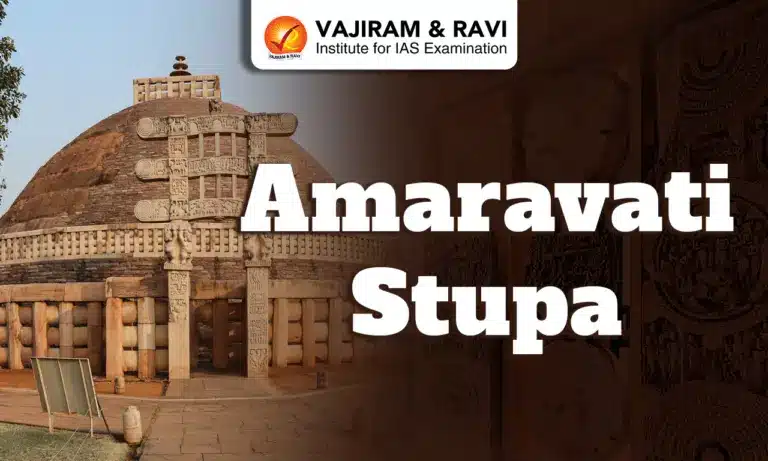
The Amaravati Stupa is one of the most famous Buddhist monuments of ancient India. It was located in the lower Krishna valley. The Amaravati school of sculpture made a lasting impact on the later South Indian sculpture, and its products were carried to Sri Lanka and South-east Asia. The stupa is known for its beautiful carvings, Buddhist art, and historical importance.
Amaravati Stupa
The Amaravati Stupa was a large Buddhist structure built in present-day Andhra Pradesh. It was an important center of Buddhism where monks, traders, and pilgrims visited for worship and learning. The stupa is also called Mahachaitya, which means “Great Stupa.” It was built to preserve sacred relics connected with Lord Buddha.
Amaravati Stupa History
The Amaravati Stupa was first built around the 2nd century BCE and was later expanded over many centuries.
The Satavahana rulers gave strong support to Buddhism and helped in the construction of the stupa. Later, the Ikshvaku rulers also added new structures and decorations. Because Amaravati was located on important trade routes, it became a rich center of culture, religion, and art.


Amaravati School of Sculpture
The Amaravati School of Sculpture was an important ancient Indian art style that developed in the lower Krishna valley of Andhra Pradesh during the Satavahana period and became famous for its beautiful Buddhist sculptures and detailed carvings.
- Developed mainly between the 2nd century BCE and 3rd century CE under the patronage of the Satavahana and later Ikshvaku rulers.
- The school flourished around the Amaravati Stupa located near the Krishna River in present-day Andhra Pradesh.
- Sculptures were mainly carved from white limestone, giving them a smooth and elegant appearance.
- The art style is known for its fine detailing, graceful human figures, and dynamic movement in sculptures.
- Amaravati artists created detailed narrative panels showing stories from the life of Lord Buddha and Jataka Tales.
- Early sculptures used symbolic representation of Buddha such as the Bodhi Tree, footprints, empty throne, and Dharma Chakra.
- Later sculptures also showed human images of Buddha, reflecting the development of Buddhist art traditions.
- The carvings included scenes of royal life, worship, social customs, animals, flowers, and nature.
- Amaravati sculptures had slim figures, expressive faces, and decorative ornamentation, making them different from the Gandhara and Mathura styles.
- The school showed a strong influence of Buddhist philosophy and religious teachings through visual storytelling.
- Sculptures were decorated with lotus designs, scroll patterns, and elaborate architectural motifs.
- The art style reflected the prosperity of the Krishna valley trade network and the support of merchants and monks.
- Amaravati became an important center for the spread of Buddhism to Sri Lanka and South-east Asia through maritime trade.
- The Amaravati School greatly influenced later South Indian temple sculpture and Buddhist art traditions abroad.
- Important Amaravati sculptures are preserved today in museums such as the Amaravati Archaeological Museum, Government Museum Chennai, and the British Museum London.
About Stupa
A Stupa is a dome-shaped Buddhist monument built to preserve sacred relics of Lord Buddha and to serve as a place of worship, meditation, and pilgrimage.
- The word “Stupa” comes from the Sanskrit language, meaning a mound or heap.
- Stupas were originally built to keep the relics of Buddha, such as ashes, bones, or sacred objects.
- After the death of Lord Buddha, his relics were divided and placed in different stupas across India.
- Stupas became important centers of Buddhist worship and pilgrimage.
- The structure of a stupa represents important ideas of Buddhist philosophy and spirituality.
- The main dome-shaped part of the stupa is called the Anda, symbolizing the universe.
- A square railing on the top known as the Harmika represents the heavenly world.
- The umbrella-like structure called Chatra symbolizes protection, honor, and spiritual authority.
- Many stupas have a Pradakshina Patha, a circular pathway used by devotees for clockwise circumambulation.
- Stupas were often surrounded by beautifully carved railings and gateways decorated with Buddhist stories and symbols.
- Early Buddhist art used symbols like the Bodhi Tree, footprints, lotus, and Dharma Chakra instead of direct images of Buddha.
- The construction of stupas increased greatly during the reign of Emperor Ashoka, who spread Buddhism across India.
- Famous stupas in India include the Sanchi Stupa, Amaravati Stupa, and Dhamek Stupa.
- Stupas also became centers of education, culture, and art in ancient India.
- The concept of stupas later spread to countries like Sri Lanka, Myanmar, Thailand, China, Japan, and Indonesia along with Buddhism.

 Last updated on Oct, 2026
→ UPSC 2027 Notification will be released on 13 January 2027 at upsconline.nic.in.
→ Check Nobel Prize 2026 Winners List here.
→ Download PIB PRiSM Monthly Magazine 2026 here.
→ Check UPSC Monthly Current Affairs Magazine The Recitals here.
→ Check out the latest UPSC Syllabus here.
→ Download UPSC Model Answers for Mains 2026
→ UPSC Mains Question Paper 2026 is out now for Essay & GS Paper 1, 2, 3 & 4.
→ UPSC Calendar 2027 has been released.
→ Enroll in Vajiram & Ravi’s UPSC Mains Test Series 2027 for structured answer writing practice, expert evaluation, and exam-oriented feedback.
→ Join Vajiram & Ravi’s UPSC Mentorship Program 2027 for personalized guidance, strategy planning, and one-to-one support from experienced mentors.
→ Go through the UPSC Mains Previous Year Papers to enhance your preparation.
→ UPSC has released UPSC Toppers List 2025 with the Civil Services final result on its official website.
→ Also check Best UPSC Coaching in India
Amaravati Stupa FAQs
Q1. What is the Amaravati Stupa?+
Q2. Where is the Amaravati Stupa located?+
Q3. Which dynasty built the Amaravati Stupa?+
Q4. Why is the Amaravati Stupa famous?+
Q5. What is the Amaravati School of Sculpture?+
Tags: amaravati stupa art and culture








