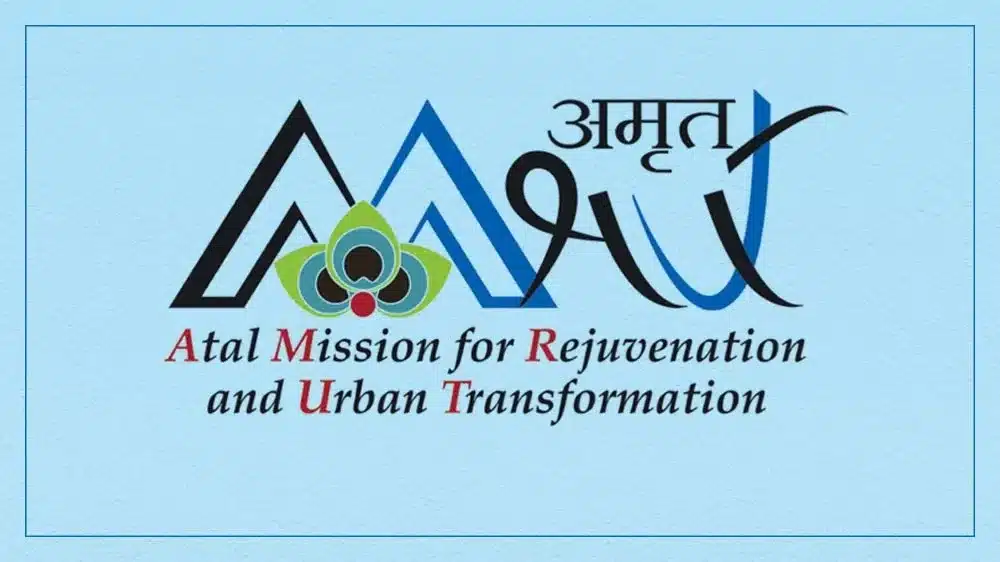
About AMRUT Scheme
- It was launched by the Ministry of Housing and Urban Affairs on 25th June 2015, in 500 selected cities and towns across the country.
- It focuses on development of basic infrastructure in the selected cities and towns in the sectors of water supply, sewerage and septage management, storm water drainage, green spaces and parks, and non-motorized urban transport.
- A set of Urban Reforms and Capacity Building have been included in the mission.
- AMRUT Mission has been subsumed under AMRUT 2.0, which was launched on 01st October, 2021.
- AMRUT 2.0, which was launched for a period of five years, from the financial year 2021-22 to the financial year 2025-26, is designed to provide universal coverage of water supply through functional taps to all households in all the statutory towns in the country and coverage of sewerage/septage management in 500 cities covered in the first phase of the AMRUT scheme.
- AMRUT 2.0 will promote a circular economy of water through the development of City Water Balance Plan (CWBP) for each city focusing on recycle/reuse of treated sewage, the rejuvenation of water bodies, and water conservation.
- It will help cities to identify scope for projects focusing on universal coverage of functional water tap connections, water source conservation, rejuvenation of water bodies and wells, recycle/reuse of treated used water, and rainwater harvesting.
- Based on the projects identified in CWBP, Mission envisages making cities ‘water secure’ through a circular economy of water.
- The mission also has a reform agenda on ease of living of citizens through reduction of non-revenue water, recycle of treated used water, rejuvenation of water bodies, augmenting double entry accounting system, urban planning, strengthening urban finance etc.
- Other components of AMRUT 2.0 are:
- Pey Jal Survekshan to ascertain equitable distribution of water, reuse of wastewater, mapping of water bodies, and promote healthy competition among the cities /towns.
- Technology Sub-Mission for water to leverage latest global technologies in the field of water.
- Information, Education, and Communication (IEC) campaign to spread awareness among the masses about conservation of water.
- The total indicative outlay for AMRUT 2.0 is ₹2,99,000 crore including Central share of ₹76,760 crore for five years.
Q1) Which are the major tributaries of Krishna River?
The principal tributaries joining Krishna are the Ghataprabha, the Malaprabha, the Bhima, the Tungabhadra and the Musi.
Source: 39 sewage treatment plants from AMRUT scheme to line Musi river in Hyderabad


 Last updated on Oct, 2026
→ UPSC 2027 Notification will be released on 13 January 2027 at upsconline.nic.in.
→ Check Nobel Prize 2026 Winners List here.
→ Download PIB PRiSM Monthly Magazine 2026 here.
→ Check UPSC Monthly Current Affairs Magazine The Recitals here.
→ Check out the latest UPSC Syllabus here.
→ Download UPSC Model Answers for Mains 2026
→ UPSC Mains Question Paper 2026 is out now for Essay & GS Paper 1, 2, 3 & 4.
→ UPSC Calendar 2027 has been released.
→ Enroll in Vajiram & Ravi’s UPSC Mains Test Series 2027 for structured answer writing practice, expert evaluation, and exam-oriented feedback.
→ Join Vajiram & Ravi’s UPSC Mentorship Program 2027 for personalized guidance, strategy planning, and one-to-one support from experienced mentors.
→ Go through the UPSC Mains Previous Year Papers to enhance your preparation.
→ UPSC has released UPSC Toppers List 2025 with the Civil Services final result on its official website.
→ Also check Best UPSC Coaching in India