


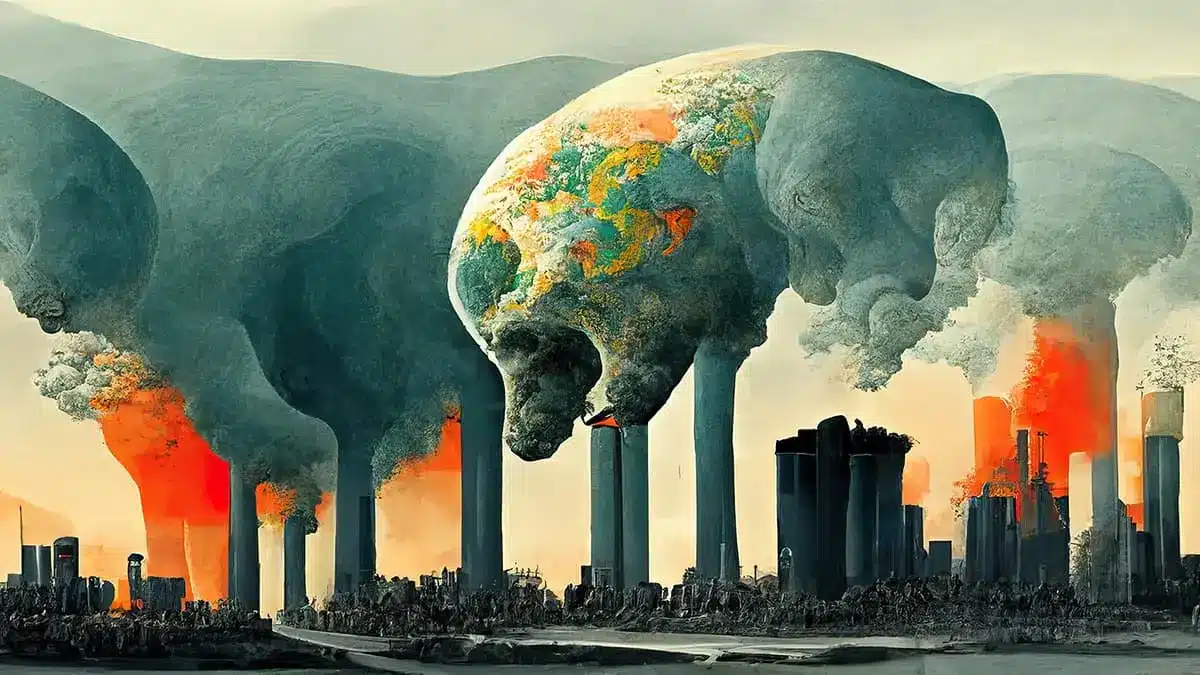
About Anthropocene Epoch
- It is an unofficial unit of geologic time, used to describe the most recent period in Earth’s history when human activity started to have a significant impact on the planet’s climate and ecosystems.
- The word Anthropocene is derived from the Greek words anthropo, for “man,” and cene, for “new,” coined and made popular by biologist Eugene Stormer and chemist Paul Crutzen in 2000.
- There are numerous phenomena associated with this proposed epoch, such as global warming, sea-level rise, ocean acidification, mass-scale soil erosion, the advent of deadly heat waves, deterioration of the biosphere, and other detrimental changes in the environment.
- What is the Geological Time Scale?
- Earth’s history is divided into a hierarchical series of smaller chunks of time, referred to as the geologic time scale.
- These divisions, in descending length of time, are called eons, eras, periods, epochs, and ages.
- These units are classified based on Earth’s rock layers, or strata, and the fossils found within them.
- From examining these fossils, scientists know that certain organisms are characteristic of certain parts of the geologic record. The study of this correlation is called stratigraphy.
- Current Epoch: Officially, the current epoch is called the Holocene, which began 11,700 years ago after the last major ice age.
- Debate:
- Scientists still debate whether the Anthropocene is different from the Holocene.
- The term Anthropocene has not been formally adopted by the International Union of Geological Sciences (IUGS), the international organization that names and defines epochs.
- The primary question that the IUGS needs to answer before declaring the Anthropocene an epoch is if humans have changed the Earth system to the point that it is reflected in the rock strata.
Q1) What is the International Union of Geological Sciences (IUGS)?
The International Union of Geological Sciences (IUGS), founded in 1961, is one of the World’s largest scientific organizations. It encourages international cooperation and participation in the earth sciences in relation to human welfare and is a member of the International Council for Science (ICSU). Membership is open to countries or defined regions. IUGS has over 120 members representing over a million geoscientists.
Source: Proposal to mark a new chapter in Earth’s history rejected, scientists say


 Last updated on Oct, 2026
→ UPSC 2027 Notification will be released on 13 January 2027 at upsconline.nic.in.
→ Check Nobel Prize 2026 Winners List here.
→ Download PIB PRiSM Monthly Magazine 2026 here.
→ Check UPSC Monthly Current Affairs Magazine The Recitals here.
→ Check out the latest UPSC Syllabus here.
→ Download UPSC Model Answers for Mains 2026
→ UPSC Mains Question Paper 2026 is out now for Essay & GS Paper 1, 2, 3 & 4.
→ UPSC Calendar 2027 has been released.
→ Enroll in Vajiram & Ravi’s UPSC Mains Test Series 2027 for structured answer writing practice, expert evaluation, and exam-oriented feedback.
→ Join Vajiram & Ravi’s UPSC Mentorship Program 2027 for personalized guidance, strategy planning, and one-to-one support from experienced mentors.
→ Go through the UPSC Mains Previous Year Papers to enhance your preparation.
→ UPSC has released UPSC Toppers List 2025 with the Civil Services final result on its official website.
→ Also check Best UPSC Coaching in India








