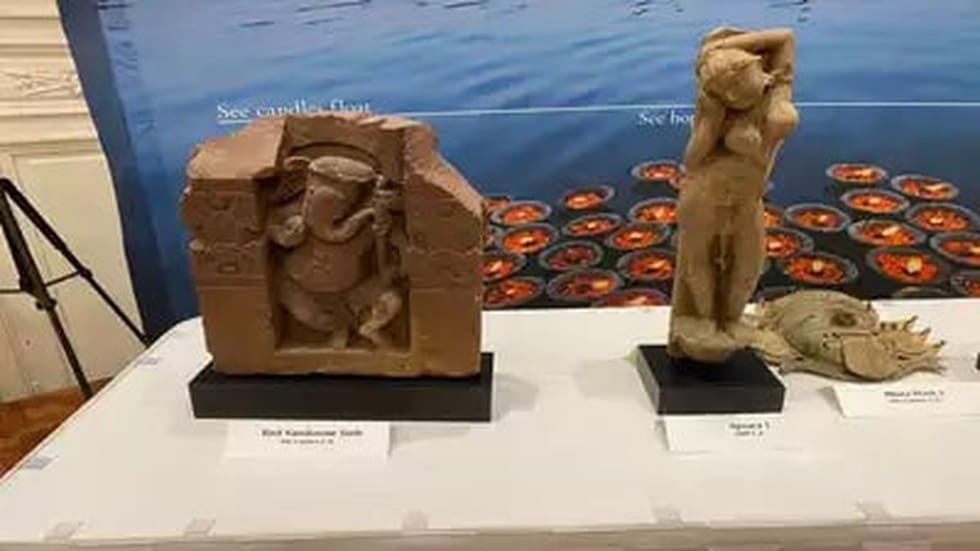
About:
Antiquities returned:
- Vishnu and Lakshmi with Garuda, dating to the 11th century C.E., which was allegedly stolen from a temple in Central India.
- A Chola-era Sambandar bronze idol, a Chola-era Devi idol in stone, bronze idols of Vinayaga, Narasimha with Lakshmi, a wooden idol of Muruga and wooden chauri bearers are other items that had been taken from Tamil Nadu.
Antiquities:
- “Antiquity” is an article or object that is at least 100 years old.
- It could be a coin, sculpture, painting or epigraph, or any object or article taken from a building or a cave, or anything that illustrates the science, art, crafts or customs or religion or literature of a bygone age, or anything of historical interest.
- If it is a manuscript or record of any scientific, historical, literary or aesthetic value, it should be at least 75 years’ old.
- An art treasure is a human work of art, other than an antiquity, declared to be a treasure by the Centre for its artistic value after the artist’s death.
- Antiquities in India are governed by The Antiquities and Art Treasures Act, 1972 which falls within the purview of the Archaeological Survey of India (“ASI”), Union Ministry of Culture.
Possession of an antiquity:
- Possession of an unregistered antiquity is a punishable offence under law.
- Section 14(3) of the Act makes it mandatory for “every person who owns, controls or is in possession of any antiquity” to register it before a registering officer within 15 days of its coming into his control or possession and obtain a certificate of registration.
- Antiquities can be sold, but only by a licensed person. However, Section 3 of the Act prohibits export of an antiquity by anyone other than the Centre or its agencies.
Punishment:
- A jail term of six months, or with fine, or both. Besides, the antiquity is also liable to be confiscated.
Source : The Hindu


 Last updated on Oct, 2026
→ UPSC 2027 Notification will be released on 13 January 2027 at upsconline.nic.in.
→ Check Nobel Prize 2026 Winners List here.
→ Download PIB PRiSM Monthly Magazine 2026 here.
→ Check UPSC Monthly Current Affairs Magazine The Recitals here.
→ Check out the latest UPSC Syllabus here.
→ Download UPSC Model Answers for Mains 2026
→ UPSC Mains Question Paper 2026 is out now for Essay & GS Paper 1, 2, 3 & 4.
→ UPSC Calendar 2027 has been released.
→ Enroll in Vajiram & Ravi’s UPSC Mains Test Series 2027 for structured answer writing practice, expert evaluation, and exam-oriented feedback.
→ Join Vajiram & Ravi’s UPSC Mentorship Program 2027 for personalized guidance, strategy planning, and one-to-one support from experienced mentors.
→ Go through the UPSC Mains Previous Year Papers to enhance your preparation.
→ UPSC has released UPSC Toppers List 2025 with the Civil Services final result on its official website.
→ Also check Best UPSC Coaching in India