Antlions Latest News
Researchers recently discovered two new species of antlions named Indophanes keralaensis and Indophanes sahyadriensis belonging to the family Myrmeleontidae under the order Neuroptera.
About Antlions
- Antlions are a group of about 2,000 different species of insects.
- They belong to a family called Myrmeleontidae.
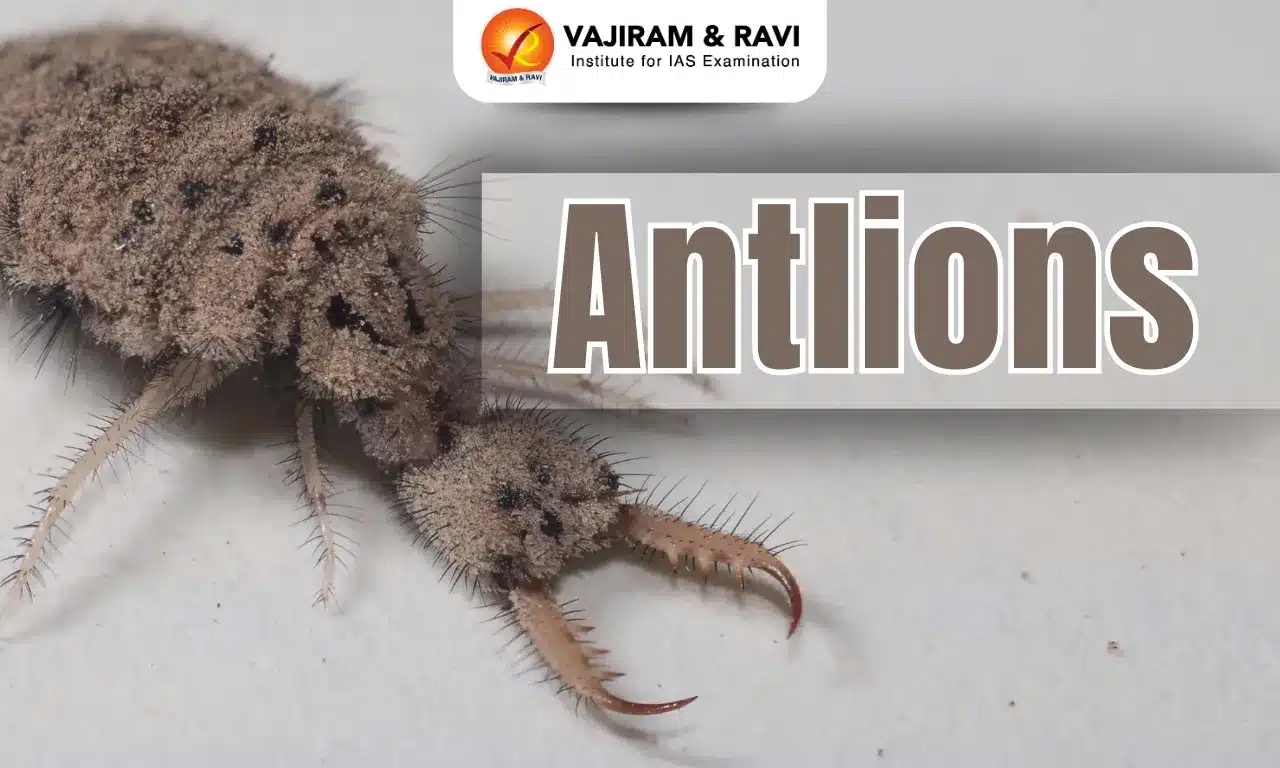
- They are named for the predatory nature of the larvae, which commonly trap ants and other small insects in pits dug into the ground.
- Adult antlions are not as well known. They live for a shorter time than the larvae.
- Adult antlions, sometimes called antlion lacewings, usually fly at dusk or after dark.
- People sometimes mistake them for dragonflies or damselflies.
- Habitat and Distribution:
- Antlions live all over the world.
- Most types are found in warm, tropical places.
- But some species, like the European Euroleon nostras, live in colder areas.
- They often live in dry, sandy places. This is where their larvae can easily dig their traps.
- However, some larvae hide under leaves or other bits of nature. They wait to ambush their prey there.
- They come in various shapes and sizes, with larvae typically measuring from a few millimeters to several centimeters, depending on the species.
- Antlion larvae have rounded bodies with long sickle-shaped jaws.
- The larvae are found at the base of cone-shaped pits in sandy areas.
- In North America, these larvae are sometimes called doodlebugs. This is because of the wiggly marks they leave in the sand.
- They usually remain in the larval stage for one to two years, depending on the species.
- Once they pupate, they require up to one month to complete their development.
- Antlions are harmless and cause no damage to flowers, people, or structures.
- They are highly beneficial and feed on ants and other insects that fall into their traps.
Source: TH


 Last updated on Oct, 2026
→ UPSC 2027 Notification will be released on 13 January 2027 at upsconline.nic.in.
→ Asian Games 2026 are being held in Aichi-Nagoya, Japan, from 19 September to 4 October.
→ Check Nobel Prize 2026 Winners List here.
→ Download PIB PRiSM Monthly Magazine 2026 here.
→ Check UPSC Monthly Current Affairs Magazine The Recitals here.
→ Check out the latest UPSC Syllabus here.
→ Download UPSC Model Answers for Mains 2026
→ UPSC Mains Question Paper 2026 is out now for Essay & GS Paper 1, 2, 3 & 4.
→ UPSC Calendar 2027 has been released.
→ Enroll in Vajiram & Ravi’s UPSC Mains Test Series 2027 for structured answer writing practice, expert evaluation, and exam-oriented feedback.
→ Join Vajiram & Ravi’s UPSC Mentorship Program 2027 for personalized guidance, strategy planning, and one-to-one support from experienced mentors.
→ Go through the UPSC Mains Previous Year Papers to enhance your preparation.
→ UPSC has released UPSC Toppers List 2025 with the Civil Services final result on its official website.
→ Also check Best UPSC Coaching in India
Antlions FAQs
Q1. Antlions belong to which insect family?+
Q2. Why are antlions named so?+
Q3. How long do antlion larvae usually remain in the larval stage?+
Q4. Adult antlions are often mistaken for which insects?+
Q5. Where are antlions most commonly found?+
Tags: antlions