


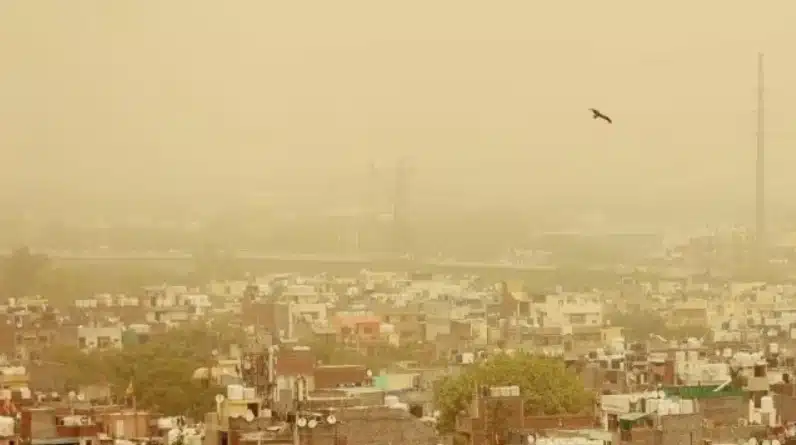
What’s in today’s article?
- Why in news?
- What is Air Quality Index (AQI)?
- What is Commission for Air Quality Management (CAQM)?
- What is Graded Response Action Plan (GRAP)?
- News Summary: Delhi AQI severe
Why in news?
- The air quality in Delhi turned ‘severe’ as its average AQI was 447 on January 14.
- The sudden deterioration in air quality prompted the Commission for Air Quality Management (CAQM) to invoke stage 3 measures under the Graded Response Action Plan (Grap) across Delhi-NCR with immediate effect.


What is Air Quality Index (AQI)?
- AQI was launched in October 2014 to disseminate information on air quality in an easily understandable form for the general public.
- The measurement of air quality is based on eight pollutants, namely, PM10, PM2.5, NO2, SO2, CO, O3, NH3, and Pb
- The AQI transforms complex air quality data of various pollutants into a single number for ease of understanding.


Image Caption: Air Quality Index
What is Commission for Air Quality Management (CAQM)?
- CAQM is a statutory body formed under the Commission for Air Quality Management in National Capital Region and Adjoining Areas, Act 2021.
- The commission aims at better coordination, research, identification, and resolution of problems related to air quality in NCR and adjoining areas.
What is Graded Response Action Plan (GRAP)?
- About
- GRAP is a set of emergency measures that kick in to prevent further deterioration of air quality once it reaches a certain threshold in the Delhi-NCR region.
- It was approved by the Supreme Court in 2016 and notified in 2017.
- The plan was formulated after several meetings between Environment Pollution (Prevention and Control) Authority (EPCA), state government and experts.
- GRAP works only as an emergency measure.
- The plan does not include action by various state governments to be taken throughout the year to tackle industrial, vehicular and combustion emissions.
- Nature

Image Caption: Graded Response Action Plan
- GRAP is incremental in nature and thus, when the air quality dips from ‘poor’ to ‘very poor,’ measures listed under both sections have to be followed.
- Stage 1 of GRAP is activated when the AQI is in the ‘poor’ category (201 to 300);
- Stage 2 is when it’s in the ‘Very poor’ category (301-400);
- Stage 3 is when the AQI is the ‘Severe’ category (401-450); and
- Stage 4 is when it rises to the ‘Severe +’ category (more than 450).
News Summary: Delhi AQI severe
- Delhi’s 24-hour average air quality index (AQI) was recorded at 447 (severe) on January 14. As a result, CAQM invoked stage 3 measures under the GRAP across Delhi-NCR.
- The sudden to a spike in pollution levels was due to the combination of:
- low wind speed,
- frigid temperatures,
- rise in the moisture levels,
- low mixing heights and
- the impact of biomass combustion across the city the previous day led.
- Invoked for the third time this winter season, the eight measures include a ban on BS- III petrol and BS-IV diesel four-wheelers plying across Delhi-NCR region.
- The measures also effectively ban private construction in the region.
Q1) Who is the National Capital Region (NCR)?
The National Capital Region (NCR) is a metropolitan area in India that includes the National Capital Territory of Delhi and surrounding urban areas in the states of Haryana, Uttar Pradesh, and Rajasthan. The NCR is a planning region centered on the National Capital Territory of Delhi. It is one of the most popular tourist destinations in the world.
Q2) What are Bharat Stage (BS) Emission standards?
Bharat Stage (BS) Emission Standards are government-mandated standards that regulate the amount of air pollutants that motor vehicles emit. All vehicles sold and driven in India must comply with these standards.
Source: Delhi AQI severe, curbs back on cars and construction | CAQM | Hindustan Times

 Last updated on Oct, 2026
→ UPSC 2027 Notification will be released on 13 January 2027 at upsconline.nic.in.
→ Check Nobel Prize 2026 Winners List here.
→ Download PIB PRiSM Monthly Magazine 2026 here.
→ Check UPSC Monthly Current Affairs Magazine The Recitals here.
→ Check out the latest UPSC Syllabus here.
→ Download UPSC Model Answers for Mains 2026
→ UPSC Mains Question Paper 2026 is out now for Essay & GS Paper 1, 2, 3 & 4.
→ UPSC Calendar 2027 has been released.
→ Enroll in Vajiram & Ravi’s UPSC Mains Test Series 2027 for structured answer writing practice, expert evaluation, and exam-oriented feedback.
→ Join Vajiram & Ravi’s UPSC Mentorship Program 2027 for personalized guidance, strategy planning, and one-to-one support from experienced mentors.
→ Go through the UPSC Mains Previous Year Papers to enhance your preparation.
→ UPSC has released UPSC Toppers List 2025 with the Civil Services final result on its official website.
→ Also check Best UPSC Coaching in India








