Aral Sea Latest News
Drying of the Aral Sea has released more than 200 teragrams of carbon from exposed lake-bed sediments, turning a once-stable carbon reservoir into an active source of greenhouse gases, according to a new study.
About Aral Sea
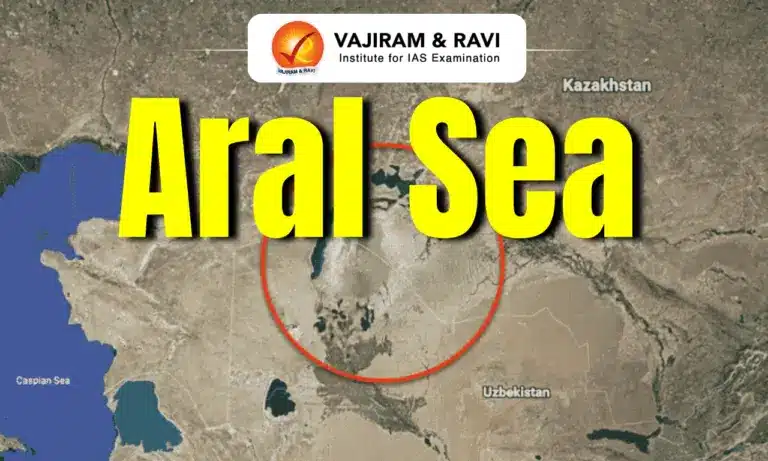
- It is a saline lake in Central Asia straddling the boundary between Uzbekistan and Kazakhstan to the south and north.
- It was once a large saltwater lake in Central Asia and the world’s fourth-largest body of inland water.
- The remnants of it nestle in the climatically inhospitable heart of Central Asia, to the east of the Caspian Sea.
- Formation:
- The Aral Sea depression was formed toward the end of the Neogene Period (which lasted from about 23 to 2.6 million years ago).
- It was made by waters from the Syr Darya and the Amu Darya rivers that were dependent on glacial melt.
- Climate:
- The Aral Sea is located within the harsh climate region of Central Asia.
- The area experiences a desert-continental climate, characterized by hot summers, cold winters, and varying diurnal air temperature.
- Reason for its Disappearance:
- The lake once covered 68,000 sq.km. between the Kyzylorda and Aktobe regions in Kazakhstan and the Karakalpakstan region of Uzbekistan.
- However, the lake started shrinking in the 1960s, when the Soviet government decided to divert the Syr Darya and the Amu Darya, to irrigate the surrounding desert region.
- By the 1980s, the Aral Sea had shed 80% of its volume, resulting in the extinction of native fish species and severe ecological degradation, including the emergence of the Aralkum Desert.
- Today it is on the verge of complete disappearance.
News: BIO


 Last updated on Oct, 2026
→ UPSC 2027 Notification will be released on 13 January 2027 at upsconline.nic.in.
→ Asian Games 2026 are being held in Aichi-Nagoya, Japan, from 19 September to 4 October.
→ Check Nobel Prize 2026 Winners List here.
→ Download PIB PRiSM Monthly Magazine 2026 here.
→ Check UPSC Monthly Current Affairs Magazine The Recitals here.
→ Check out the latest UPSC Syllabus here.
→ Download UPSC Model Answers for Mains 2026
→ UPSC Mains Question Paper 2026 is out now for Essay & GS Paper 1, 2, 3 & 4.
→ UPSC Calendar 2027 has been released.
→ Enroll in Vajiram & Ravi’s UPSC Mains Test Series 2027 for structured answer writing practice, expert evaluation, and exam-oriented feedback.
→ Join Vajiram & Ravi’s UPSC Mentorship Program 2027 for personalized guidance, strategy planning, and one-to-one support from experienced mentors.
→ Go through the UPSC Mains Previous Year Papers to enhance your preparation.
→ UPSC has released UPSC Toppers List 2025 with the Civil Services final result on its official website.
→ Also check Best UPSC Coaching in India
Aral Sea FAQs
Q1. Where is the Aral Sea located?+
Q2. What type of water body is the Aral Sea?+
Q3. Which two rivers originally fed the Aral Sea?+
Q4. Why did the Aral Sea begin to shrink?+
Tags: aral sea prelims pointers upsc current affairs upsc prelims current affairs