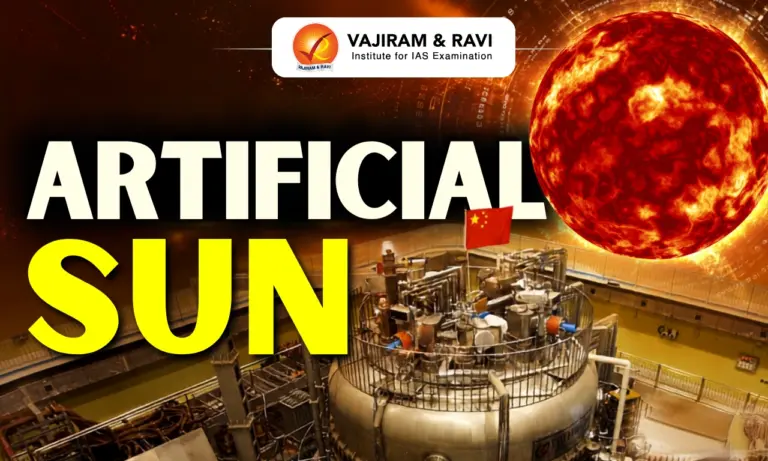
The Artificial Sun is a term used to describe advanced scientific experiments that try to recreate the energy of the Sun on Earth. Scientists do this using a process called nuclear fusion, where small atoms combine to release a huge amount of clean energy, just like what happens inside the real Sun. The main aim of creating an Artificial Sun is to develop a safe, sustainable, and pollution-free source of energy for the future. In simple words, it is an effort by humans to bring the power of the Sun into controlled laboratory conditions to solve the world’s growing energy needs.
Artificial Sun
- The HL-2M Tokamak reactor is China’s largest and most advanced nuclear fusion research device, developed to explore a powerful source of clean energy for the future.
- This device works by trying to replicate the nuclear fusion process that naturally takes place inside the Sun, where energy is produced on a massive scale.
- It uses a strong magnetic field to control and fuse extremely hot plasma (fourth state of matter), allowing it to reach temperatures of over 150 million°C, which is about ten times hotter than the Sun’s core.
- The reactor is located in Sichuan province, China, and is often called an “Artificial Sun” because it produces immense heat and energy similar to the Sun.
Other Similar Experiment
- The International Thermonuclear Experimental Reactor (ITER) is a major global project involving 35 countries, launched in 1985.
- It is located in France and aims to build the world’s largest tokamak reactor.
- The main goal of ITER is to prove that nuclear fusion can be used as a large-scale, carbon-free energy source.
- A tokamak is a special experimental machine designed to harness fusion energy. The heat produced during fusion is absorbed by the reactor walls and then used to generate steam, turbines, and electricity, similar to a conventional power plant.


Nuclear Fusion vs Nuclear Fission
- Nuclear fission is a process in which heavy atomic nuclei (e.g., Uranium-235) are split into smaller nuclei, releasing energy. This process is currently used in nuclear power plants, but it produces radioactive waste and carries risks like meltdown accidents.
- Nuclear fusion is the opposite process, where light nuclei (such as isotopes of hydrogen like deuterium and tritium) combine to form a heavier nucleus (helium), releasing much larger amounts of energy per reaction.
- Fusion is considered superior because it produces minimal long-lived radioactive waste, has lower risk of catastrophic failure, and uses abundant fuel sources (like hydrogen from water).
- However, fusion requires extreme conditions (temperature, pressure, and confinement), making it far more difficult to achieve and sustain compared to fission.
Also Read : Difference Between Nuclear Fission and Nuclear Fusion
Why Fusion is Difficult on Earth?
- In stars like the Sun, fusion occurs naturally due to immense gravitational pressure, which forces atomic nuclei close enough to overcome their natural repulsion and fuse together.
- On Earth, since such gravitational forces are absent, scientists must artificially create similar conditions by heating fuel to over 100 million°C, increasing particle speed and collision probability.
- Even if fusion is initiated, the main difficulty lies in sustaining the reaction for long durations, which is essential for generating continuous energy.
- Another major challenge is energy balance. Scientists must ensure that the energy produced by fusion is greater than the energy used to initiate and maintain it, which is still a work in progress.
Role of Plasma in Fusion
- Plasma is the fourth state of matter, formed when a gas is heated to extremely high temperatures, causing electrons to separate from atomic nuclei, resulting in a collection of charged particles.
- Fusion reactions occur only in the plasma state, as particles need to move freely at high speeds to collide and fuse.
- Plasma is highly unstable and turbulent, making it extremely difficult to control and confine within a reactor.
- One of the key research goals is achieving plasma stability and confinement for longer durations, which directly impacts the efficiency and feasibility of fusion energy.
Importance of Superconducting Magnets
- The 582-tonne superconducting magnet developed by China is a core component of a fusion reactor, responsible for generating the strong magnetic fields required to confine plasma.
- These magnets create an invisible magnetic confinement system, preventing the plasma from touching the reactor walls, which would otherwise lead to energy loss and structural damage.
- The magnet’s large size (about 21 metres in length) and high capacity make it one of the most advanced fusion magnets globally, capable of storing massive magnetic energy.
- Superconducting magnets are essential because they can carry extremely high electrical currents with zero resistance, enabling the creation of powerful and stable magnetic fields needed for fusion.
What Is a Tokamak?
- A tokamak is a toroidal (doughnut-shaped) fusion reactor that uses a combination of magnetic fields and electric currents to confine and control plasma.
- It consists of several key components, including toroidal field magnets, a central solenoid, vacuum chamber, and plasma heating systems.
- The tokamak design ensures that plasma moves in a circular path, reducing energy loss and increasing the chances of sustained fusion reactions.
- The heat generated from fusion is absorbed by the reactor walls and can eventually be used to produce steam and generate electricity through turbines, similar to conventional thermal power plants.
Extreme Temperature Conditions
- Fusion reactors operate under extreme dual conditions, where the plasma core reaches over 100 million°C, while surrounding superconducting systems are cooled to -269°C (near absolute zero).
- This massive temperature difference is managed using advanced cryogenic systems, vacuum insulation, and heat shielding technologies, which prevent heat transfer between components.
- Maintaining these conditions requires precise engineering and continuous monitoring, as even small fluctuations can destabilize the system.
- This “hot inside, cold outside” setup is one of the most complex engineering challenges in modern science.
China’s Progress in Fusion Research
- China has made rapid advancements through its EAST reactor, which has achieved long-duration plasma confinement, including maintaining plasma at 100 million°C for over 1,000 seconds.
- The development of the BEST (Burning Plasma Experimental Superconducting Tokamak) represents the next phase, aiming to achieve self-sustaining fusion reactions (burning plasma).
- China’s approach emphasizes domestic manufacturing and supply chain control, ensuring that critical components like superconductors and magnets are produced within the country.
- The long-term goal is to demonstrate practical fusion electricity generation by around 2030, although significant technical hurdles remain.
ITER – International Fusion Effort
- The International Thermonuclear Experimental Reactor (ITER) is a multinational collaboration involving 35 countries, including major economies like the US, EU members, China, India, Japan, and Russia.
- Located in France, ITER aims to build the world’s largest tokamak and demonstrate that fusion can produce more energy than it consumes (positive energy gain).
- ITER is not designed to produce electricity but to serve as a proof-of-concept reactor, paving the way for future commercial fusion power plants.
- The project represents global scientific cooperation, combining expertise, technology, and funding to tackle one of the most complex challenges in energy science.
Why Fusion Is the Future of Energy?
- Fusion has the potential to provide virtually unlimited energy, as its fuel sources (like deuterium from seawater) are abundant and widely available.
- It produces no greenhouse gas emissions during operation, making it a key solution for addressing climate change and global warming.
- Compared to fission, fusion generates much less long-lived radioactive waste and has a lower risk of accidents, making it safer.
- Although still in the experimental stage, continued progress in plasma physics, superconducting technology, and reactor design is steadily bringing fusion closer to becoming a practical and sustainable energy source.

 Last updated on Oct, 2026
→ UPSC 2027 Notification will be released on 13 January 2027 at upsconline.nic.in.
→ Check Nobel Prize 2026 Winners List here.
→ Download PIB PRiSM Monthly Magazine 2026 here.
→ Check UPSC Monthly Current Affairs Magazine The Recitals here.
→ Check out the latest UPSC Syllabus here.
→ Download UPSC Model Answers for Mains 2026
→ UPSC Mains Question Paper 2026 is out now for Essay & GS Paper 1, 2, 3 & 4.
→ UPSC Calendar 2027 has been released.
→ Enroll in Vajiram & Ravi’s UPSC Mains Test Series 2027 for structured answer writing practice, expert evaluation, and exam-oriented feedback.
→ Join Vajiram & Ravi’s UPSC Mentorship Program 2027 for personalized guidance, strategy planning, and one-to-one support from experienced mentors.
→ Go through the UPSC Mains Previous Year Papers to enhance your preparation.
→ UPSC has released UPSC Toppers List 2025 with the Civil Services final result on its official website.
→ Also check Best UPSC Coaching in India
Artificial Sun FAQs
Q1. What is an Artificial Sun?+
Q2. What is the HL-2M Tokamak reactor?+
Q3. Why is the HL-2M called an Artificial Sun?+
Q4. What is nuclear fusion and how does it work?+
Q5. What is the difference between nuclear fusion and nuclear fission?+
Tags: artificial sun nuclear power