About Atomic clock:
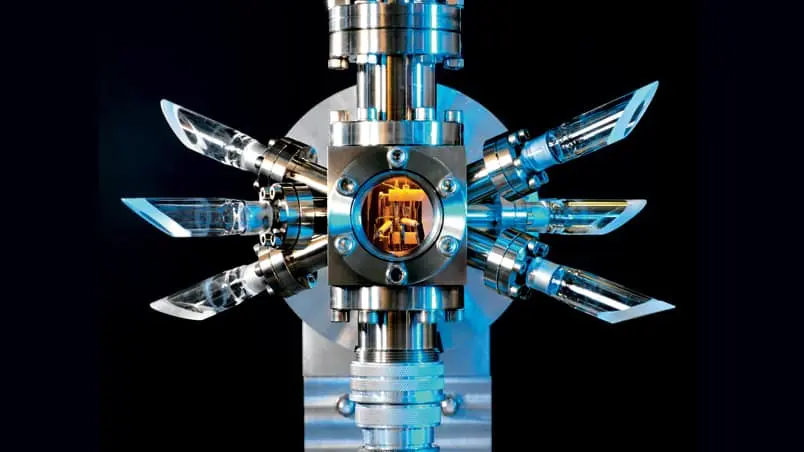
- It is a device that measures time using the vibrations of atoms.
- It specifically uses the oscillations of the electrons in atoms to keep time.
- It is the most accurate time-keeping device available, with a margin of error of just a few billionths of a second per day.
- It is far more precise than conventional clocks because atomic oscillations have a much higher frequency and are much more stable.
- Working
- Atomic clocks work by using a type of atom called a “cesium atom”.
- Cesium atoms are very stable and have a very specific frequency at which their electrons vibrate. This frequency is used as the basis for the atomic clock’s timekeeping.
- To measure time using cesium atoms, an atomic clock uses a device called a “microwave cavity”. The microwave cavity is a chamber that is filled with cesium vapor.
- A microwave signal is then sent into the cavity, which causes the cesium atoms to vibrate. As the cesium atoms vibrate, they emit radiation at a very specific frequency.
- This frequency is then detected by a detector, which compares it to a standard frequency.
- The difference between the two frequencies is used to adjust the clock’s timekeeping.
- Applications
- GPS systems: GPS systems use atomic clocks to measure the time it takes for a signal to travel from a satellite to a receiver on Earth. This allows GPS systems to calculate the receiver’s location with great accuracy.
- Telecommunications networks: Telecommunications networks use atomic clocks to synchronize the timing of signals that are sent over long distances.
- Scientific research: Atomic clocks are used in many scientific experiments that require precise timing, such as studies of the behavior of atoms and molecules.
Q1: What is quantum technology?
Quantum technology is a class of technology that works by using the principles of quantum mechanics (the physics of subatomic particles), including quantum entanglement and quantum superposition.. It enables revolutionary advancements in computing, communication, and sensing.
Source: NDTV


 Last updated on Sep, 2026
→ UPSC 2027 Notification will be released on 13 January 2027 at upsconline.nic.in.
→ Asian Games 2026 are being held in Aichi-Nagoya, Japan, from 19 September to 4 October.
→ Check out the latest UPSC Syllabus here.
→ Download UPSC Model Answers for Mains 2026
→ UPSC Mains Question Paper 2026 is out now for Essay & GS Paper 1, 2, 3 & 4.
→ UPSC Calendar 2027 has been released.
→ Enroll in Vajiram & Ravi’s UPSC Mains Test Series 2027 for structured answer writing practice, expert evaluation, and exam-oriented feedback.
→ Join Vajiram & Ravi’s UPSC Mentorship Program 2027 for personalized guidance, strategy planning, and one-to-one support from experienced mentors.
→ Go through the UPSC Mains Previous Year Papers to enhance your preparation.
→ UPSC has released UPSC Toppers List 2025 with the Civil Services final result on its official website.
→ Also check Best UPSC Coaching in India