About Auroras
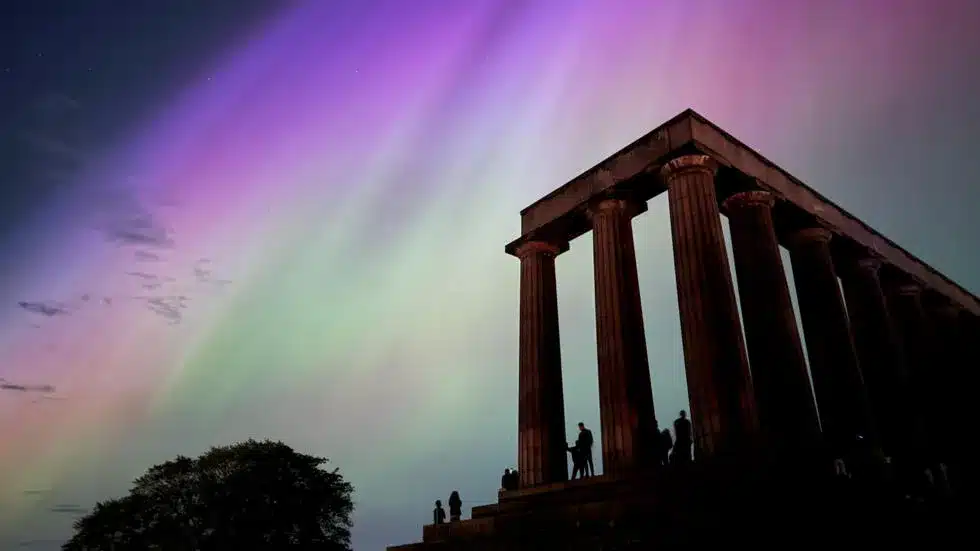
- These are essentially natural lights that appear as bright, swirling curtains in the night sky and can be seen in a range of colours, including blue, red, yellow, green, and orange.
- These lights primarily appear near the poles of both the northern and southern hemispheres all year round but sometimes they expand to lower latitudes.
- These are called aurora borealis in the north and in the south, it is known as the aurora australis.
Why do auroras occur?
- It is due to activity on the surface of the Sun.
- The star continuously releases a stream of charged particles, mainly electrons and protons, and magnetic fields called the solar wind.
- As the solar wind approaches the Earth, it is deflected by the planet’s magnetic field, which acts like a protective shield.
- However, some of the charged particles are trapped in the magnetic field and they travel down the magnetic field lines at the north and south poles into the upper atmosphere of the Earth.
- These particles then interact with different gases present there, resulting in tiny flashes that light up the night sky.
- When solar wind particles collide with oxygen, a green colour light is produced. Interaction with nitrogen produces shades of blue and purple.
- Auroras expand to midlatitudes when the solar wind is extremely strong.
- This happens when the activity on the Sun’s surface goes up, leading to solar flares and coronal mass ejections (CMEs), which are essentially extra bursts of energy in the solar wind.
- In such cases, the solar wind is so intense that it can result in a geomagnetic storm, also known as a magnetic storm — a temporary disturbance of the Earth’s magnetic field. It is during a magnetic storm that auroras can be seen in the mid-latitudes.
Q1: What is a Solar flare?
It is an intense burst of radiation coming from the release of magnetic energy associated with sunspots. Flares are our solar system’s largest explosive events.
Source: What are northern and southern lights? Why do they occur?


 Last updated on Oct, 2026
→ UPSC 2027 Notification will be released on 13 January 2027 at upsconline.nic.in.
→ Asian Games 2026 are being held in Aichi-Nagoya, Japan, from 19 September to 4 October.
→ Check Nobel Prize 2026 Winners List here.
→ Download PIB PRiSM Monthly Magazine 2026 here.
→ Check UPSC Monthly Current Affairs Magazine The Recitals here.
→ Check out the latest UPSC Syllabus here.
→ Download UPSC Model Answers for Mains 2026
→ UPSC Mains Question Paper 2026 is out now for Essay & GS Paper 1, 2, 3 & 4.
→ UPSC Calendar 2027 has been released.
→ Enroll in Vajiram & Ravi’s UPSC Mains Test Series 2027 for structured answer writing practice, expert evaluation, and exam-oriented feedback.
→ Join Vajiram & Ravi’s UPSC Mentorship Program 2027 for personalized guidance, strategy planning, and one-to-one support from experienced mentors.
→ Go through the UPSC Mains Previous Year Papers to enhance your preparation.
→ UPSC has released UPSC Toppers List 2025 with the Civil Services final result on its official website.
→ Also check Best UPSC Coaching in India