About Auroras
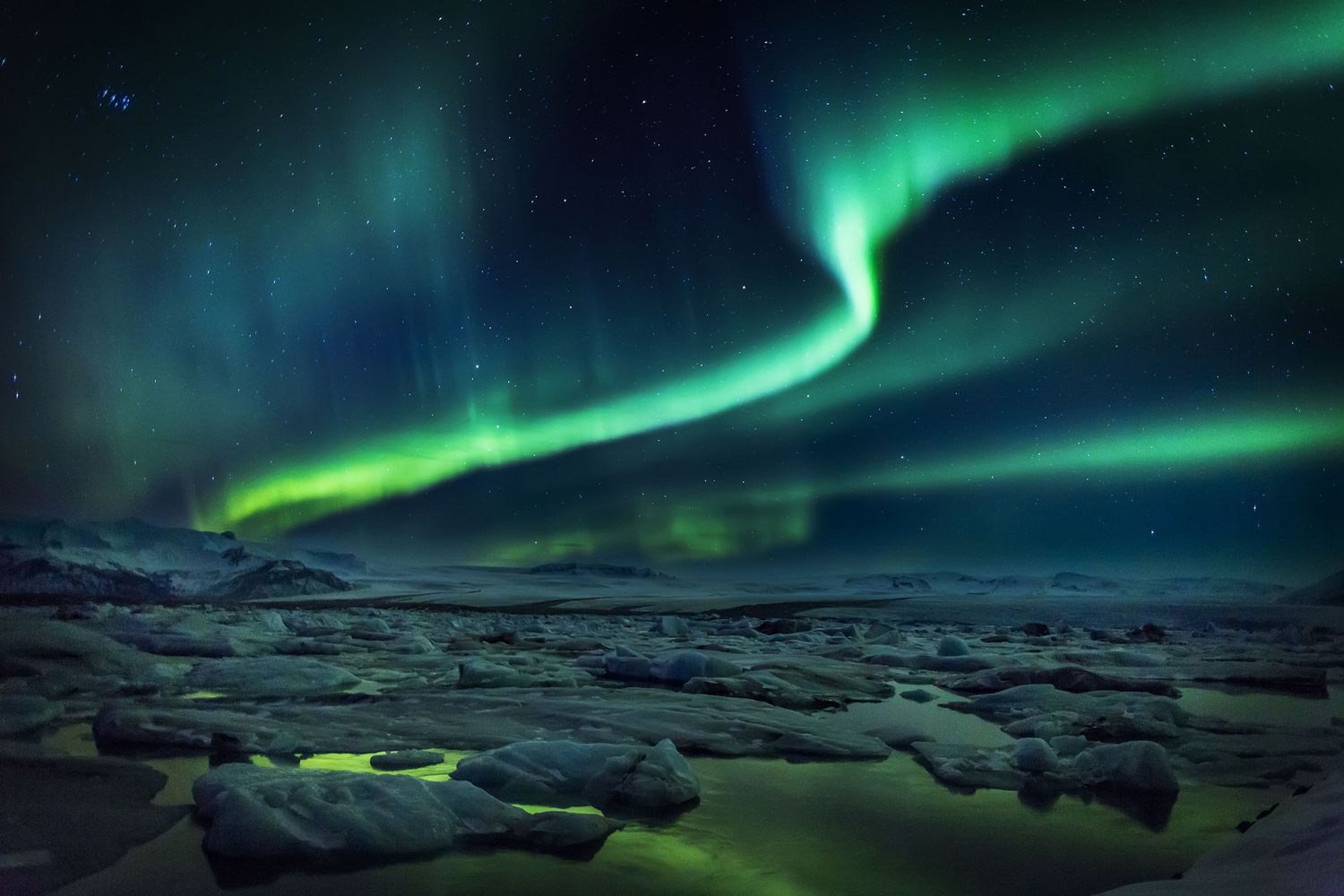
- An aurora is a natural phenomenon that is characterised by a display of a natural-coloured (green, red, yellow, or white) light in the sky.
- What causes it?
- It is a light show which is caused when electrically-charged particles from the sun interact with the Earth’s magnetosphere and atmosphere.
- Solar particles interact with different types of gas molecules in the atmosphere, mostly nitrogen and oxygen, resulting in unique, colored displays of light.
- Oxygen gives off green and red light, while nitrogen glows blue and reddish-purple.
- It is sometimes referred to as ‘polar light’. It is predominantly seen in regions of high altitudes like the Arctic and Antarctic.
- In the Northern Hemisphere, the phenomenon is called the northern lights (aurora borealis), while in the Southern Hemisphere; it’s called the southern lights (aurora australis).
- Auroras can appear in various forms, like streamers, patches, arcs, scattered light, diffused light, etc.
- Do other planets have Auroras?
- Earth isn’t the only planet that experiences auroras.
- Any planet with an atmosphere and a magnetic field is likely to have auroras.
- Auroras have been observed on Saturn and Jupiter.
Q1) What is Earth’s Magnetosphere?
The magnetosphere is the region around a celestial body, such as a planet or a moon, where its magnetic field dominates the influence of the solar wind—a continuous stream of charged particles, mainly electrons and protons, emitted by the Sun.Other planets in our solar system have magnetospheres, but Earth has the strongest one of all the rocky planets.The Earth’s magnetosphere is a protective magnetic shield that plays a crucial role in shielding the planet from the solar wind and cosmic rays.
Source: NASA Shares Stunning Image Of Aurora Taken From International Space Station


 Last updated on Oct, 2026
→ UPSC 2027 Notification will be released on 13 January 2027 at upsconline.nic.in.
→ Check Nobel Prize 2026 Winners List here.
→ Download PIB PRiSM Monthly Magazine 2026 here.
→ Check UPSC Monthly Current Affairs Magazine The Recitals here.
→ Check out the latest UPSC Syllabus here.
→ Download UPSC Model Answers for Mains 2026
→ UPSC Mains Question Paper 2026 is out now for Essay & GS Paper 1, 2, 3 & 4.
→ UPSC Calendar 2027 has been released.
→ Enroll in Vajiram & Ravi’s UPSC Mains Test Series 2027 for structured answer writing practice, expert evaluation, and exam-oriented feedback.
→ Join Vajiram & Ravi’s UPSC Mentorship Program 2027 for personalized guidance, strategy planning, and one-to-one support from experienced mentors.
→ Go through the UPSC Mains Previous Year Papers to enhance your preparation.
→ UPSC has released UPSC Toppers List 2025 with the Civil Services final result on its official website.
→ Also check Best UPSC Coaching in India