Australopithecus Latest News
An unidentified early hominin fossil that might be a new species confirms that Australopithecus and Homo species lived in the same region of Africa in the same time frame.
About Australopithecus
- Australopithecus, (genus Australopithecus) is a group of extinct primates known from a series of fossils found at numerous sites in eastern, north-central, and southern Africa.
- They are the closest known relatives of our genus, Homo.
- The various species of Australopithecus lived 4.4 million to 1.4 million years ago (mya), during the Pliocene and Pleistocene epochs (which lasted from 5.3 million to 11,700 years ago).
- The genus name, meaning “southern ape,” refers to the first fossils found, which were discovered in South Africa.
- Perhaps the most famous specimen of Australopithecus is “Lucy,” a remarkably preserved fossilized skeleton from Ethiopia that has been dated to 3.2 mya.


Australopithecus Features
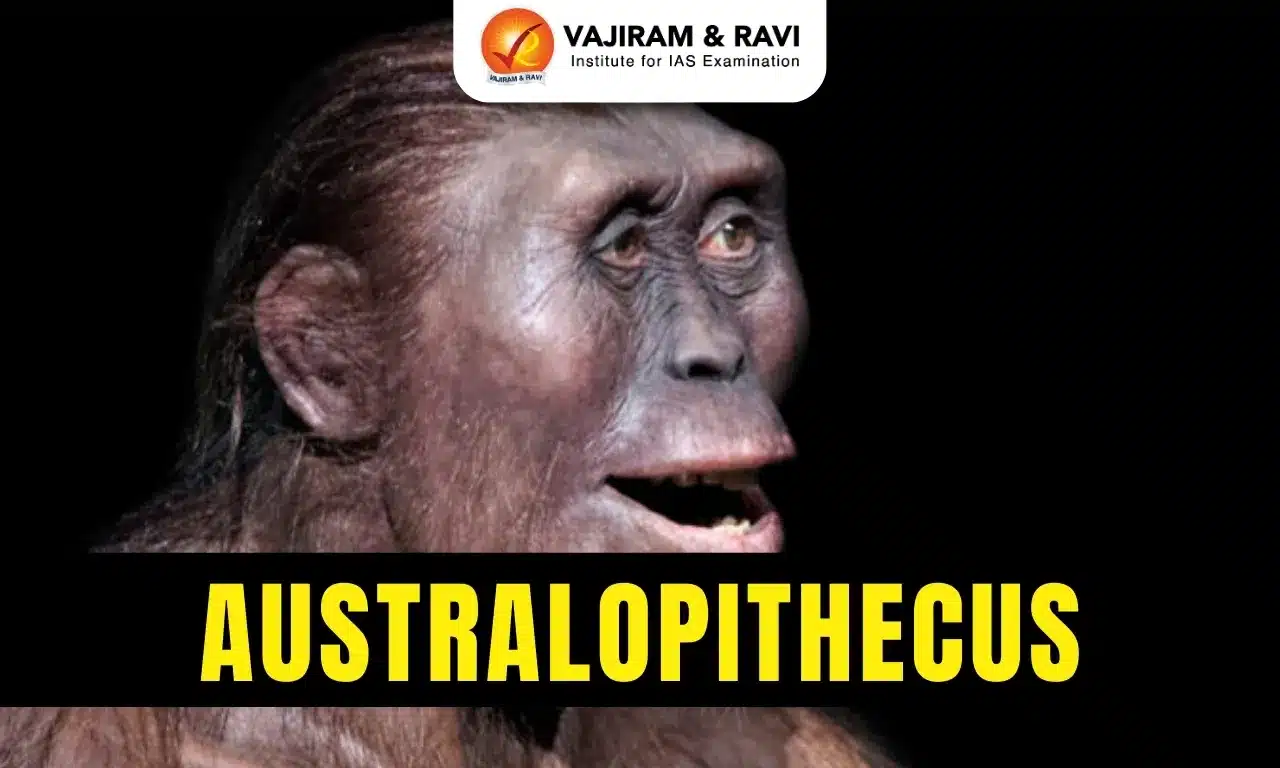
- Members of Australopithecus bore a combination of humanlike and apelike traits.
- They had apelike face proportions (a flat nose, a strongly projecting lower jaw) and braincase (with a small brain, usually less than 500 cubic centimeters – about 1/3 the size of a modern human brain), and long, strong arms with curved fingers adapted for climbing trees.
- They also had small canine teeth like all other early humans, and a body that stood on two legs and regularly walked upright.
- They were roughly 1.2-1.5 m tall and probably weighed about 30-50 kg.
- Males were almost twice the size of females, a level of difference, or sexual dimorphism, greater than modern chimpanzees or humans but less than gorillas or orangutans.
- They had mainly a plant-based diet, including leaves, fruit, seeds, roots, nuts, and insects.
Source: LS

 Last updated on Oct, 2026
→ UPSC 2027 Notification will be released on 13 January 2027 at upsconline.nic.in.
→ Check Nobel Prize 2026 Winners List here.
→ Download PIB PRiSM Monthly Magazine 2026 here.
→ Check UPSC Monthly Current Affairs Magazine The Recitals here.
→ Check out the latest UPSC Syllabus here.
→ Download UPSC Model Answers for Mains 2026
→ UPSC Mains Question Paper 2026 is out now for Essay & GS Paper 1, 2, 3 & 4.
→ UPSC Calendar 2027 has been released.
→ Enroll in Vajiram & Ravi’s UPSC Mains Test Series 2027 for structured answer writing practice, expert evaluation, and exam-oriented feedback.
→ Join Vajiram & Ravi’s UPSC Mentorship Program 2027 for personalized guidance, strategy planning, and one-to-one support from experienced mentors.
→ Go through the UPSC Mains Previous Year Papers to enhance your preparation.
→ UPSC has released UPSC Toppers List 2025 with the Civil Services final result on its official website.
→ Also check Best UPSC Coaching in India
Australopithecus FAQs
Q1. Australopithecus fossils have been primarily discovered in which regions?+
Q2. During which epochs did Australopithecus species live?+
Q3. The brain size of Australopithecus was about what fraction of the modern human brain?+
Tags: australopithecus prelims pointers upsc current affairs upsc prelims current affairs