Austria Latest News
India and Austria recently signed multiple agreements and announcements aimed at deepening bilateral cooperation across defence, trade, technology, education, and culture.
About Austria
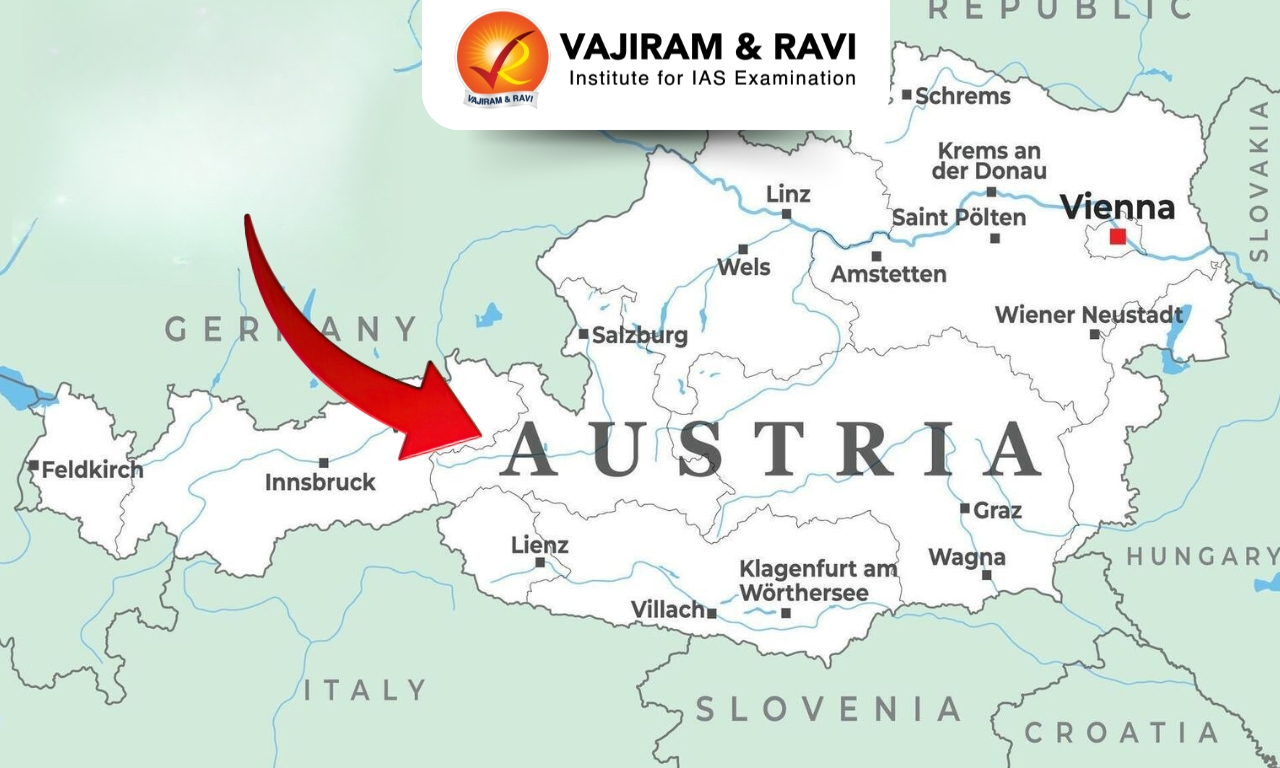
- It is a largely mountainous landlocked country of south-central Europe.
- Capital: Vienna
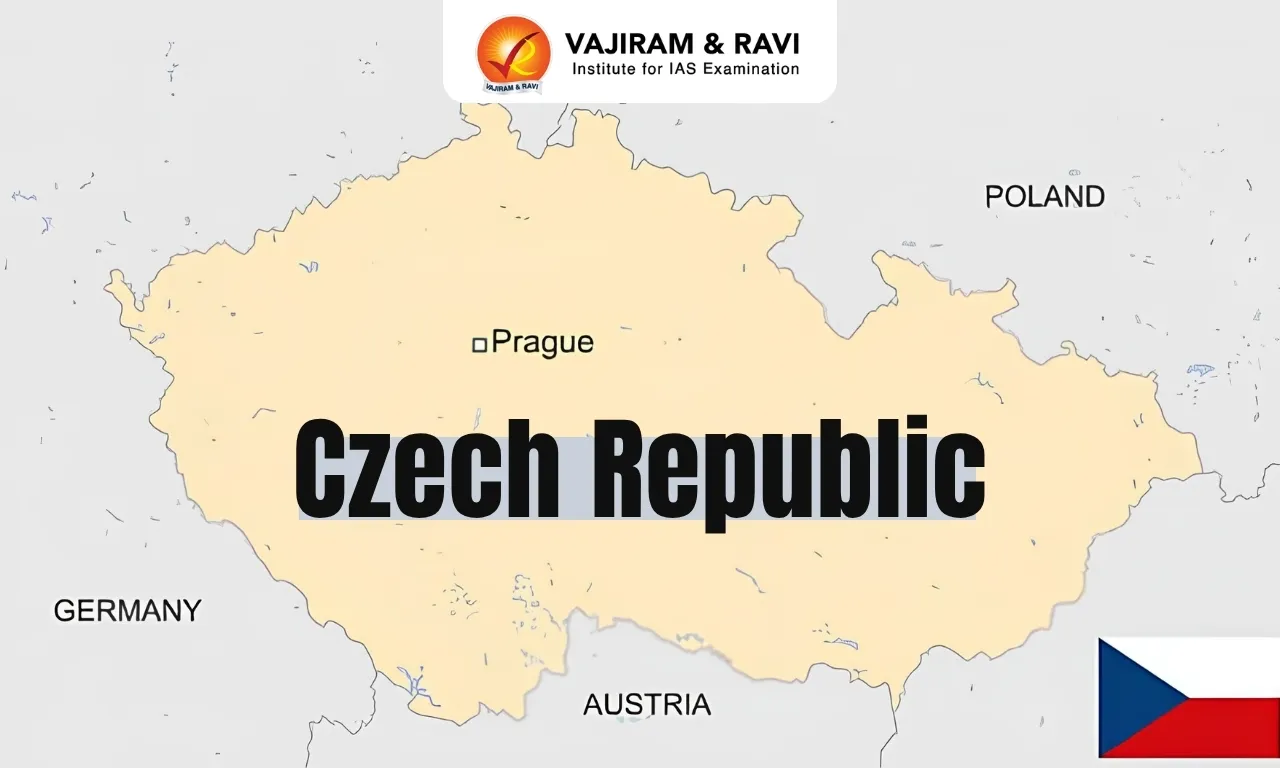
- Austria is bordered by 8 countries: by the Czech Republic in the north; by Slovakia in the northeast; by Hungary in the east; by Slovenia in the south; by Italy in the southwest; by Switzerland and Liechtenstein in the west; and by Germany in the northwest.
- Most of Austria (70%) is covered by the Alpine Region, central and west, as the Alps extend on into Austria from Switzerland.
- It has a temperate and alpine climate.
- The Danube (1,771 miles) (2,850 km) is the most significant river in the country. It’s the second-longest river in Europe and a vital waterway for commerce.
- Ethnic groups: Germans, Turks, Serbs, Croats, Slovenes, and Bosnians; other recognized minorities include Hungarians, Czechs, Slovaks, and Roma.
- Languages: The majority of the population speaks German, which is also the country’s official language. Other local official languages are Croatian, Hungarian, and Slovene.
- Political System: It is a federal parliamentary republic with a chancellor who is the head of government and a president who is the head of state.


Austria History
- The origins of Austria date back to the time of the Roman Empire when a Celtic kingdom was conquered by the Romans in approximately 15 BC and later became Noricum, a Roman province, in the mid-1st century AD—an area which mostly encloses today’s Austria.
- In 788 AD, the Frankish king Charlemagne conquered the area and introduced Christianity.
- Under the native Habsburg dynasty, Austria became one of the great powers of Europe.
- During the 18th and 19th centuries, Vienna was the European capital of classical music and an important hub of musical innovation.
- Legendary musicians like Mozart, Beethoven, Joseph Haydn, Johann Strauss II, and others are all associated with Vienna.
- In 1867, the Austrian Empire was reformed into Austria-Hungary.
- The Austro-Hungarian Empire collapsed in 1918 with the end of World War I.
- The First Austrian Republic was established in 1919.
Source: DDN

 Last updated on Oct, 2026
→ UPSC 2027 Notification will be released on 13 January 2027 at upsconline.nic.in.
→ Check Nobel Prize 2026 Winners List here.
→ Download PIB PRiSM Monthly Magazine 2026 here.
→ Check UPSC Monthly Current Affairs Magazine The Recitals here.
→ Check out the latest UPSC Syllabus here.
→ Download UPSC Model Answers for Mains 2026
→ UPSC Mains Question Paper 2026 is out now for Essay & GS Paper 1, 2, 3 & 4.
→ UPSC Calendar 2027 has been released.
→ Enroll in Vajiram & Ravi’s UPSC Mains Test Series 2027 for structured answer writing practice, expert evaluation, and exam-oriented feedback.
→ Join Vajiram & Ravi’s UPSC Mentorship Program 2027 for personalized guidance, strategy planning, and one-to-one support from experienced mentors.
→ Go through the UPSC Mains Previous Year Papers to enhance your preparation.
→ UPSC has released UPSC Toppers List 2025 with the Civil Services final result on its official website.
→ Also check Best UPSC Coaching in India
Austria FAQs
Q1. What is the capital of Austria?+
Q2. Which major mountain range covers most of Austria?+
Q3. What is the most significant river in Austria?+
Q4. What is the political system of Austria?+
Tags: austria