


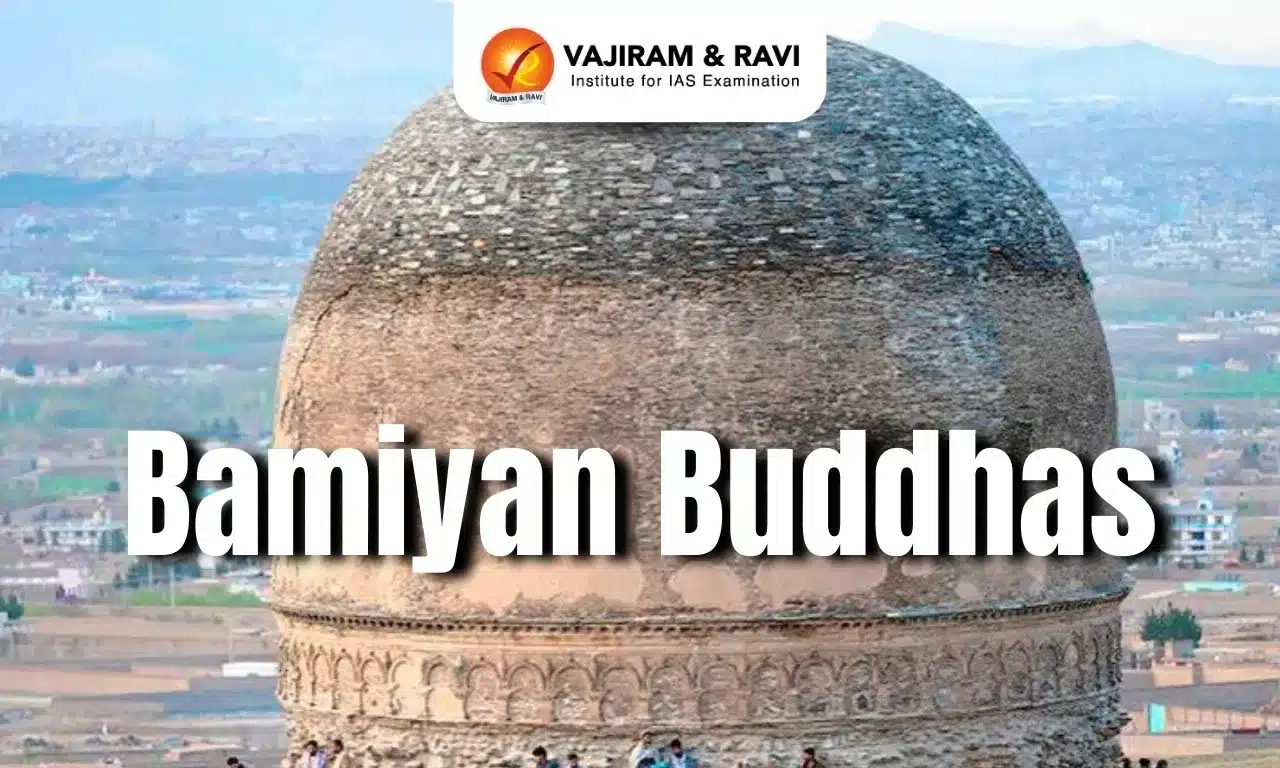
Bamiyan Buddhas Latest News
Taliban’s Changing Approach Towards Heritage Sites in Afghanistan.
About Bamiyan Buddhas
- The Bamiyan Buddhas, carved in the 6th century CE, were two monumental statues of standing Buddhas measuring 115 feet and 174 feet in height, embedded into the sandstone cliffs of Bamiyan Valley, central Afghanistan.
- These statues are considered exemplary of the Gandhara School of Buddhist Art, which reflected a unique blend of Indian, Persian, and Greco-Roman artistic influences.
- The Bamiyan Buddhas, named Salsal (meaning “light shines through the universe”) and Shamama (“Queen Mother”), stood 55 metres and 38 metres tall, respectively.
- These statues represented a fusion of Gupta, Sassanian, and Hellenistic styles, representing a unique confluence of civilisations.
- The statues represented the confluence of cultural traditions and were significant markers of the spread of Buddhism across Central and South Asia between the 1st and 13th centuries.


Background of Destruction
- The Taliban, a hardline group that emerged in the 1990s, imposed an extremist interpretation of Islamic law, which included banning art, education for girls, and public expression.
- On 27 February 2001, the Taliban officially announced its plan to demolish the Bamiyan Buddhas, deeming them un-Islamic.
- Over 25 days, the statues were systematically destroyed using explosives, marking one of the most egregious acts of cultural vandalism in modern history.
- In 2003, UNESCO designated the Bamiyan Valley as a World Heritage Site, despite the irreversible damage done.
- In 2021, a 3D holographic projection temporarily recreated the statue of Salsal, offering a new way to engage with the lost heritage.
Source: TH

 Last updated on Oct, 2026
→ UPSC 2027 Notification will be released on 13 January 2027 at upsconline.nic.in.
→ Check Nobel Prize 2026 Winners List here.
→ Download PIB PRiSM Monthly Magazine 2026 here.
→ Check UPSC Monthly Current Affairs Magazine The Recitals here.
→ Check out the latest UPSC Syllabus here.
→ Download UPSC Model Answers for Mains 2026
→ UPSC Mains Question Paper 2026 is out now for Essay & GS Paper 1, 2, 3 & 4.
→ UPSC Calendar 2027 has been released.
→ Enroll in Vajiram & Ravi’s UPSC Mains Test Series 2027 for structured answer writing practice, expert evaluation, and exam-oriented feedback.
→ Join Vajiram & Ravi’s UPSC Mentorship Program 2027 for personalized guidance, strategy planning, and one-to-one support from experienced mentors.
→ Go through the UPSC Mains Previous Year Papers to enhance your preparation.
→ UPSC has released UPSC Toppers List 2025 with the Civil Services final result on its official website.
→ Also check Best UPSC Coaching in India
Bamiyan Buddhas FAQs
Q1. Where are the Bamiyan Buddhas located?+
Q2. Why were the Bamiyan Buddhas destroyed?+
Q3. What is the historical significance of the Bamiyan Buddhas?+
Tags: bamiyan buddhas








