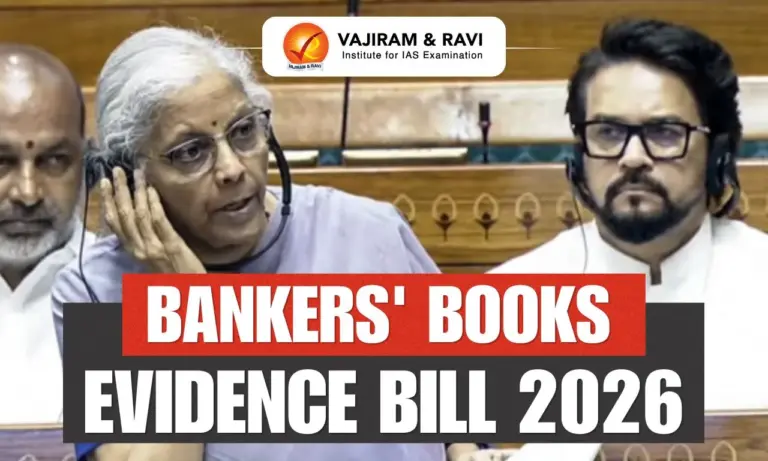
Bankers’ Books Evidence Bill 2026 Latest News
- Recently, the Lok Sabha passed the Bankers’ Books Evidence Bill, 2026, aiming to overhaul the colonial-era Bankers’ Books Evidence Act, 1891.
- While legal experts have welcomed this technological update, they have flagged concerns over data privacy and the absence of robust digital safeguards.
Why the Old Law Needed Replacement
- The 135-year-old Act allowed certified copies of bank records to be used as evidence in court, sparing bank officials the burden of physically producing original ledgers each time.
- However, the law was framed when banking records were predominantly maintained in physical form.
- With the growth of digital banking, bank records today are increasingly created, stored, and maintained using modern technology — necessitating a modernised legal framework.


Key Change: Expanded Definition of “Bankers’ Books”
- Old law: Defined bankers’ books narrowly as records “kept in written form or stored in a micro film, magnetic tape or in any other form of mechanical or electronic data retrieval mechanism.”
- 2026 Bill: Recognises records stored in electronic or digital form, whether onsite, offsite, or in virtual/cloud locations — bringing the law in line with contemporary banking practices.
Standardising Digital Evidence
- To ensure courts can trust digital records, the Bill introduces specific certificate formats and conditions for presenting such evidence.
- Experts compared this to the Section 63 certificate required for electronic evidence under the Bharatiya Sakshya Adhiniyam, calling it a major improvement — it provides a defined format and undertakings so courts can be satisfied of a copy’s genuineness.
Clarifying “Special Cause”
- Under the 1891 Act, bank officers could not be compelled to produce records or appear as witnesses in cases where the bank wasn’t a party — unless a court ordered it for “special cause,” a term the old Act never defined.
- The 2026 Bill defines “special cause” as situations where:
- The accuracy of the record is doubtful;
- Regular record-keeping has been interrupted;
- The bank disobeys an inspection order.
- Analysts noted this will streamline commercial litigation, such as cheque bounce cases, since bank officials won’t be dragged into court unnecessarily, and electronic records can be directly admitted as evidence — reducing case lifespans.
Concern Over Police Powers
- Section 11 of the Bill allows court orders compelling production of bank records for investigations to be treated as orders from an officer not below the rank of Superintendent of Police (SP).
- This is not a new power — Section 8 of the 1891 Act contained an identical provision. Expertscalled concerns over this a “red herring.”
- However, others pointed out that since records are now electronic, they can be obtained and shared far more easily (even via phone), raising the risk of data leaks and privacy breaches — unlike physical books, which were harder to copy or share.
- They suggested such access should require court authorisation.
Missed Opportunities: Data Protection Gaps
- No safeguards like hash values: The Bill should have incorporated hash values — a unique digital fingerprint verifying that an electronic file hasn’t been tampered with — to preserve evidence integrity, since lawyers and judges currently struggle to prove or disprove digital documents.
- No data protection framework: Experts questioned whether Indian banks are prepared for data leaks and manipulation, noting the Bill doesn’t address data protection at all.
- Unrealistic certification burden: Analsts criticised the Bill’s requirement that a branch head certify that the bank’s network and devices are secure from cyber threats.
- In a centralised banking environment, branch managers typically lack knowledge of the data centre or cloud provider’s cybersecurity status.
- Hence, experts suggested a modular certification system with designated technical officers instead.
- Section 4 concerns: This provision lets the Union government extend the law’s provisions to any financial entity via notification. Critics warned that loosely regulated digital lenders or fintech platforms shouldn’t automatically receive the same reliability presumption as scheduled commercial banks without Parliamentary approval.
- Litigation risk from wholesale replacement: Replacing the Act entirely could cause interpretation issues, as parties dispute whether new definitions apply to ongoing trials — with pending cases likely to be the “first casualty.”
Conclusion
- The Bill rightly modernises a 135-year-old law to reflect India’s digital banking reality, easing litigation and standardising electronic evidence.
- Yet, without robust safeguards like tamper-proof verification and clear data protection provisions, this legal upgrade risks creating new vulnerabilities even as it resolves old ones.
Source: IE

 Last updated on Oct, 2026
→ UPSC 2027 Notification will be released on 13 January 2027 at upsconline.nic.in.
→ Check Nobel Prize 2026 Winners List here.
→ Download PIB PRiSM Monthly Magazine 2026 here.
→ Check UPSC Monthly Current Affairs Magazine The Recitals here.
→ Check out the latest UPSC Syllabus here.
→ Download UPSC Model Answers for Mains 2026
→ UPSC Mains Question Paper 2026 is out now for Essay & GS Paper 1, 2, 3 & 4.
→ UPSC Calendar 2027 has been released.
→ Enroll in Vajiram & Ravi’s UPSC Mains Test Series 2027 for structured answer writing practice, expert evaluation, and exam-oriented feedback.
→ Join Vajiram & Ravi’s UPSC Mentorship Program 2027 for personalized guidance, strategy planning, and one-to-one support from experienced mentors.
→ Go through the UPSC Mains Previous Year Papers to enhance your preparation.
→ UPSC has released UPSC Toppers List 2025 with the Civil Services final result on its official website.
→ Also check Best UPSC Coaching in India
Bankers' Books Evidence Bill 2026 FAQs
Q1. What is the Bankers' Books Evidence Bill 2026? +
Q2. How does the Bankers' Books Evidence Bill 2026 recognise digital records?+
Q3. What safeguards are missing from the Bankers' Books Evidence Bill 2026?+
Q4. How does the Bankers' Books Evidence Bill 2026 address special cause? +
Q5. Why is the Bankers' Books Evidence Bill 2026 important? +
Tags: bankers’ books evidence bill 2026 mains articles upsc current affairs upsc mains current affairs