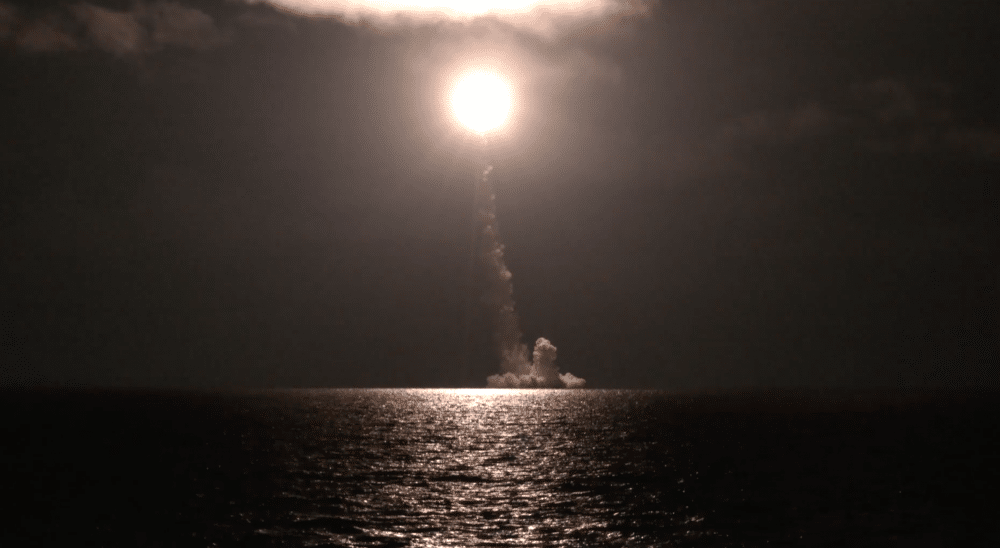
About Bulava Ballistic Missile
- It is a new Russian submarine-launched Intercontinental Ballistic Missile (ICBM).
- Development of this missile commenced in 1998. The first powered flight test of the Bulava missile occurred in September 2005. It’s first submerged test launch followed in December.
- It was designed to be deployed onto Russia’s Borey-class ballistic missile submarines (SSBN’s).
- Features:
- It was designed to be the backbone of Moscow’s nuclear triad and has a range of over 8,000 kilometres (close to 5,000 miles).
- It is 12-13.5 m in length and has a diameter of approximately 2.0 m.
- Launch Weight: 36,800 kg
- It is a three-stage solid-fuel missile.
- It is designed to carry multiple warheads. Each warhead will strike a different target.
- It can carry 6 Multiple Independent Re-entry Vehicles (MIRVs). These MIRVs capable of maneuvering in-flight and re-targeting, in order to outmaneuver hostile air defenses.
- It is stated that this missile has an accuracy of 350 m.
What is a Ballistic Missile?
- It is a rocket-propelled self-guided strategic weapon system that follows a ballistic trajectory to deliver a payload from its launch site to a predetermined target.
- Ballistic missiles are powered initially by a rocket or series of rockets in stages, but then follow an unpowered trajectory that arches upwards before descending to reach their intended target.
- Ballistic missiles can carry either nuclear or conventional warheads.
Q1) What is a Multiple Independent Re-entry Vehicle (MIRV)?
MIRVs were originally developed in the early 1960s to permit a missile to deliver multiple nuclear warheads to different targets. In contrast to a traditional missile, which carries one warhead, MIRVs can carry multiple warheads.Warheads on MIRVed missiles can be released from the missile at different speeds and in different directions. Some MIRVed missiles can hit targets as far as 1,500 kilometers apart. Although MIRVs were not initially intended to defeat ballistic missile defenses, they are much more difficult to defend against than traditional missiles.
Source: Russia’s new nuclear submarine successfully test launches Bulava ballistic missile


 Last updated on Oct, 2026
→ UPSC 2027 Notification will be released on 13 January 2027 at upsconline.nic.in.
→ Check Nobel Prize 2026 Winners List here.
→ Download PIB PRiSM Monthly Magazine 2026 here.
→ Check UPSC Monthly Current Affairs Magazine The Recitals here.
→ Check out the latest UPSC Syllabus here.
→ Download UPSC Model Answers for Mains 2026
→ UPSC Mains Question Paper 2026 is out now for Essay & GS Paper 1, 2, 3 & 4.
→ UPSC Calendar 2027 has been released.
→ Enroll in Vajiram & Ravi’s UPSC Mains Test Series 2027 for structured answer writing practice, expert evaluation, and exam-oriented feedback.
→ Join Vajiram & Ravi’s UPSC Mentorship Program 2027 for personalized guidance, strategy planning, and one-to-one support from experienced mentors.
→ Go through the UPSC Mains Previous Year Papers to enhance your preparation.
→ UPSC has released UPSC Toppers List 2025 with the Civil Services final result on its official website.
→ Also check Best UPSC Coaching in India