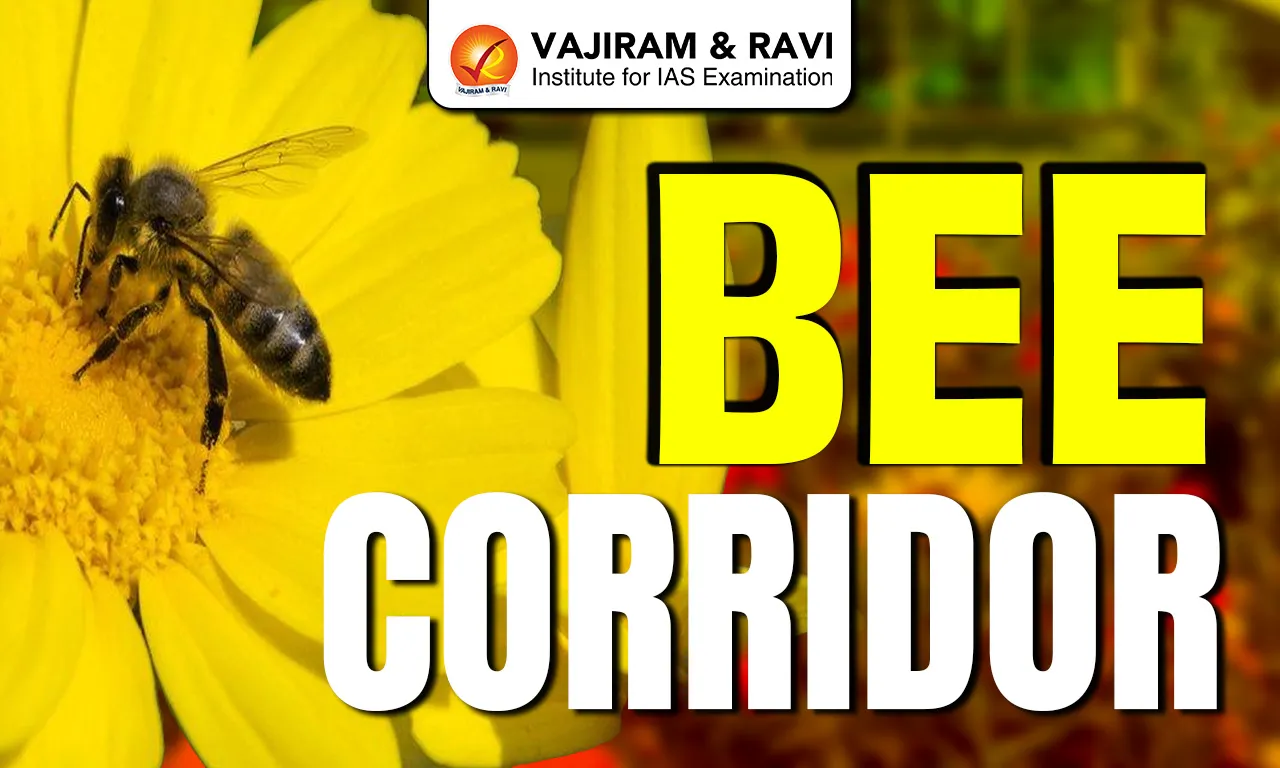
The National Highways Authority of India (NHAI) announced a first-of-its-kind initiative to develop Bee Corridors (pollinator corridors) along stretches of national highways in India under its sustainable infrastructure programme.
What is a Bee Corridor?
A Bee Corridor is a continuous linear stretch of flowering trees, shrubs, herbs, and grasses that provide nectar and pollen throughout the year through staggered seasonal flowering patterns.
Bee Corridors Objective
The programme aims to transform ornamental roadside plantations into ecologically functional green corridors that support pollinators and strengthen environmental sustainability.


Need for Bee Corridors
Pollinators, especially bees, are facing increasing ecological stress due to habitat loss, excessive use of pesticides, monoculture farming, and the impacts of climate change. The expansion of urban areas, highways, and industrial zones has reduced the availability of natural flowering plants that provide nectar and pollen. As pollinator populations decline, agricultural productivity and horticultural output are also affected because a large share of crops depend on insect pollination. This poses risks to food security, farmer incomes, and overall ecological balance.
Bee Corridors Programme Implementation
- Pollinator corridors will be developed along selected highway stretches and unused NHAI land parcels.
- Flowering clusters will be planted at intervals of about 500 metres to 1 kilometre, matching the typical foraging range of bees.
- Around 40 lakh trees are proposed to be planted during 2026–27, with nearly 60% under the Bee Corridor programme.
- In the initial phase, at least three dedicated pollinator corridors will be developed across different regions.
- The plantations will prioritise native and nectar-rich species such as Neem, Karanj, Mahua, Palash, Bottle Brush, Jamun, and Siris.
- Natural elements like flowering weeds, dead wood, and hollow trunks will also be retained to create suitable habitats for pollinators.

 Last updated on Oct, 2026
→ UPSC 2027 Notification will be released on 13 January 2027 at upsconline.nic.in.
→ Check Nobel Prize 2026 Winners List here.
→ Download PIB PRiSM Monthly Magazine 2026 here.
→ Check UPSC Monthly Current Affairs Magazine The Recitals here.
→ Check out the latest UPSC Syllabus here.
→ Download UPSC Model Answers for Mains 2026
→ UPSC Mains Question Paper 2026 is out now for Essay & GS Paper 1, 2, 3 & 4.
→ UPSC Calendar 2027 has been released.
→ Enroll in Vajiram & Ravi’s UPSC Mains Test Series 2027 for structured answer writing practice, expert evaluation, and exam-oriented feedback.
→ Join Vajiram & Ravi’s UPSC Mentorship Program 2027 for personalized guidance, strategy planning, and one-to-one support from experienced mentors.
→ Go through the UPSC Mains Previous Year Papers to enhance your preparation.
→ UPSC has released UPSC Toppers List 2025 with the Civil Services final result on its official website.
→ Also check Best UPSC Coaching in India
Bee Corridors FAQs
Q1. What is a Bee Corridor?+
Q2. Why has the Bee Corridor initiative been launched?+
Q3. Who is implementing the Bee Corridor programme?+
Q4. What types of plants will be used in Bee Corridors?+
Q5. What are the expected benefits of Bee Corridors?+
Tags: bee corridors