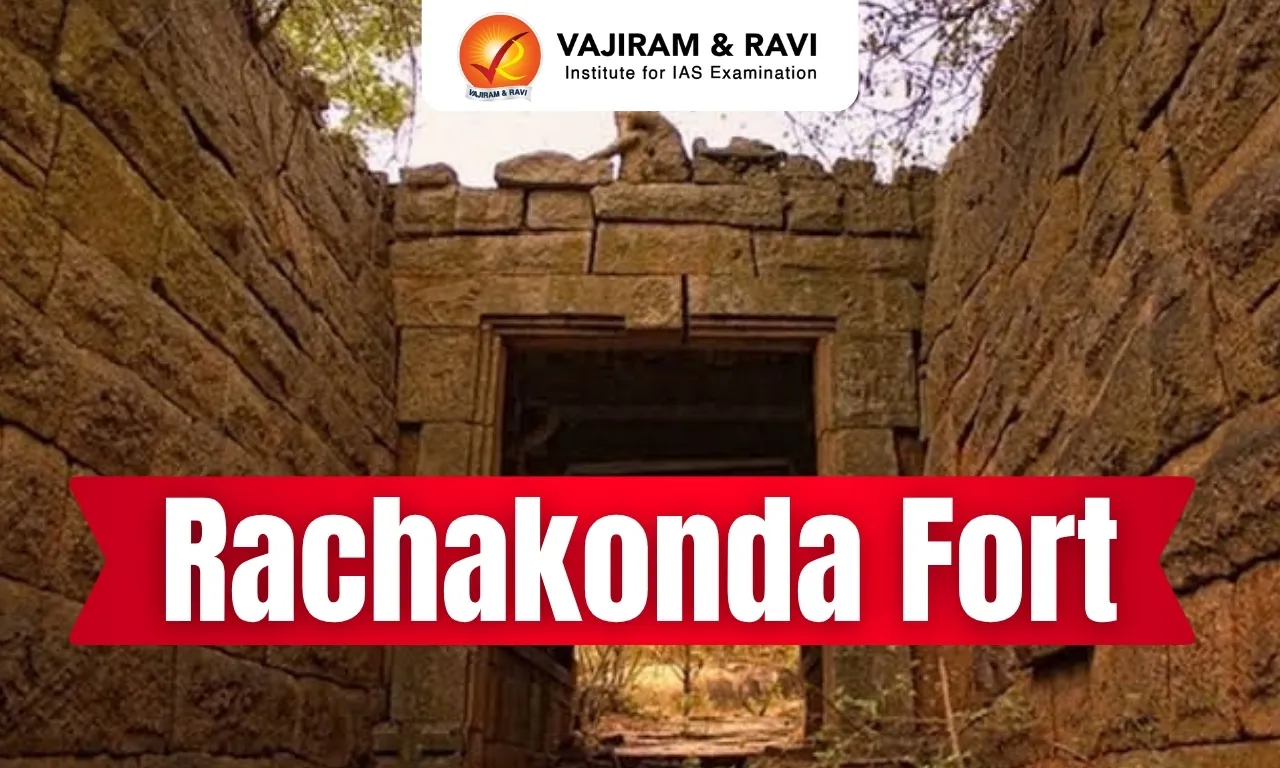
About Bidar Fort:
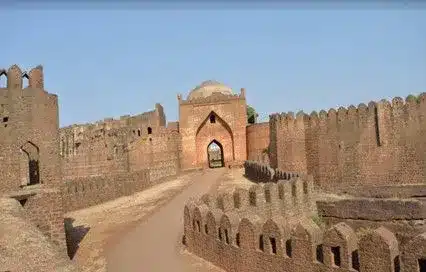
- Bidar Fort is situated in Bidar city of the northern plateau of Karnataka, India.
- The history of Bidar Fort dates back over 500 years, starting with the reign of the Western Chalukya dynasty.
- Sultan Ahmed Shah Wali of the Bahmani dynasty made Bidar his capital in 1430 and renovated it as an impressive citadel.
- Arcitecture:
- It had been built of trap rock. Stone and mortar were used to build the fort-walls.
- The entrance gate has a lofty dome, the interior of which had been painted in bright colours.
- Bidar Fort includes:
- Islamic and Persian architecture,
- Seven main entrances,
- 37 bastions (Balcony like structures extending from the fort) of octagonal shape with metal shielded cannons,
- Mosques and mahals,
- Thirty plus Islamic monuments.
About Bahmani Kingdom:
- The Bahmani Kingdom rose to power after the Turkish Governor Ala-ud-din Hassan Bahman Shan established an independent empire by revolting against the Sultan of Delhi Sultanate, Muhammad Bin Tughlaq in 1347.
- It was the first independent Islamic kingdom in South India that rose to power.
- It was established in present-day Karnataka, Maharashtra, and Andhra Pradesh.
- They set up the capital in Ahsanabad (Gulbarga) between 1347 and 1425 and later moved to Bidar.
- There were a total of fourteen sultans ruling over this kingdom. Among them, Alauddin Bahman Shah, Muhammad Shah I and Firoz Shah were important.
- The Bahmani kingdom reached its peak under the guidance of Mahmud Gawan, who served with great distinction as Prime Minister of three Bahamni Sultans for about twenty-three years from 1458 to 1481 AD.
- Mahmud Gawan extended the empire by reconquering Goa, which was under the Vijayanagar Empire at the time.
- Around 1518, Krishnadeva Raya of the Vijayanagar Empire defeated the last ruler of the Bahmani Empire.
Q1. Who was Krishnadevaraya?
The greatest emperor in the Vijayanagar empire’s history was Krishnadevaraya(17 January 1471-17 October 1529). He presided over the Tuluva Dynasty as its third king. By overthrowing the sultans of Bijapur, Golconda, the Bahmani Sultanate, and the Gajapatis of Odisha, he rose to power.
News: Bidar fort, Gol Gumbaz and more: Waqf claims 53 ASI sites in Karnataka


 Last updated on Oct, 2026
→ UPSC 2027 Notification will be released on 13 January 2027 at upsconline.nic.in.
→ Asian Games 2026 are being held in Aichi-Nagoya, Japan, from 19 September to 4 October.
→ Check out the latest UPSC Syllabus here.
→ Download UPSC Model Answers for Mains 2026
→ UPSC Mains Question Paper 2026 is out now for Essay & GS Paper 1, 2, 3 & 4.
→ UPSC Calendar 2027 has been released.
→ Enroll in Vajiram & Ravi’s UPSC Mains Test Series 2027 for structured answer writing practice, expert evaluation, and exam-oriented feedback.
→ Join Vajiram & Ravi’s UPSC Mentorship Program 2027 for personalized guidance, strategy planning, and one-to-one support from experienced mentors.
→ Go through the UPSC Mains Previous Year Papers to enhance your preparation.
→ UPSC has released UPSC Toppers List 2025 with the Civil Services final result on its official website.
→ Download PIB PRiSM Monthly Magazine 2026 here.
→ Also check Best UPSC Coaching in India