UY Scuti is known as the Biggest Star in the Universe in the Milky Way and ranks among the most massive ever identified. Its size surpasses the Sun by over 1,700 times, making it an astronomical giant. More than 5 billion Suns could fit inside UY Scuti. However, despite its vast expanse, its mass is only about ten times that of the Sun, while its luminosity is nearly 100,000 times greater. This Biggest Star in the Universe is currently in its final evolutionary stages, having expanded significantly. In the future, it is expected to end its life in a dramatic supernova explosion, potentially giving rise to a neutron star or a black hole.
UY Scuti
UY Scuti is situated in the Scutum constellation, is one of the Biggest Star in the Universe having a radius approximately 1,700 times that of the Sun. Despite its staggering size, its vast distance of about 9,500 light-years makes detailed observations difficult. As a red supergiant, UY Scuti has a relatively cool surface temperature and continues to amaze astronomers due to its immense scale and evolving nature.
Top 10 Biggest Stars in the Universe
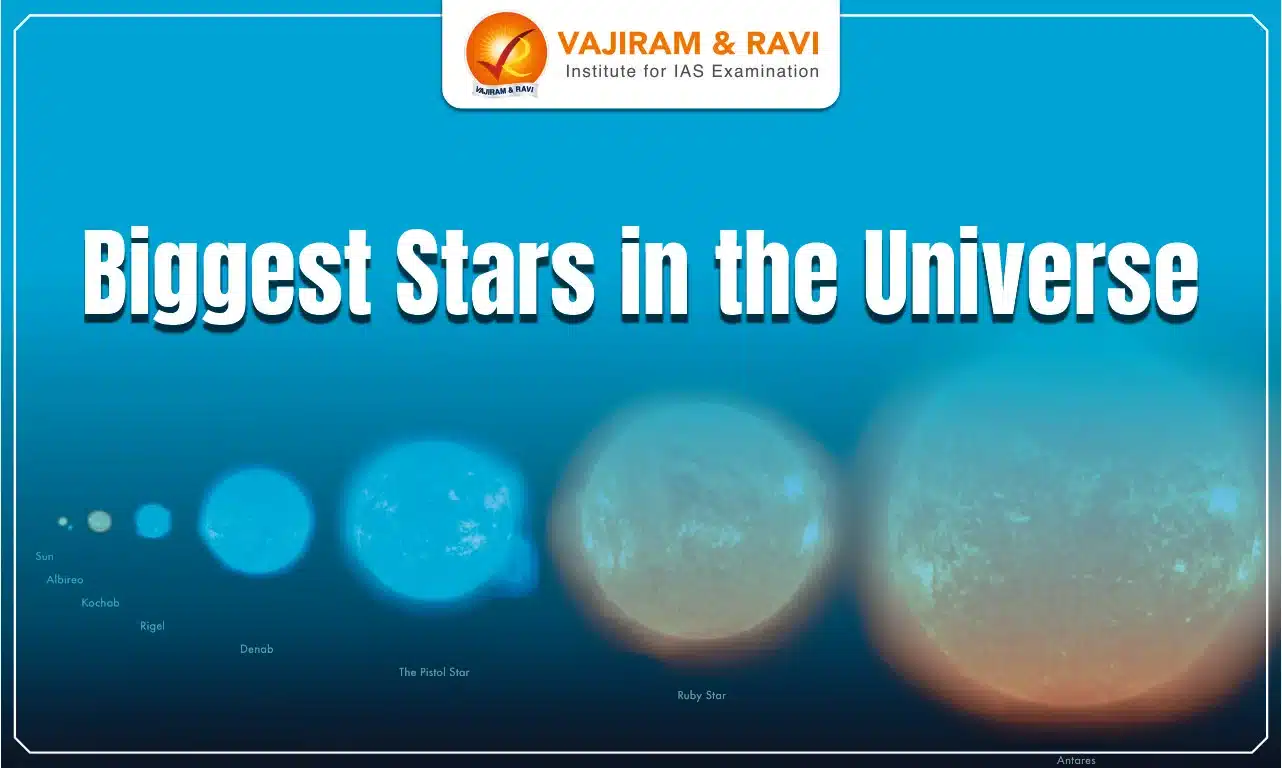
The table below includes the Top 10 Biggest Stars in the Universe known stars, along with their respective constellations, estimated radii, and distances from Earth.
| Top 10 Biggest Stars in the Universe | ||||
| Rank | Stars | Constellation | Distance (light year) | Diameter (solar radii) |
|
1. |
UY Scuti |
Scutum |
5,900 |
1,700 |
|
2. |
VY Canis Majoris |
Canis Majoris |
3,900 |
>1,500 |
|
3. |
RW Cephei |
Cepheus |
3,500 |
1,530 |
|
4. |
V354 Cephei |
Cepheus |
8,900 |
1,520 |
|
5. |
KY Cygni |
Cygnus |
5,000 |
1,430 |
|
6. |
Mu Cephei |
Cepheus |
2,838 |
1,200 |
|
7. |
VV Cephei A |
Cepheus |
5,000 |
1,050 |
|
8. |
KW Sagittarii |
Sagittarius |
6,200 |
1,090 |
|
9. |
Betelgeuse |
Orion |
640 |
887 |
|
10. |
Antares |
Scorpius |
550 |
832 |


Biggest Stars in the Universe
The universe is home to some of the most luminous stars, surpassing our Sun in both size and brightness. These celestial bodies are typically located thousands of light-years away, with some reaching astonishing radii over 2,000 times that of the Sun. Studying these stars provides valuable insights into stellar evolution, supernova events, and the formation of neutron stars or black holes.
UY Scuti – The Largest Known Star
UY Scuti, located in the Scutum constellation, holds the title of the Biggest Stars in the Universe. UY Scuti is about 9,500 light-years away, making it difficult to observe in detail. It is classified as a variable star, meaning its brightness fluctuates over time. Currently, UY Scuti is in the final stages of its life cycle and will eventually explode in a supernova, potentially leaving behind a neutron star or a black hole.
Stephenson 2-18 – The Second Largest Star
Stephenson 2-18 is another red supergiant found in the Scutum constellation, and has an even greater radius of approximately 2,150 times that of the Sun. Located nearly 19,000 light-years away, it is one of the most massive and luminous stars known. Its vast size and brightness contribute to our understanding of the extreme limits of stellar evolution.
VY Canis Majoris
VY Canis Majoris, situated in the Canis Major constellation, is one of the largest and most massive stars ever recorded. With a radius of about 1,420 times that of the Sun, this hypergiant is located 3,900 light-years away.
Betelgeuse
Betelgeuse, a red supergiant in the Orion constellation, is one of the most easily visible stars in the night sky. It has a radius of approximately 950 times that of the Sun and is relatively close, at 643 light-years away. Its brightness varies, indicating that it is approaching the final stages of its life cycle. Astronomers predict that Betelgeuse may explode in a supernova within the next few thousand years, providing an incredible cosmic spectacle.
Pistol Star
The Pistol Star, located in the Sagittarius constellation, is a blue hypergiant known for its extreme mass and brightness. While its exact dimensions vary, it is among the most massive stars in the universe. Situated 25,000 light-years away, its luminosity makes it an important object of study for understanding the formation of massive stars.
Antares
Antares, a red supergiant in the Scorpius constellation, has a radius of about 680 times that of the Sun. Recognized for its deep red hue, it is located 550 light-years away and is a binary star system, helping astronomers explore stellar life cycles and mass transfer in binary systems.
Rigel
Rigel, another massive star in Orion, is a blue supergiant with a radius 78 times that of the Sun. Despite being 860 light-years away, it remains one of the brightest stars visible in the night sky. Its high luminosity makes it a key object for studying stellar evolution.
Aldebaran
Aldebaran is located in the Taurus constellation, is an orange giant with a radius 44.2 times that of the Sun. At just 65 light-years away, it is one of the closest and most easily visible stars from Earth. Often referred to as the “Eye of the Bull,” Aldebaran plays an important role in astronomical navigation and observational studies.
KY Cygni
KY Cygni is found in the Cygnus constellation, is another massive red supergiant, having a radius of approximately 1,420 times that of the Sun. At a distance of 5,000 light-years, it is known for its brightness fluctuations, making it a key target for studying variable stars and their impact on the surrounding space environment.
Westerlund 1 W26
Westerlund 1 W26 is a red supergiant located in the Ara constellation. Though its exact size is uncertain, it is one of the largest stars within the Westerlund 1 cluster, a group of extremely young and massive stars. This star provides insight into how massive stars evolve within dense stellar environments.

 Last updated on Oct, 2026
→ UPSC 2027 Notification will be released on 13 January 2027 at upsconline.nic.in.
→ Asian Games 2026 are being held in Aichi-Nagoya, Japan, from 19 September to 4 October.
→ Check Nobel Prize 2026 Winners List here.
→ Download PIB PRiSM Monthly Magazine 2026 here.
→ Check UPSC Monthly Current Affairs Magazine The Recitals here.
→ Check out the latest UPSC Syllabus here.
→ Download UPSC Model Answers for Mains 2026
→ UPSC Mains Question Paper 2026 is out now for Essay & GS Paper 1, 2, 3 & 4.
→ UPSC Calendar 2027 has been released.
→ Enroll in Vajiram & Ravi’s UPSC Mains Test Series 2027 for structured answer writing practice, expert evaluation, and exam-oriented feedback.
→ Join Vajiram & Ravi’s UPSC Mentorship Program 2027 for personalized guidance, strategy planning, and one-to-one support from experienced mentors.
→ Go through the UPSC Mains Previous Year Papers to enhance your preparation.
→ UPSC has released UPSC Toppers List 2025 with the Civil Services final result on its official website.
→ Also check Best UPSC Coaching in India
Biggest Stars in the Universe FAQs
Q1. Which is bigger, Betelgeuse or UY Scuti?+
Q2. What are the stars in order from largest to smallest?+
Q3. What star is 100x bigger than the sun?+
Q4. Is Stephenson 218 bigger than UY Scuti?+
Q5. What is the 2nd largest star?+
Tags: biggest stars in the universe