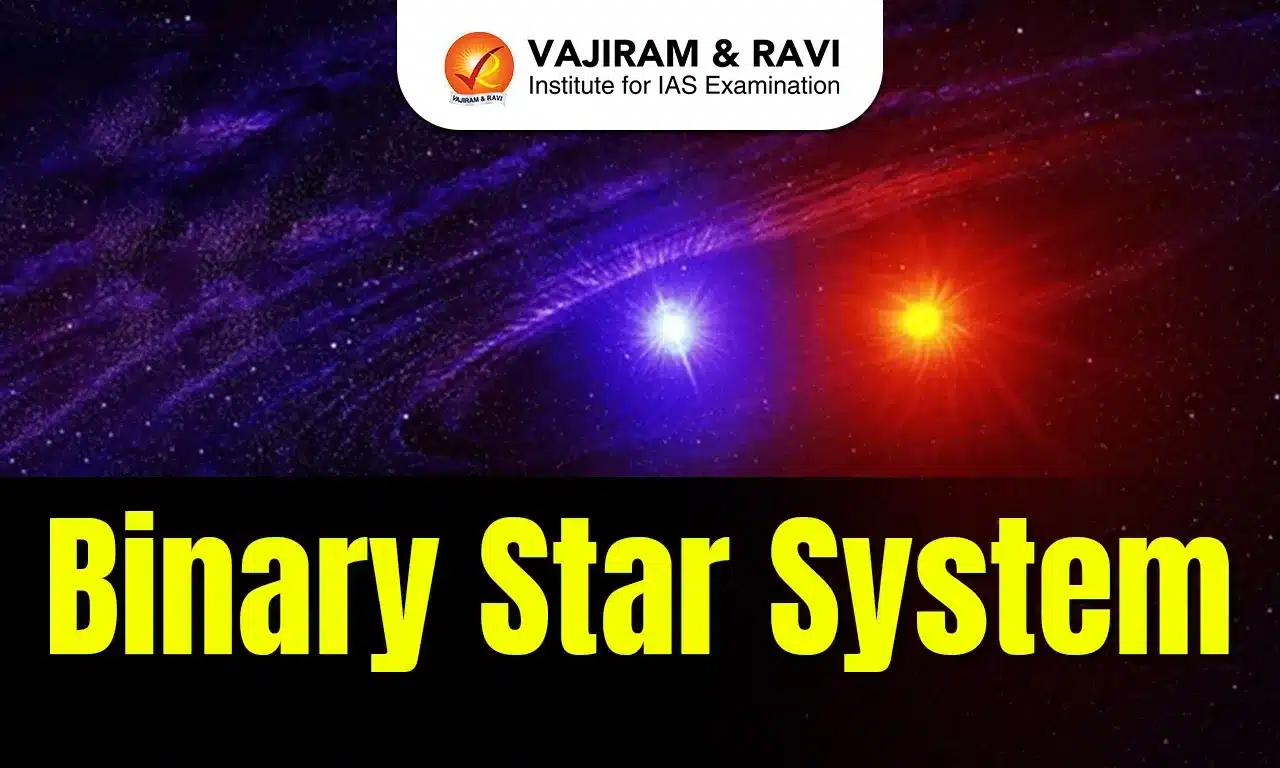
Binary Star System Latest News
A large team of astronomers and astrophysicists affiliated with several institutions in China recently discovered a binary star system, where one of the stars is a millisecond pulsar and the other is made mostly of helium.
About Binary Star System
- A binary star is a system of two gravitationally bound stars that orbit a common center of mass called a barycenter.
- Stars in a binary system do not necessarily have the same mass, size, or brightness.
- The larger star of a binary couple is called the primary star, while the smaller one is known as the secondary star or the companion star.
- Binary stars are double stars, but not all double stars are binary stars.
- This is because some double stars comprise two stars close enough in the sky over Earth to appear as a single point of light, but they are actually vastly separated in space and not part of a gravitationally bound binary system–these are called optical doubles.
- Unlike the sun, the vast majority of stars have a binary partner. It is estimated that around 85% of stars exist in binary star systems or systems with three or more stars.
- Binary star systems can also include systems containing a normal star and a stellar remnant, an object that forms when a star runs out of the fuel for nuclear fusion and collapses under its own gravity.
- These dense and compact star “corpses” can include white dwarfs, neutron stars, and black holes.
- Especially ancient binary systems can contain two stellar remnants orbiting each other.
- In some binary systems, the stars are so close together that they exchange material. This mass transfer occurs when the radius of one star is not much smaller than the orbital separation between the stars.


Binary Star System FAQs
Q1: What is a binary star system?
Ans: It is a system of two gravitationally bound stars that orbit a common center of mass called a barycenter.
Q2: What is the common center of mass around which binary stars orbit called?
Ans: Barycenter
Q3: When can mass transfer occur between stars in a binary system?
Ans: When the radius of one star is not much smaller than the orbital separation between the stars.
Source: PHYS

 Last updated on Oct, 2026
→ UPSC 2027 Notification will be released on 13 January 2027 at upsconline.nic.in.
→ Check Nobel Prize 2026 Winners List here.
→ Download PIB PRiSM Monthly Magazine 2026 here.
→ Check UPSC Monthly Current Affairs Magazine The Recitals here.
→ Check out the latest UPSC Syllabus here.
→ Download UPSC Model Answers for Mains 2026
→ UPSC Mains Question Paper 2026 is out now for Essay & GS Paper 1, 2, 3 & 4.
→ UPSC Calendar 2027 has been released.
→ Enroll in Vajiram & Ravi’s UPSC Mains Test Series 2027 for structured answer writing practice, expert evaluation, and exam-oriented feedback.
→ Join Vajiram & Ravi’s UPSC Mentorship Program 2027 for personalized guidance, strategy planning, and one-to-one support from experienced mentors.
→ Go through the UPSC Mains Previous Year Papers to enhance your preparation.
→ UPSC has released UPSC Toppers List 2025 with the Civil Services final result on its official website.
→ Also check Best UPSC Coaching in India
Tags: Binary Star System prelims pointers upsc prelims current affairs