


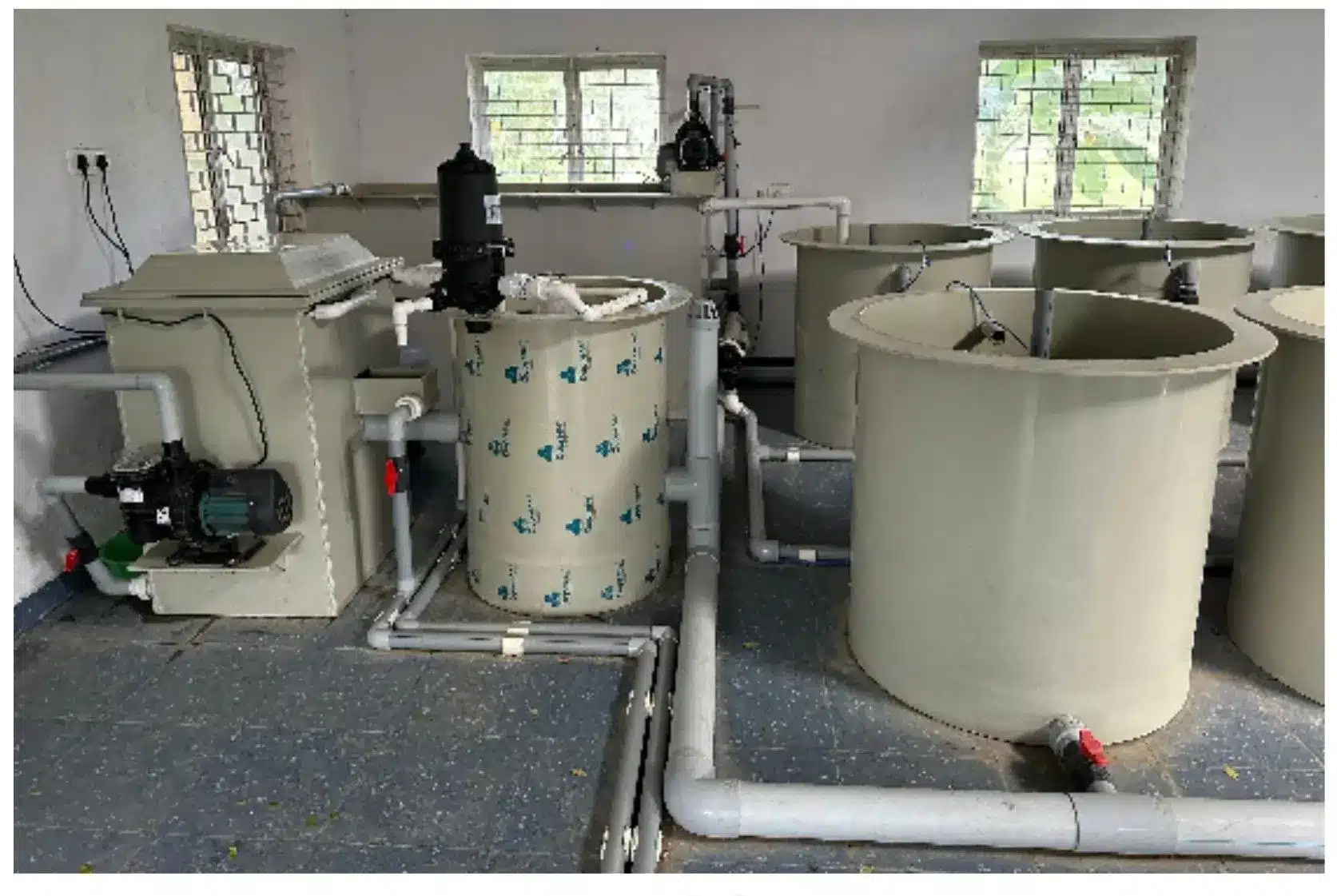
About Biofloc Technology and Recirculating Aquaculture Systems:
- Biofloc Technology is a closed tank-based fish farming approach which cleans the water in fish tanks by using beneficial bacteria.
- Heterotrophic bacteria (commonly Bacillus, Pseudomonas, Nitrosomonas, Nitrobacter, Acinetobacter, and Alcaligenes) are used to convert organic waste (such as uneaten feed and fish waste) into microbial biomass, which can then be consumed by the fish or shrimp.
- Advantages
- This process keeps the water clean without needing to change it often and at the same time reduces the risk of disease as well in the fish. Water stays cleaner, hence farmers do not need to depend on external use of chemicals or antibiotics.
- BFT also saves money on feed, as fish can get extra nutrients from the recycled waste, making it sustainable, cost-effective and environmentally friendly for fish farming.
- The inbuilt aeration system to maintain adequate dissolved oxygen levels to promote microbial activity, along with mechanical filtration reduces chances of infection.
- It is more suitable for small farmers with limited land as it can be established in a small area and even set up for backyard farming. However, it is associated with challenges, including high costs.
What is Recirculating Aquaculture Systems?
- It is also a closed-loop tank-based farming that recycles water after filtration.
- RAS filters and cleans the water in the tank, removing waste and keeping it safe for the fish to live in.
- It has automated set up of culture tanks with both mechanical and biological filtration units, and effectively prevents the entry of pathogens from external sources.
- It requires the minimal interventions to assess the culture, water and disease monitoring, which allows for improved biosecurity. So, fish are less likely to get sick and need for disinfectants or antibiotics is thereby reduced.
- The RAS approach also offers a controlled environment for factors like temperature, oxygen levels and cleanliness, ensuring optimal conditions for healthy fish growth.
- It can be set up indoors or in areas without natural water sources, allowing fish to be raised closer to cities and where demand is high.
Q1: What is Aquaculture?
It is the propagation and husbandry of aquatic plants, animals, and other organisms for commercial, recreational, and scientific purposes. Aquaculture is an approximate aquatic equivalent to agriculture—that is, the rearing of certain marine and freshwater organisms to supplement the natural supply.


 Last updated on Oct, 2026
→ UPSC 2027 Notification will be released on 13 January 2027 at upsconline.nic.in.
→ Check Nobel Prize 2026 Winners List here.
→ Download PIB PRiSM Monthly Magazine 2026 here.
→ Check UPSC Monthly Current Affairs Magazine The Recitals here.
→ Check out the latest UPSC Syllabus here.
→ Download UPSC Model Answers for Mains 2026
→ UPSC Mains Question Paper 2026 is out now for Essay & GS Paper 1, 2, 3 & 4.
→ UPSC Calendar 2027 has been released.
→ Enroll in Vajiram & Ravi’s UPSC Mains Test Series 2027 for structured answer writing practice, expert evaluation, and exam-oriented feedback.
→ Join Vajiram & Ravi’s UPSC Mentorship Program 2027 for personalized guidance, strategy planning, and one-to-one support from experienced mentors.
→ Go through the UPSC Mains Previous Year Papers to enhance your preparation.
→ UPSC has released UPSC Toppers List 2025 with the Civil Services final result on its official website.
→ Also check Best UPSC Coaching in India








