Blue Micromoon Latest News
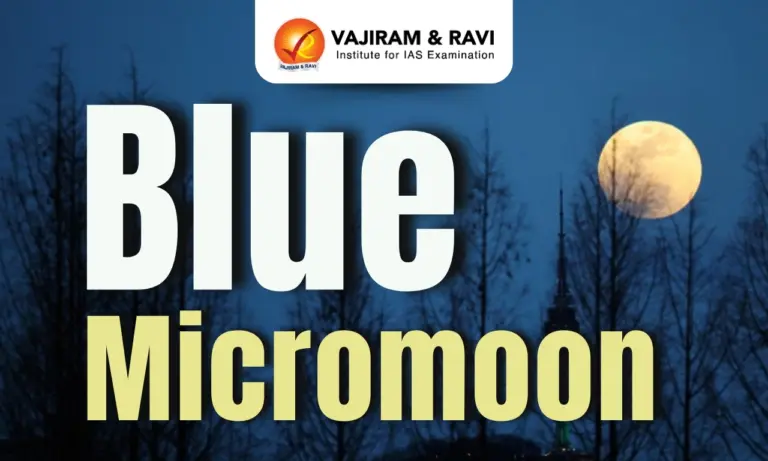
Skywatchers will be treated to a rare sight this month: a Blue Moon that is also a “micromoon.
What is a Blue Moon?
- A blue moon is the second full moon in a calendar month.
- That is unusual because the period from one full moon to another is about 29 1/2 days.
- So when two occur in the same month, the first of these full moons is always on the first or second day of the month.
- On average, a blue moon occurs once every 33 months or full moons, 41 times per century, or about seven times every 19 years.
- An even rarer event is when two blue moons happen in the same calendar year, which happens about four times per century.
- Sometimes, smoke or dust in the air can scatter red wavelengths of light, as a result of which the moon may, in certain places, appear more blue than usual.
- But this has nothing to do with the name “blue” moon, and the association of the colour with the term is unclear.


What is a Micro Moon?
- This refers to the apparent size of the moon as viewed from Earth.
- The moon is not always a constant distance away from the Earth.
- Its orbit around the Earth is elliptical.
- The moon is about 363,711 km away at its closest to earth, known as perigee. At apogee, or the furthest point, the moon is about 403,945 km away.
- If a full moon happens to occur close to its closest point, then we call that a supermoon. And if it’s close to its furthest point, then we call that a micromoon.
- A micromoon appears only about 14% smaller than a supermoon and about 6% smaller than a typical full moon.
How Rare is a Blue Micromoon?
- Blue moons occur every couple of years, and micromoons occur two or three times every year.
- A blue micromoon occurs about once every couple of decades.
- However, they aren’t regular, and two such events may occur closer together or further apart.
- No special equipment is needed to observe this blue micromoon, and it should be clearly visible in the absence of clouds.
Source: LS

 Last updated on Oct, 2026
→ UPSC 2027 Notification will be released on 13 January 2027 at upsconline.nic.in.
→ Check Nobel Prize 2026 Winners List here.
→ Download PIB PRiSM Monthly Magazine 2026 here.
→ Check UPSC Monthly Current Affairs Magazine The Recitals here.
→ Check out the latest UPSC Syllabus here.
→ Download UPSC Model Answers for Mains 2026
→ UPSC Mains Question Paper 2026 is out now for Essay & GS Paper 1, 2, 3 & 4.
→ UPSC Calendar 2027 has been released.
→ Enroll in Vajiram & Ravi’s UPSC Mains Test Series 2027 for structured answer writing practice, expert evaluation, and exam-oriented feedback.
→ Join Vajiram & Ravi’s UPSC Mentorship Program 2027 for personalized guidance, strategy planning, and one-to-one support from experienced mentors.
→ Go through the UPSC Mains Previous Year Papers to enhance your preparation.
→ UPSC has released UPSC Toppers List 2025 with the Civil Services final result on its official website.
→ Also check Best UPSC Coaching in India
Blue Micromoon FAQs
Q1. What is a Blue Moon?+
Q2. Why is the occurrence of a Blue Moon considered unusual?+
Q3. Does a Blue Moon actually appear blue in color?+
Q4. What is a Micro Moon?+
Q5. How often does a Blue Micromoon occur?+
Tags: blue micromoon