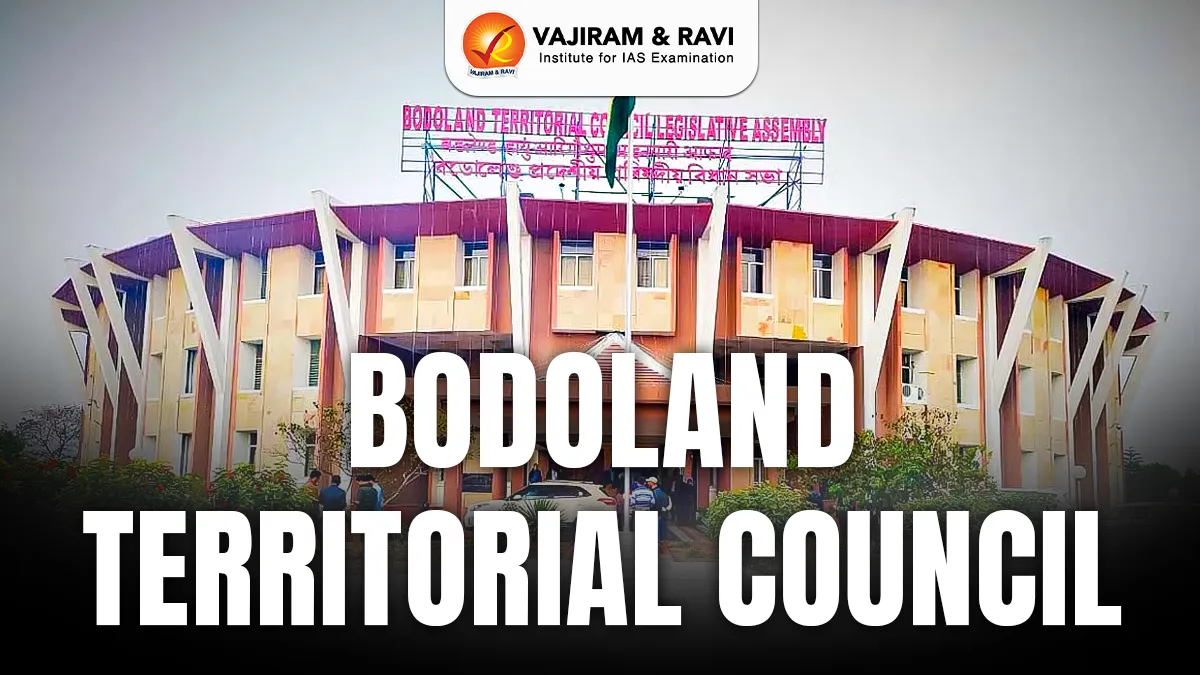
Bodoland Territorial Council (BTC) is an autonomous administrative body in Assam created to give the Bodo people self-governance and control over their region. It plays an important role in promoting development, preserving culture, and ensuring political representation for the Bodo community.
Bodoland Territorial Council (BTC) Background
The demand for a separate Bodoland state began in the 1980s, led by the All Bodo Students Union (ABSU), as the Bodo people sought political power, cultural recognition, and development. After years of protests and unrest, the Bodo Accord 2003 was signed between the Government of India, Assam, and the militant group Bodo Liberation Tigers Force (BLTF).
Following this agreement, the Bodoland Territorial Council (BTC) was established in 2003 under the Sixth Schedule of Indian Constitution to provide autonomy and self-governance to the Bodo people.
The BTC administers the Bodoland Territorial Region, which includes four districts of Assam – Kokrajhar, Chirang, Baksa and Udalguri.
Bodoland Territorial Council Objectives
The main objectives of the Bodoland Territorial Council (BTC) are:
- Political Autonomy: To provide the Bodo people with self-governance and allow them to make decisions for their own region.
- Cultural Preservation: To protect and promote Bodo language, traditions, customs, and cultural identity.
- Social and Economic Development: To ensure development in areas like education, healthcare, infrastructure, agriculture, and employment.
- Inclusive Representation: To give fair political representation to all communities living in the Bodoland region, including underrepresented groups.
- Peace and Stability: To reduce conflicts and integrate the region into the democratic framework, replacing earlier unrest and insurgency.
- Regional Planning: To plan and implement local development schemes that reflect the needs of the community and improve their quality of life.


Bodoland Territorial Council (BTC) Composition and Structure
The composition and structure of the Bodoland Territorial Council (BTC) is as follows:
- The Bodoland Territorial Council can have a maximum of 46 members.
- Out of these, 40 members are elected by the people of the Bodoland region, while the remaining 6 members are nominated by the Governor of Assam to represent communities that might otherwise be underrepresented.
- Among the 40 elected seats, 35 seats are reserved for Scheduled Tribes and certain non-tribal communities, ensuring adequate representation of the Bodo people and other local communities.
- The remaining 5 seats are unreserved and open to candidates from any community.
- The council is headed by a Chief Executive Member (CEM), who leads the executive administration and is supported by other executive members responsible for different departments.
BTC functions as a governing body under the Sixth Schedule of the Indian Constitution, but it is an exception in terms of size and composition compared to other autonomous councils in Northeast India.
Bodoland Territorial Council (BTC) Powers and Functions
The Bodoland Territorial Council exercises legislative, executive, and financial powers in matters relating to regional governance. These powers are derived from the provisions of the Sixth Schedule of the Constitution.
- Legislative Powers: Bodoland Territorial Council (BTC) can make laws on on subjects such as land use, forest management (excluding reserved forests), agriculture, village administration, inheritance, social customs, local cultural practices etc
- Executive Powers: Bodoland Territorial Council (BTC) implements development schemes, manages transferred departments, runs welfare programmes, and coordinates with the state for law and order.
- Financial Powers: Bodoland Territorial Council (BTC) can collect certain taxes, tolls, and fees within its jurisdiction. It also receives grants and financial assistance from both the state government of Assam and the central government for developmental activities.
- Cultural and Social Functions: Bodoland Territorial Council (BTC) protects and promotes Bodo language, culture, traditions, and community institutions.
- Developmental Functions: Bodoland Territorial Council (BTC) plans and executes infrastructure projects and supports livelihood, employment, and skill development initiatives.
Bodoland Territorial Council Significance
The Bodoland Territorial Council plays an important role in the region:
- It provides autonomy and political representation to the Bodo people.
- It helps preserve Bodo culture, language, and traditions.
- It enables regional development by managing local administration and welfare schemes.
- It contributes to peace and stability by addressing the grievances that once led to unrest.
- BTC is a model of asymmetrical federalism, showing how India accommodates diverse regional and ethnic aspirations.

 Last updated on Oct, 2026
→ UPSC 2027 Notification will be released on 13 January 2027 at upsconline.nic.in.
→ Check Nobel Prize 2026 Winners List here.
→ Download PIB PRiSM Monthly Magazine 2026 here.
→ Check UPSC Monthly Current Affairs Magazine The Recitals here.
→ Check out the latest UPSC Syllabus here.
→ Download UPSC Model Answers for Mains 2026
→ UPSC Mains Question Paper 2026 is out now for Essay & GS Paper 1, 2, 3 & 4.
→ UPSC Calendar 2027 has been released.
→ Enroll in Vajiram & Ravi’s UPSC Mains Test Series 2027 for structured answer writing practice, expert evaluation, and exam-oriented feedback.
→ Join Vajiram & Ravi’s UPSC Mentorship Program 2027 for personalized guidance, strategy planning, and one-to-one support from experienced mentors.
→ Go through the UPSC Mains Previous Year Papers to enhance your preparation.
→ UPSC has released UPSC Toppers List 2025 with the Civil Services final result on its official website.
→ Also check Best UPSC Coaching in India
Bodoland Territorial Council (BTC) FAQs
Q1. What is the Bodoland Territorial Council (BTC)?+
Q2. Which areas are covered under the Bodoland Territorial Council (BTC)?+
Q3. How is the Bodoland Territorial Council (BTC) structured?+
Q4. What powers does the Bodoland Territorial Council (BTC) have?+
Q5. Why is the Bodoland Territorial Council (BTC) important?+
Tags: bodoland territorial council sixth schedule