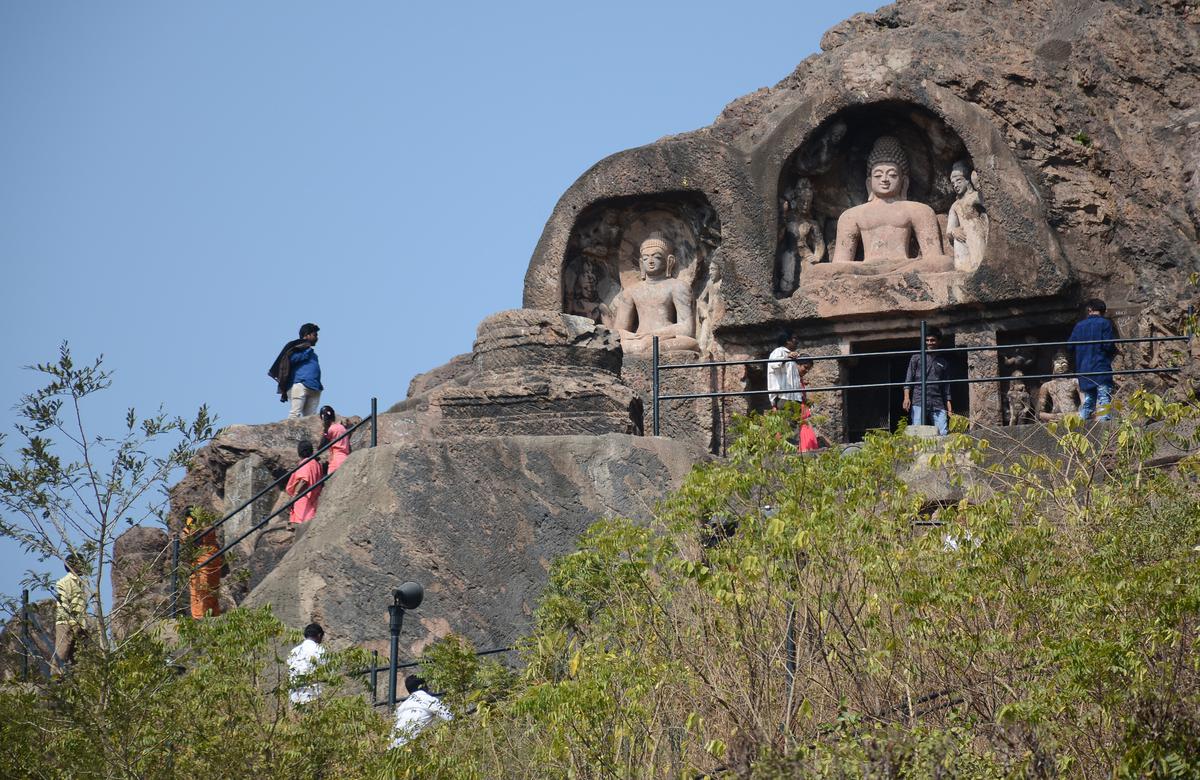
About Bojjannakonda:
- It is located in the state of Andhra Pradesh.
- The site was excavated under the aegis of Alexander Rim in 1906.
- It was originally known as ‘Buddhuni konda’ (hill of the Buddha), but it came to be known as ‘Bojjannakonda’ in the course of time.
- Buddhist monks used to practice on the hill about 2,000 years ago.
- A gold coin belonging to the Samudra Gupta period, copper coins of the Chalukya king Kubja Vishnu Vardhan, coins of Andhra Satavahanas and pottery were discovered at the site.
- Features
- An interesting feature of this site is that it shows features of all the three phases of Buddhism: Hinayana, Mahayana and Vajrayana.
- A figure of ‘Kalabhairava’ with the head of Lord Ganesha wearing conch shells and the statue of a Buddhist monk, ‘Harati’, have also been found at the site.
- There is a large double-storeyed cave on the hill.
- The rectangular cave has a doorway and is flanked by ‘dwarapalakas’ on either side.
- There is a rock-cut stupa, standing on a square platform, at the centre of the cave.
- A series of rock-cut caves and monolithic structures standing on rock platforms are present on the northern side of the hill.
- The upper cave has a rectangular doorway flanked by figures of the Buddha on either side.
- The imposing figures of the Buddha, seated in meditation posture, and the stupa are the main attraction for tourists at Bojjannakonda.
- On the top of the hill, there is a group of structural buildings and a vihara (monastery), which has been reduced to ruins.
- To the west of Bojjannakonda, another hillock, Lingalakonda or Lingalametta, is present.
- A number of monolithic and structural stupas can be seen on the top of this hillock.
- The Buddhist temple at Barabodur in Java has been constructed on the lines of the structures on Lingalametta”.
- The caves at Bojjannakonda and those in Takshasila are similar.
- The word ‘Sangrama’ was in use at Takshasila but was never used in Andhra Pradesh. These two features suggest that Buddhist practices influenced Bojjannakonda in northern India,”.
Q1) What is Vajrayana?
It is also known as Tantric Buddhism is one of the major traditions within Buddhism. It is primarily practiced in Tibetan Buddhism, as well as in some forms of East Asian Buddhism such as Shingon Buddhism in Japan. Vajrayana is characterized by its emphasis on esoteric rituals, complex symbolism, and the use of mantras, mudras, and visualizations to attain enlightenment.
Source: Andhra Pradesh’s Bojjannakonda gets major facelift to draw more tourists


 Last updated on Oct, 2026
→ UPSC 2027 Notification will be released on 13 January 2027 at upsconline.nic.in.
→ Check Nobel Prize 2026 Winners List here.
→ Download PIB PRiSM Monthly Magazine 2026 here.
→ Check UPSC Monthly Current Affairs Magazine The Recitals here.
→ Check out the latest UPSC Syllabus here.
→ Download UPSC Model Answers for Mains 2026
→ UPSC Mains Question Paper 2026 is out now for Essay & GS Paper 1, 2, 3 & 4.
→ UPSC Calendar 2027 has been released.
→ Enroll in Vajiram & Ravi’s UPSC Mains Test Series 2027 for structured answer writing practice, expert evaluation, and exam-oriented feedback.
→ Join Vajiram & Ravi’s UPSC Mentorship Program 2027 for personalized guidance, strategy planning, and one-to-one support from experienced mentors.
→ Go through the UPSC Mains Previous Year Papers to enhance your preparation.
→ UPSC has released UPSC Toppers List 2025 with the Civil Services final result on its official website.
→ Also check Best UPSC Coaching in India