Bombay Blood Group Latest News
Recently, in a rare and complex medical procedure, a 30-year-old woman with the extremely rare ‘Bombay’ (hh) blood group underwent a successful kidney transplant in India.
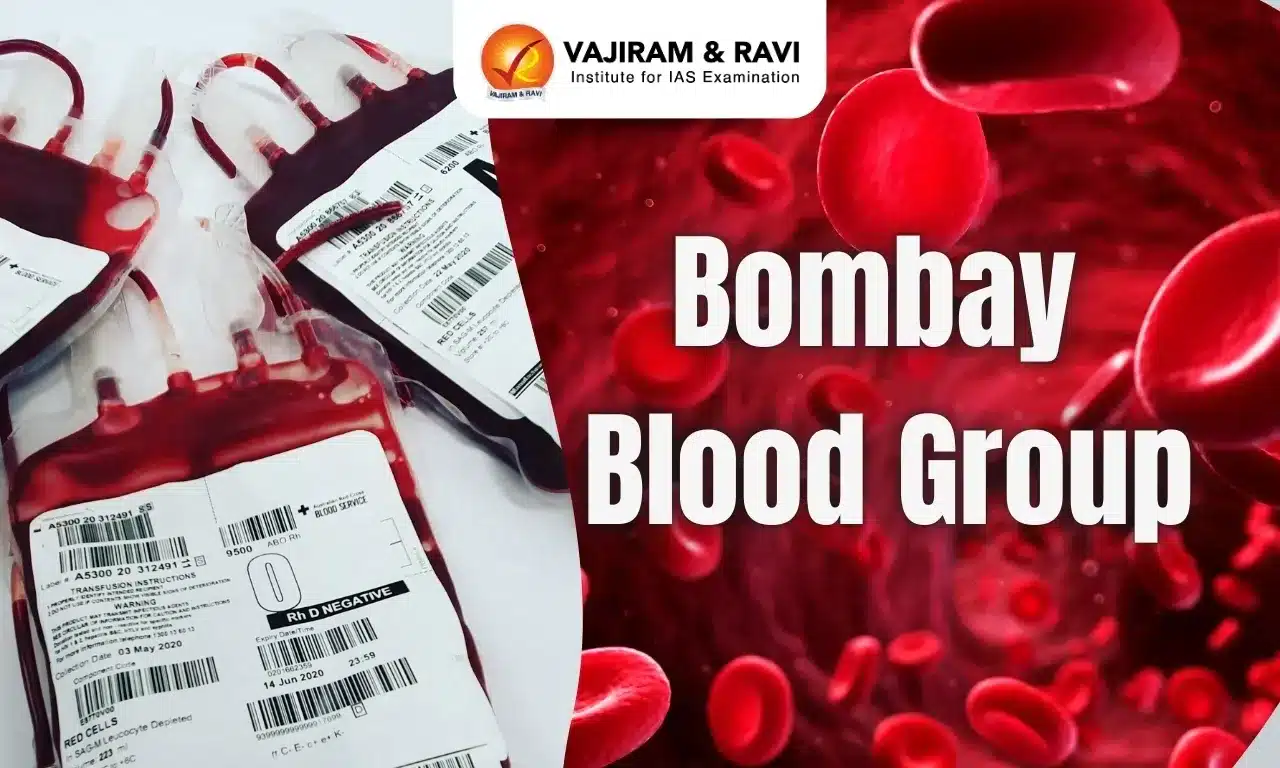
About Bombay Blood Group
- The Bombay, a.k.a. HH, blood group is a rare blood group first discovered in Mumbai in 1952 by Y.M. Bhende.
- The key differences between the Bombay blood group and the common ABO blood groups lie in the presence (or absence) of the H antigen, which is the fundamental building block for the ABO blood group system.
- Why is it Rare?
- In normal individuals, the H antigen serves as the base structure for building A and B antigens. In Bombay blood group individuals, the gene responsible for producing the H antigen is mutated or absent, so neither A nor B antigens can be formed.
- Unlike common blood groups, people with this type lack the H antigen, making them incompatible with all standard blood types, including O-negative, complicating both transfusions and organ transplants.
- They can only receive blood from another Bombay blood group donor. Its prevalence is about 0.0004% (one in 4 million) of the total human population.
- While it drops to one in a million in the European population and one in 10,000 in Mumbai, the act of finding a donor is still daunting.


Bombay Blood Group FAQs
Q1: What is the difference between O and Bombay blood group?
Ans: Bombay blood group is a rare blood group in which there is the absence of H antigen and presence of anti-H antibodies. At the time of blood grouping, this blood group mimics O blood group due to the absence of H antigen, but it shows incompatibility with O group blood during cross matching.
Q2: What is the Bombay blood group defect?
Ans: Named for the city in which it was first discovered, the “Bombay phenotype” describes individuals whose RBCs lack the H antigen.
Q3: What is golden blood?
Ans: The rarest blood type in the world is known as “golden blood type”.
Source: TH

 Last updated on Oct, 2026
→ UPSC 2027 Notification will be released on 13 January 2027 at upsconline.nic.in.
→ Check Nobel Prize 2026 Winners List here.
→ Download PIB PRiSM Monthly Magazine 2026 here.
→ Check UPSC Monthly Current Affairs Magazine The Recitals here.
→ Check out the latest UPSC Syllabus here.
→ Download UPSC Model Answers for Mains 2026
→ UPSC Mains Question Paper 2026 is out now for Essay & GS Paper 1, 2, 3 & 4.
→ UPSC Calendar 2027 has been released.
→ Enroll in Vajiram & Ravi’s UPSC Mains Test Series 2027 for structured answer writing practice, expert evaluation, and exam-oriented feedback.
→ Join Vajiram & Ravi’s UPSC Mentorship Program 2027 for personalized guidance, strategy planning, and one-to-one support from experienced mentors.
→ Go through the UPSC Mains Previous Year Papers to enhance your preparation.
→ UPSC has released UPSC Toppers List 2025 with the Civil Services final result on its official website.
→ Also check Best UPSC Coaching in India