Bow Echo Latest News
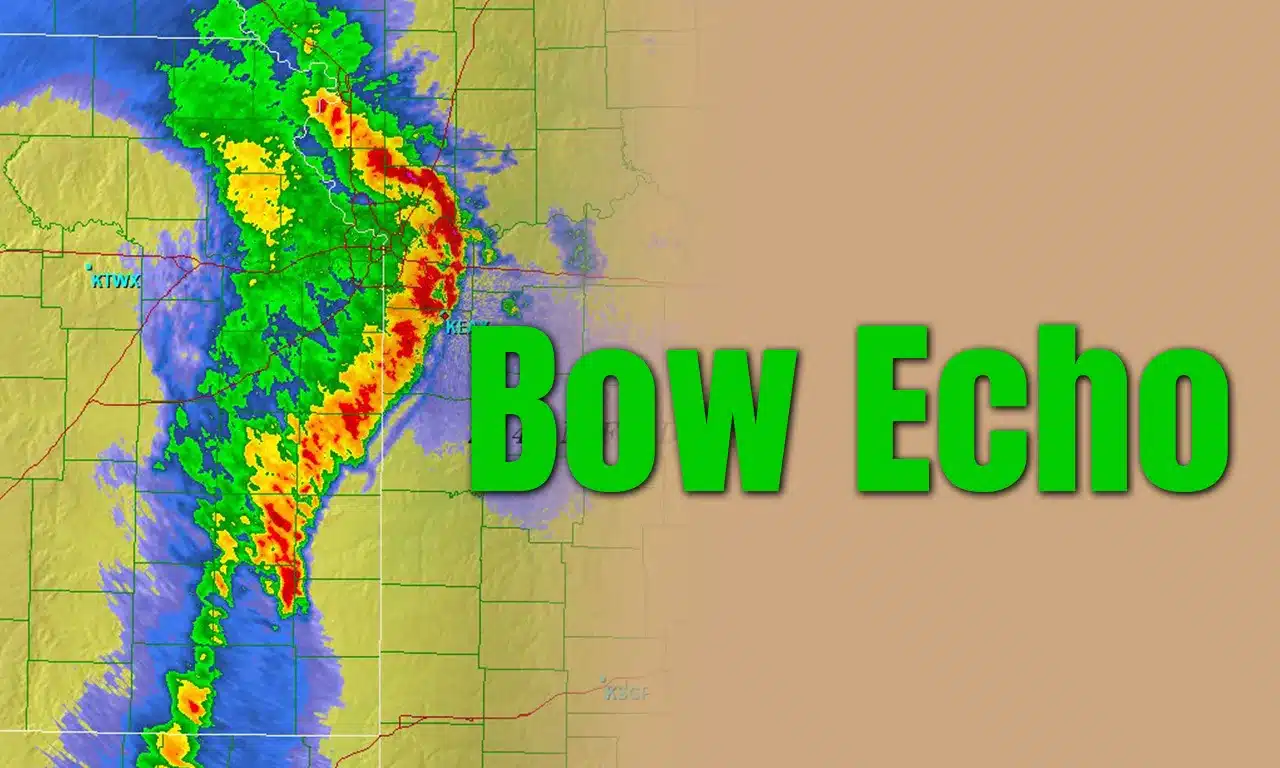
The intense storms that hit Delhi recently looked like a crescent or an archer’s bow which in technical terms are called “bow echoes.”
About Bow Echo
- A bow echo is essentially a line of storms, also called a squall line, on the radar that looks like a bow. Note that this squall line can sometimes be embedded in a larger squall line.
- A bow echo can extend from 20 km to 100 km, and last between three and six hours.
- The term was coined in the 1970s by Ted Fujita, a Japanese American meteorologist known for developing the scale to classify tornadoes.


Formation of Bow Echo
- When rain-cooled air comes down to the ground, and spreads out horizontally. As this happens, a boundary called the gust front is created between the rain-cooled air and warm-moist air on the surface.
- This front pushes up the warm-moist air into the atmosphere, which forms new thunderstorms.
- These new thunderstorms produce more rain, thereby creating more rain-cooled air, which helps the gust front to maintain its strength.
- As this process keeps repeating itself, there comes a point when there is an inflow of air on the trailing side of the line of storms and bends it like an archer’s bow.
- The cycle lasts as long as new thunderstorms keep forming at the front, helping the system grow and move forward with strong winds.
- Bow echoes are not a new phenomenon. In 2022, a bow echo was formed over Delhi and Noida. However, it was short-lived, lasting for an hour, and produced winds of up to 100 kmph.
Bow Echo FAQs
Q1: What is a decharo?
Ans: A derecho (pronounced similar to “deh-REY-cho”) is a widespread, long-lived wind storm that is associated with a band of rapidly moving showers or thunderstorms
Q2: What are the different types of bow echoes?
Ans: Three primary initial modes of bow-echo formation are (i) weakly organized cells, (ii) squall lines, and (iii) supercells.
Source: IE

 Last updated on Oct, 2026
→ UPSC 2027 Notification will be released on 13 January 2027 at upsconline.nic.in.
→ Check Nobel Prize 2026 Winners List here.
→ Download PIB PRiSM Monthly Magazine 2026 here.
→ Check UPSC Monthly Current Affairs Magazine The Recitals here.
→ Check out the latest UPSC Syllabus here.
→ Download UPSC Model Answers for Mains 2026
→ UPSC Mains Question Paper 2026 is out now for Essay & GS Paper 1, 2, 3 & 4.
→ UPSC Calendar 2027 has been released.
→ Enroll in Vajiram & Ravi’s UPSC Mains Test Series 2027 for structured answer writing practice, expert evaluation, and exam-oriented feedback.
→ Join Vajiram & Ravi’s UPSC Mentorship Program 2027 for personalized guidance, strategy planning, and one-to-one support from experienced mentors.
→ Go through the UPSC Mains Previous Year Papers to enhance your preparation.
→ UPSC has released UPSC Toppers List 2025 with the Civil Services final result on its official website.
→ Also check Best UPSC Coaching in India
Tags: bow echo prelims pointers upsc current affairs upsc prelims current affairs