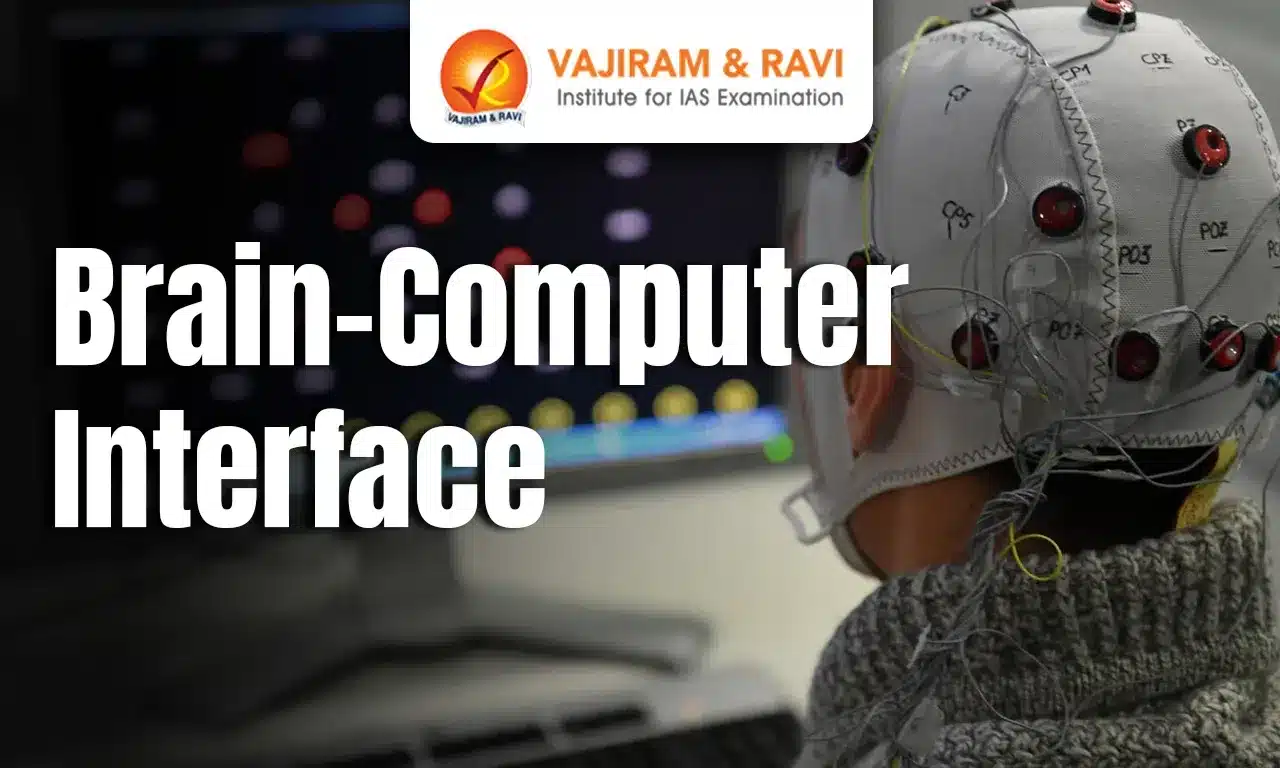
Brain-Computer Interface (BCI) Latest News
Researchers at the University of California, San Francisco (UCSF) have developed a stable Brain-Computer Interface (BCI) that allows a paralysed person to control a robotic arm using only their thoughts, over 7 months, with minimal recalibration.
What is a Brain-Computer Interface (BCI)?
- A Brain-Computer Interface (BCI) is a system that enables direct communication between the brain and an external device, such as a computer or robotic limb.
- It decodes brain signals and translates them into commands to control machines, bypass damaged neural pathways, and restore lost functions in persons with neurological disorders.
- Earlier BCI systems could only translate brain signals into text, and that too with limited vocabulary, slow processing speed, and reduced accuracy.


How Does It Work?
- Sensor implantation: Electrodes were surgically placed on the motor cortex (brain region controlling movement).
- Signal interpretation: The system decodes neural signals of imagined movement, using machine learning to predict changes over time in signal patterns.
- Virtual training: The user was first trained using a virtual robotic arm, allowing refinement of mental control.
- Real-world application: The participant performed complex tasks like picking up blocks, opening a cabinet, and holding a cup under a water dispenser, indicating precise, consistent control.
Applications of BCI Technology
- The BCI also has potential for restoring speech in individuals with conditions like brainstem stroke or Amyotrophic Lateral Sclerosis (ALS).
- Fine electrodes and artificial neural networks can decode intended speech and generate text output, Audible speech, and a speaking avatar.
- One study showed a patient with ALS communicating at 62 words per minute, 3.4 times faster than previous BCI systems.
Brain-Computer Interface (BCI) FAQs
Q1. What is a Brain-Computer Interface (BCI)?
Ans. A Brain-Computer Interface (BCI) is a system that allows direct communication between the brain and an external device by interpreting brain signals, often for assistive technologies or medical applications.
Q2. What are the main applications of BCI?
Ans. BCIs are used in neuroprosthetics, communication for disabled individuals, gaming, cognitive training, and even military research.
Source: TH

 Last updated on Oct, 2026
→ UPSC 2027 Notification will be released on 13 January 2027 at upsconline.nic.in.
→ Check Nobel Prize 2026 Winners List here.
→ Download PIB PRiSM Monthly Magazine 2026 here.
→ Check UPSC Monthly Current Affairs Magazine The Recitals here.
→ Check out the latest UPSC Syllabus here.
→ Download UPSC Model Answers for Mains 2026
→ UPSC Mains Question Paper 2026 is out now for Essay & GS Paper 1, 2, 3 & 4.
→ UPSC Calendar 2027 has been released.
→ Enroll in Vajiram & Ravi’s UPSC Mains Test Series 2027 for structured answer writing practice, expert evaluation, and exam-oriented feedback.
→ Join Vajiram & Ravi’s UPSC Mentorship Program 2027 for personalized guidance, strategy planning, and one-to-one support from experienced mentors.
→ Go through the UPSC Mains Previous Year Papers to enhance your preparation.
→ UPSC has released UPSC Toppers List 2025 with the Civil Services final result on its official website.
→ Also check Best UPSC Coaching in India
Tags: Brain-Computer Interface (BCI) prelims pointers upsc prelims current affairs