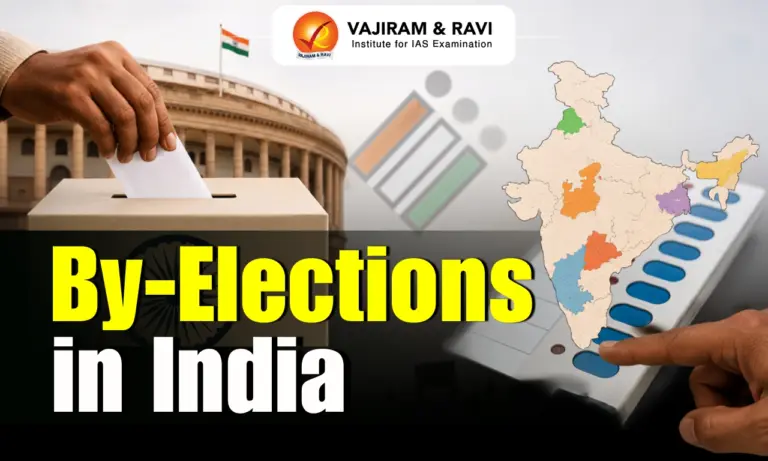
By Elections in India are conducted to fill vacant seats in the Lok Sabha, Rajya Sabha, State Legislative Assemblies, or Legislative Councils before the completion of their regular term. These elections ensure that every constituency continues to have elected representation even when a seat becomes vacant due to resignation, death, disqualification, or other reasons. Conducted by the Election Commission of India (ECI), by-elections play a crucial role in maintaining the continuity of India’s democratic system.
Why Are Bye Elections Conducted?
By Elections in India are conducted to ensure that citizens continue to have representation in Parliament or State Legislatures whenever a seat falls vacant before the House completes its term.
The major objectives include:
- Ensuring Representation: Every constituency continues to have an elected representative.
- Maintaining Democratic Governance: Vacant seats are filled without waiting for the next general election.
- Protecting Voters’ Rights: Citizens retain their voice in legislative decision-making.
- Strengthening Accountability: Political representatives remain accountable throughout the tenure.
- Maintaining Legislative Strength: Prevents prolonged vacancies in Parliament and State Assemblies.
Constitutional and Legal Provisions for By-Elections
The legal framework governing By Elections in India is provided by the Constitution and the Representation of the People Act, 1951.
- Article 324 empowers the Election Commission of India (ECI) to supervise, direct, and control elections.
- Representation of the People Act, 1951 lays down the procedures for conducting elections, including by-elections.
- Section 151A of the Representation of the People Act, 1951 provides that a by-election should ordinarily be conducted within six months of the vacancy.
- A by-election may not be held if:
- The remaining term of the House is less than one year, or
- The Election Commission certifies that holding the election within six months is impractical due to exceptional circumstances.


Reasons for Holding Bye Elections
A legislative seat may become vacant before the completion of its term for several reasons. Common reasons include:
- Death of an MP or MLA
- Resignation from the legislature
- Disqualification under constitutional or legal provisions
- Election declared void by a competent court
- Conviction resulting in disqualification
- Acceptance of an office of profit or another incompatible constitutional office
- Vacating one seat after being elected from multiple constituencies or Houses
Who Conducts Bye Elections?
By Elections in India are conducted by the Election Commission of India (ECI), an independent constitutional body established under Article 324 of the Constitution. The ECI is responsible for announcing the election schedule, supervising the entire polling process, and ensuring free and fair elections. It also works with state election officials to manage polling, vote counting, and the declaration of results.
Difference Between General Elections and Bye Elections
Both general elections and by-elections are essential to India’s democratic system, but they differ in their purpose, timing, coverage, and the tenure of elected representatives.
| Difference Between General Elections and By-Elections |
||
|---|---|---|
| Basis of Comparison | General Elections | By-Elections |
| Meaning | Held to elect representatives for all constituencies after the completion of a legislative term. | Held to fill a vacant seat in a specific constituency before the legislative term ends. |
| Purpose | To constitute a new government or legislature. | To fill an unexpected vacancy and ensure continued representation. |
| Coverage | Conducted across the entire country or state. | Conducted only in the constituency where the vacancy has occurred. |
| Timing | Held at the end of the normal tenure of the House. | Held whenever a seat becomes vacant during the tenure. |
| Number of Seats | Covers all or most seats in the legislature. | Usually involves one or a few vacant seats. |
| Tenure of the Elected Representative | Serves a full legislative term. | Serves only the remaining term of the previous member. |
| Reason for Conducting | Scheduled as part of the regular electoral cycle. | Triggered by death, resignation, disqualification, conviction, or other vacancy. |
| Government Formation | May result in the formation of a new government. | Does not usually change the government but fills a vacant seat. |
| Frequency | Conducted at fixed intervals as per the Constitution. | Conducted only when a vacancy arises before the end of the term. |
Importance of Bye Elections in Indian Democracy
By-Elections in India play a vital role in ensuring uninterrupted democratic representation and the smooth functioning of legislative bodies. They fill vacant seats promptly, allowing citizens to continue having an elected representative in Parliament or State Legislatures.
- Ensures Continuous Representation: Every constituency remains represented even if a seat becomes vacant.
- Strengthens Democracy: Upholds the principle of representative government by filling vacancies without delay.
- Protects Voters’ Rights: Ensures citizens continue to have a voice in the legislative process.
- Maintains Legislative Functioning: Prevents prolonged vacancies that could affect law-making and governance.
- Promotes Political Accountability: Gives voters an opportunity to assess the performance of political parties between general elections.
- Reflects Public Sentiment: By-election results often indicate changing political trends and voter preferences.
- Encourages Democratic Participation: Enables eligible voters to exercise their voting rights whenever a vacancy arises.
- Provides Opportunities for New Leaders: Allows emerging political leaders to enter Parliament or State Legislatures before the next general election.

 Last updated on Oct, 2026
→ UPSC 2027 Notification will be released on 13 January 2027 at upsconline.nic.in.
→ Asian Games 2026 are being held in Aichi-Nagoya, Japan, from 19 September to 4 October.
→ Check Nobel Prize 2026 Winners List here.
→ Download PIB PRiSM Monthly Magazine 2026 here.
→ Check UPSC Monthly Current Affairs Magazine The Recitals here.
→ Check out the latest UPSC Syllabus here.
→ Download UPSC Model Answers for Mains 2026
→ UPSC Mains Question Paper 2026 is out now for Essay & GS Paper 1, 2, 3 & 4.
→ UPSC Calendar 2027 has been released.
→ Enroll in Vajiram & Ravi’s UPSC Mains Test Series 2027 for structured answer writing practice, expert evaluation, and exam-oriented feedback.
→ Join Vajiram & Ravi’s UPSC Mentorship Program 2027 for personalized guidance, strategy planning, and one-to-one support from experienced mentors.
→ Go through the UPSC Mains Previous Year Papers to enhance your preparation.
→ UPSC has released UPSC Toppers List 2025 with the Civil Services final result on its official website.
→ Also check Best UPSC Coaching in India
Bye Elections in India FAQs
Q1. What are Bye Elections in India?+
Q2. Why are Bye Elections conducted in India?+
Q3. Who conducts By-Elections in India?+
Q4. Within how much time are By-Elections held?+
Q5. Does a candidate elected in a by-election serve a full term?+
Q6. What is the difference between a general election and a by-election?+
Tags: by-elections in india elections elections in india