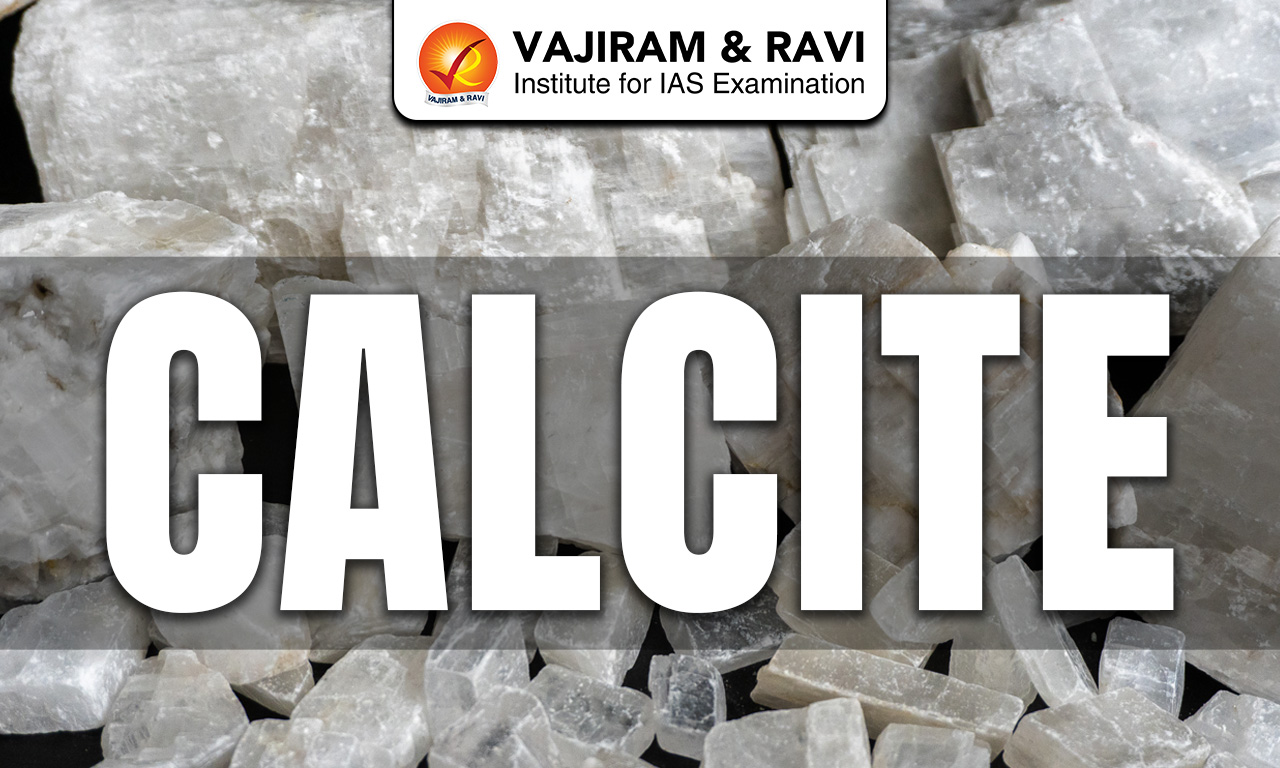
Calcite is one of the most abundant and widely distributed minerals on Earth. It is a naturally occurring form of calcium carbonate (CaCO₃) and plays a crucial role in geology, industry, and even biological systems. Found in sedimentary rocks like limestone and marble, calcite is known for its unique crystal structure and remarkable physical properties.
About Calcite
Calcite is a common and widely distributed mineral made of calcium carbonate (CaCO₃), forming a major part of rocks like limestone and marble. It is found in sedimentary, metamorphic, and hydrothermal environments and plays a key role in both natural processes and human industries.
- Shows perfect cleavage in three directions forming rhomb-shaped fragments
- Exhibits effervescence when reacts with dilute acids due to release of CO₂
- Displays double refraction (birefringence) splitting light into two rays
- Forms from accumulation of shells and skeletons of marine organisms in sedimentary rocks
- Precipitates from calcium-rich water in caves forming stalactites and stalagmites
- Develops during metamorphism when limestone converts into marble
- Also forms through hydrothermal processes from mineral-rich fluids
- Widely used in cement and lime production in construction industry
- Acts as raw material for marble and limestone building stones
- Used as filler in paper, plastic, paint, and rubber industries
- Helps in agriculture by neutralizing acidic soils and improving fertility
- Plays vital role in carbon cycle by acting as long-term carbon sink
- Stores atmospheric carbon in sedimentary rocks over geological time scales
- Releases carbon dioxide back during weathering and geological processes
- Forms shells and skeletons of marine organisms like corals and mollusks
- Contributes to formation of karst landscapes such as caves and sinkholes
- Maintains ecological balance by regulating soil and water chemistry
About Karst Topography
Karst topography is a distinctive landscape formed by the dissolution of soluble rocks like limestone, mainly composed of calcite. It is shaped by the action of slightly acidic water, leading to unique surface and underground landforms.
- Formed due to chemical weathering of limestone, dolomite, and gypsum by carbonic acid
- Characterized by underground drainage systems with very little surface runoff
- Presence of sinkholes (dolines) formed by collapse or dissolution of rock
- Development of caves and caverns through continuous rock dissolution
- Features stalactites and stalagmites formed by deposition of calcium carbonate
- Includes large depressions like poljes and limestone pavements with clints and grikes
- Ecologically and economically important for groundwater storage, tourism, and carbon cycle processes


 Last updated on Oct, 2026
→ UPSC 2027 Notification will be released on 13 January 2027 at upsconline.nic.in.
→ Check Nobel Prize 2026 Winners List here.
→ Download PIB PRiSM Monthly Magazine 2026 here.
→ Check UPSC Monthly Current Affairs Magazine The Recitals here.
→ Check out the latest UPSC Syllabus here.
→ Download UPSC Model Answers for Mains 2026
→ UPSC Mains Question Paper 2026 is out now for Essay & GS Paper 1, 2, 3 & 4.
→ UPSC Calendar 2027 has been released.
→ Enroll in Vajiram & Ravi’s UPSC Mains Test Series 2027 for structured answer writing practice, expert evaluation, and exam-oriented feedback.
→ Join Vajiram & Ravi’s UPSC Mentorship Program 2027 for personalized guidance, strategy planning, and one-to-one support from experienced mentors.
→ Go through the UPSC Mains Previous Year Papers to enhance your preparation.
→ UPSC has released UPSC Toppers List 2025 with the Civil Services final result on its official website.
→ Also check Best UPSC Coaching in India
Calcite FAQs
Q1. What is calcite made of?+
Q2. Where is calcite commonly found?+
Q3. Why does calcite react with acid?+
Q4. What are the major uses of calcite?+
Q5. Is calcite important for the environment?+