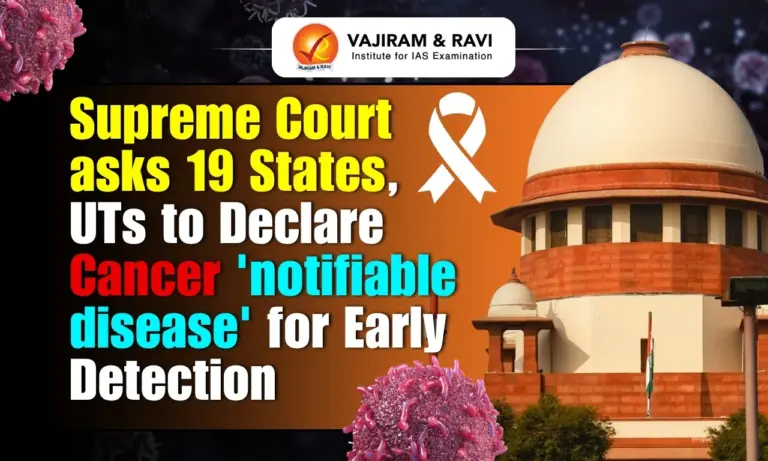
Recently, the Supreme Court directed the 19 remaining States and Union Territories to consider declaring cancer a “notifiable disease” to ensure uniform reporting, early detection and proper care of patients. The direction came in Anurag Srivastava v. Union of India & Ors., a Public Interest Litigation seeking nationwide mandatory reporting of cancer cases.
Background
The Public Interest Litigation (PIL) was filed by Dr. Anurag Srivastava, seeking directions to the Union Ministry of Health and Family Welfare and the States/UTs to ensure uniform and mandatory reporting of cancer cases.
The petitioner invoked Articles 14 and Article 21, arguing that continued non-notification could result in unequal treatment of similarly situated citizens and undermine the right to health and a life with dignity.
Key Highlights of the Supreme Court’s Direction
During the proceedings, the Court was informed that 17 of the 36 States and UTs had already notified cancer as a notifiable disease, following recommendations of a Parliamentary Standing Committee.
- The Court therefore directed the remaining 19 States and UTs to consider the Committee’s recommendations and take appropriate decisions.
- The concerned States and UTs were also directed to file compliance affidavits on the steps taken.
- The Bench also questioned the Centre on why mandatory guidelines could not be issued for all States and UTs, emphasising the need for a uniform policy.
- The Centre responded that health is a State subject, highlighting the need for Centre-State coordination.


What Does Declaring Cancer a ‘Notifiable Disease’ Mean?
A notifiable disease is a disease whose diagnosed cases must be reported by doctors, hospitals or laboratories to designated public-health authorities.
The purpose of declaring a disease notifiable is to create a legally required reporting system so that health authorities receive timely and systematic information about diagnosed cases. This helps to:
- Monitor the disease burden and trends across regions and populations.
- Detect emerging patterns or outbreaks early, where relevant.
- Plan healthcare resources such as personnel, medicines and facilities.
- Design and target public-health interventions based on reliable data.
- Evaluate the effectiveness of health programmes and policies.
For cancer, notification is primarily aimed at systematic surveillance, reliable data collection, early detection and evidence-based cancer-control planning.
Notifiable Diseases in India
India does not have a single uniform national list of notifiable diseases. Since public health is primarily a State subject, notification requirements can vary across States and UTs.
The Epidemic Diseases Act, 1897 provides a broad legal framework for dealing with epidemic diseases, while the Integrated Disease Surveillance Programme (IDSP) supports national surveillance of epidemic-prone diseases.
Commonly notified diseases include tuberculosis, cholera, malaria, dengue, measles, diphtheria, polio, rabies, typhoid and Japanese encephalitis.
Cancer Notification and the Existing Registry System
India already has the National Cancer Registry Programme (NCRP) under the Indian Council of Medical Research (ICMR), which collects cancer data through Population-Based Cancer Registries (PBCRs) and Hospital-Based Cancer Registries (HBCRs).
Mandatory notification could complement the NCRP by improving the coverage, timeliness and consistency of cancer data. The PIL also sought a centralized, real-time digital cancer registry to strengthen cancer surveillance.

 Last updated on Oct, 2026
→ UPSC 2027 Notification will be released on 13 January 2027 at upsconline.nic.in.
→ Check Nobel Prize 2026 Winners List here.
→ Download PIB PRiSM Monthly Magazine 2026 here.
→ Check UPSC Monthly Current Affairs Magazine The Recitals here.
→ Check out the latest UPSC Syllabus here.
→ Download UPSC Model Answers for Mains 2026
→ UPSC Mains Question Paper 2026 is out now for Essay & GS Paper 1, 2, 3 & 4.
→ UPSC Calendar 2027 has been released.
→ Enroll in Vajiram & Ravi’s UPSC Mains Test Series 2027 for structured answer writing practice, expert evaluation, and exam-oriented feedback.
→ Join Vajiram & Ravi’s UPSC Mentorship Program 2027 for personalized guidance, strategy planning, and one-to-one support from experienced mentors.
→ Go through the UPSC Mains Previous Year Papers to enhance your preparation.
→ UPSC has released UPSC Toppers List 2025 with the Civil Services final result on its official website.
→ Also check Best UPSC Coaching in India
Supreme Court asks 19 States, UTs to Declare Cancer 'notifiable disease' for Early Detection FAQs
Q1. What did the Supreme Court direct regarding cancer notification?+
Q2. What is a notifiable disease?+
Q3. How many States and UTs have notified cancer as a notifiable disease?+
Q4. Which case is associated with the Supreme Court’s direction on cancer notification?+
Q5. What is the significance of the Supreme Court’s direction on cancer notification?+