


Cash After Demonetisation Latest News
- November 8, 2026 marked ten years since PM Modi’s dramatic televised announcement demonetising ₹500 and ₹1,000 notes, aimed at curbing black money, counterfeit currency, and pushing India toward a cashless economy.
- A decade later, RBI data reveals a striking paradox: despite a massive digital payments boom, currency held by the public has more than doubled since demonetisation — raising questions about whether the note ban achieved its core objective.
The Big Announcement and Immediate Impact
- On November 8, 2016, at 8 PM, PM Modi declared existing ₹500 and ₹1,000 notes invalid from midnight — denominations that made up ~86% of currency in circulation.
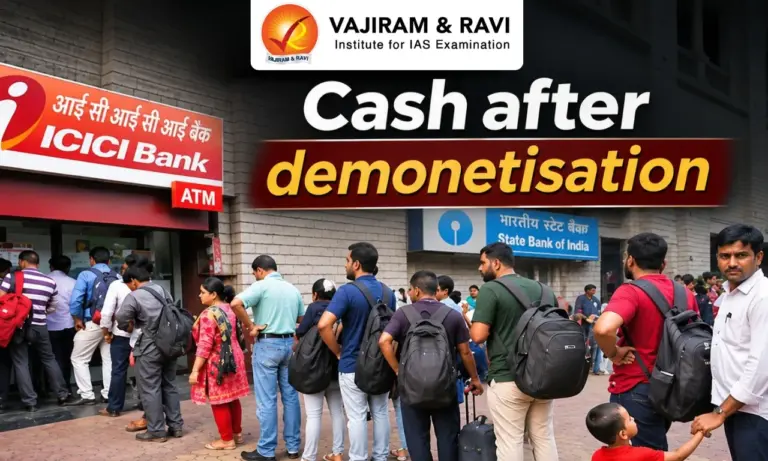
- The sudden cash crunch disrupted shops, businesses, and households nationwide; people queued for hours at banks and ATMs.
- GDP growth declined by nearly 1.5 percentage points; many small businesses shut down due to liquidity shortages.


The Long-Term Currency Trend
- Currency with the public stood at ₹17.97 lakh crore (November 4, 2016), crashed to ₹7.8 lakh crore by January 2017, but has since surged to ₹42.55 lakh crore (as of October 15, 2026) — a 137% increase over pre-demonetisation levels.
- Currency with the public = Currency in Circulation (CIC) minus cash held by banks.
- In calendar year 2026 alone (till October 16), cash with the public rose by ₹5.26 lakh crore (14.1%).
- A sharp spike occurred in 2020-21, driven by pandemic-induced cash hoarding for groceries and medical expenses during the Covid-19 lockdown.
Currency-to-GDP Ratio: A Mixed Signal
- The CIC-to-GDP ratio rose from 8.7% (2016-17) to 14.4% (2020-21), before settling at 12.1% in FY26 — nearly identical to March 2016’s 12.1%.
- Global Comparison: Japan (16%+), China (10.2%), US (7.3%) — India’s ratio is higher than the US and China but lower than Japan.
- A higher ratio indicates greater cash dependence; a lower ratio typically reflects stronger digitalisation and better monetary policy transmission.
- Importantly, a high ratio doesn’t necessarily signal lower economic sophistication.
Cash vs Digital: Coexistence, Not Replacement
- Despite RBI and government efforts toward a “less-cash society”, cash usage has not declined — it has grown alongside digital payments.
- Total digital payments (FY2025-26): ₹3,251.04 lakh crore (covering RTGS, retail transfers, cards, and prepaid instruments).
- Card and wallet transactions (FY2025-26): ~151,611 lakh transactions worth ₹30.31 lakh crore.
- Credit cards: ₹23.62 lakh crore (60,238 lakh transactions) — dominant by value.
- Debit cards: ₹4.45 lakh crore (12,802 lakh transactions).
- Wallets: ₹2.23 lakh crore, but highest transaction volume (78,571 lakh) — used for frequent, low-value payments.
- Comparison with FY2015-16: just 1,003.87 crore card transactions worth ₹29.39 lakh crore (debit cards dominant then).
- By value share in FY26: Credit cards (78%), Debit cards (14.7%), Wallets (7.4%).
- By volume share: Wallets (51.8%), Credit cards (39.7%), Debit cards (8.4%).
Conclusion
- A decade on, demonetisation’s cashless dream remains unrealised — cash and digital payments now coexist rather than compete.
- India’s economy has formalised and digitised significantly, yet physical currency continues circulating robustly, proving that convenience, trust, and habit still make cash resilient in a rapidly digitalising nation.
Source: IE

 Last updated on Nov, 2026
→ UPSC 2027 Notification will be released on 13 January 2027 at upsconline.nic.in.
→ Check Nobel Prize 2026 Winners List here.
→ Download PIB PRiSM Monthly Magazine 2026 here.
→ Check UPSC Monthly Current Affairs Magazine The Recitals here.
→ Check out the latest UPSC Syllabus here.
→ Download UPSC Model Answers for Mains 2026
→ UPSC Mains Question Paper 2026 is out now for Essay & GS Paper 1, 2, 3 & 4.
→ UPSC Calendar 2027 has been released.
→ Enroll in Vajiram & Ravi’s UPSC Mains Test Series 2027 for structured answer writing practice, expert evaluation, and exam-oriented feedback.
→ Join Vajiram & Ravi’s UPSC Mentorship Program 2027 for personalized guidance, strategy planning, and one-to-one support from experienced mentors.
→ Go through the UPSC Mains Previous Year Papers to enhance your preparation.
→ UPSC has released UPSC Toppers List 2025 with the Civil Services final result on its official website.
→ Also check Best UPSC Coaching in India
Cash after Demonetisation FAQs
Q1. Why was demonetisation announced in India in November 2016? +
Q2. How has cash after demonetisation changed in India? +
Q3. What happened to currency with the public immediately after demonetisation? +
Q4. What does India's currency-to-GDP ratio indicate? +
Q5. Why has cash after demonetisation remained popular despite digital payment growth? +
Tags: Cash after demonetisation mains articles upsc current affairs upsc mains current affairs








