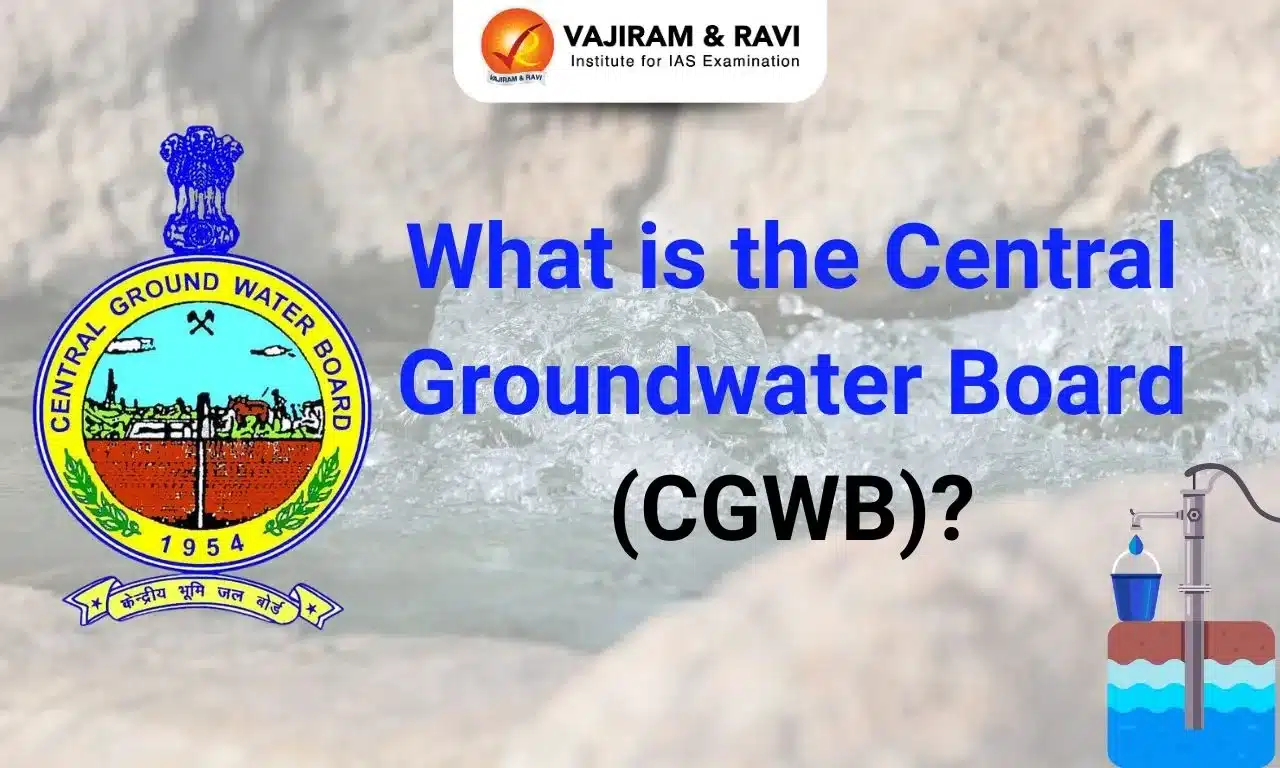
About Central Groundwater Board (CGWB):
- CGWB is a multi-disciplinary scientific organization of the Department of Water Resources, River Development and Ganga Rejuvenation, Ministry of Jal Shakti, Government of India.
- It is the National Apex Agency entrusted with the responsibilities of providing scientific inputs for management, exploration, monitoring, assessment, augmentation, and regulation of groundwater resources of the country.
- Mandate: Develop and disseminate technologies and monitor and implement national policies for the scientific and sustainable development and management of India’s groundwater resources, including their exploration, assessment, conservation, augmentation, protection from pollution, and distribution, based on principles of economic and ecological efficiency and equity.
- Organization Setup:
- The Board is headed by the Chairman and has five members.
- CGWB is a multi-disciplinary scientific organization consisting of Hydrogeologists, Geophysicists, Chemists, Hydrologists, Hydrometeorologists, and Engineers.
- Headquarters: Bhujal Bhawan, Faridabad, Haryana.
- The major activities of the CGWB are:
- National Aquifer mapping and Management (NAQUIM) involving Preparation of Aquifer Maps and Management Plans.
- Groundwater explorations to delineate groundwater worthy areas and potential aquifers.
- Geophysical surveys to delineate groundwater bearing zones, etc.
- Periodic assessment of the country’s groundwater resources.
- Monitoring of groundwater levels and quality through groundwater observation wells.
- Dissemination of Ground Water Data and knowledge.
- Groundwater modelling.
- GIS and Remote sensing.
- Regulation and control of groundwater development and management by CGWA in coordination with State Government Organizations.
- Coordination with State Government with a view to establish benchmark methodologies for groundwater studies.
- R&D studies in ground water sector and application and operationalization of new technologies/techniques for groundwater investigation, development, and management.
- Water conservation and artificial recharge to groundwater.
- Capacity building and knowledge transfer.
Q1: What is an aquifer?
An aquifer is a body of porous rock or sediment saturated with groundwater. Groundwater enters an aquifer as precipitation seeps through the soil. It can move through the aquifer and resurface through springs and wells.
Source: TH


 Last updated on Oct, 2026
→ UPSC 2027 Notification will be released on 13 January 2027 at upsconline.nic.in.
→ Check Nobel Prize 2026 Winners List here.
→ Download PIB PRiSM Monthly Magazine 2026 here.
→ Check UPSC Monthly Current Affairs Magazine The Recitals here.
→ Check out the latest UPSC Syllabus here.
→ Download UPSC Model Answers for Mains 2026
→ UPSC Mains Question Paper 2026 is out now for Essay & GS Paper 1, 2, 3 & 4.
→ UPSC Calendar 2027 has been released.
→ Enroll in Vajiram & Ravi’s UPSC Mains Test Series 2027 for structured answer writing practice, expert evaluation, and exam-oriented feedback.
→ Join Vajiram & Ravi’s UPSC Mentorship Program 2027 for personalized guidance, strategy planning, and one-to-one support from experienced mentors.
→ Go through the UPSC Mains Previous Year Papers to enhance your preparation.
→ UPSC has released UPSC Toppers List 2025 with the Civil Services final result on its official website.
→ Also check Best UPSC Coaching in India