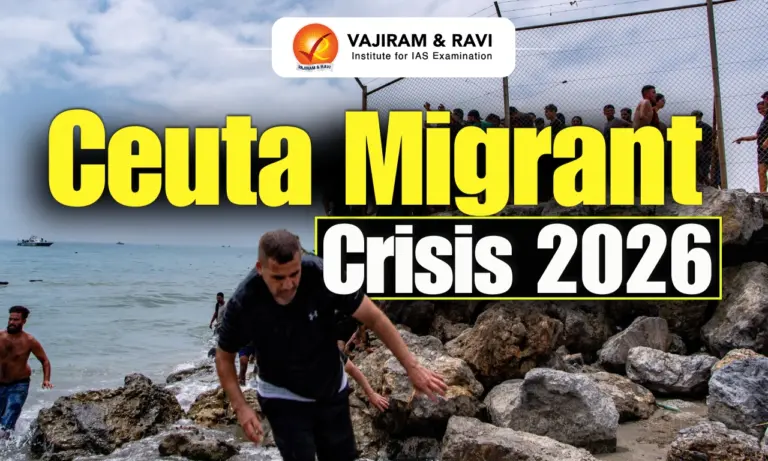
The Ceuta Migrant Crisis 2026 has come into focus after thousands of migrants crossed from Morocco into the Spanish enclave of Ceuta, creating a major border management challenge.
About Ceuta
Ceuta is a strategically important Spanish autonomous city located on the northern coast of Africa along the Strait of Gibraltar.
- Although geographically located in Africa, Ceuta is politically part of Spain and the European Union (EU).
- Together with Melilla, another Spanish enclave on Morocco’s Mediterranean coast, it forms the European Union’s only land borders with Africa.
- The city covers around 18.5 sq km and has a population of nearly 85,000 people comprising diverse communities, including Christians and Muslims of Spanish and Moroccan origin.
- Ceuta lies close to mainland Spain across the Strait of Gibraltar and shares a land border with Morocco.
- Its location near the Strait of Gibraltar gives it strategic importance for maritime trade, defence and border management.
- Ceuta has remained under Spanish administration since 1580, although Morocco continues to claim Ceuta and Melilla as its territories.
- Due to its status as EU territory, reaching Ceuta provides migrants access to European immigration and asylum systems, making it a major route for irregular migration.
About Ceuta Migrant Crisis 2026
The 2026 Ceuta migrant crisis refers to the sudden arrival of thousands of migrants from Morocco into the Spanish enclave of Ceuta. Many migrants crossed by swimming around coastal barriers, using inflatable devices or climbing the high border fence, overwhelming Spanish security forces and reception facilities.
The scale of the influx created a serious law-and-order and humanitarian challenge. Spanish authorities deployed the military to support the Civil Guard, while Spain and Morocco reached an agreement to facilitate the return of migrants who entered the territory illegally.


Ceuta Migrant Crisis 2026 Reasons
The 2026 Ceuta migrant crisis was not caused by a single event but by a combination of geographical, economic, political and humanitarian factors. Ceuta’s location on the Morocco-Spain border, together with growing migration pressures from Africa and the activities of smuggling networks, turned the enclave into the centre of one of Europe’s largest recent border crises.
Reasons Behind the Ceuta Migrant Crisis:
- Gateway to Europe: Ceuta is part of Spain and the European Union, making it one of the closest and easiest entry points into Europe from Africa.
- Economic hardship: Poverty, unemployment and the search for better livelihood opportunities continue to drive many migrants towards Europe.
- Conflict and instability: Violence, political instability and humanitarian crises in several African countries have forced many people to migrate.
- Role of smuggling networks: Criminal organisations involved in human trafficking and migrant smuggling reportedly facilitated and encouraged many of the crossings.
- Geographical proximity: Ceuta shares a land border with Morocco and is separated by only a short coastal stretch, making it relatively easier to reach by swimming, inflatable boats or by crossing the border fence.
- Possible legal factor: Some analysts believe a recent Spanish court ruling requiring due process before returning migrants arriving by sea may have encouraged more people to attempt the crossing.
- Persistent migration pressure: Ceuta and Melilla have long remained major migration hotspots because they are the European Union’s only land borders with Africa, attracting repeated attempts at irregular entry.
Legal Trigger Behind the Ceuta Migrant Crisis 2026
A major factor behind the 2026 Ceuta migrant surge was a Spanish Supreme Court ruling in June 2026 regarding the process of returning migrants who enter the country illegally.
- Earlier, Spain’s border policy allowed authorities to immediately return migrants who were caught while crossing the land fence separating Ceuta from Morocco.
- The Supreme Court clarified that this immediate return procedure would apply only to people crossing the physical border fence and not to those entering through the sea route.
- Migrants reaching Ceuta by sea would now have to undergo a regular legal process, including identification, legal assistance and examination of possible asylum claims.
- Spanish authorities argued that this created a practical challenge because the existing security system, including fences, cameras and surveillance, was mainly designed to stop land crossings and could not effectively prevent sea arrivals.
- As a result, the legal change created a gap between border control mechanisms and new migration routes, encouraging more migrants to attempt entry through coastal waters.

 Last updated on Oct, 2026
→ UPSC 2027 Notification will be released on 13 January 2027 at upsconline.nic.in.
→ Check Nobel Prize 2026 Winners List here.
→ Download PIB PRiSM Monthly Magazine 2026 here.
→ Check UPSC Monthly Current Affairs Magazine The Recitals here.
→ Check out the latest UPSC Syllabus here.
→ Download UPSC Model Answers for Mains 2026
→ UPSC Mains Question Paper 2026 is out now for Essay & GS Paper 1, 2, 3 & 4.
→ UPSC Calendar 2027 has been released.
→ Enroll in Vajiram & Ravi’s UPSC Mains Test Series 2027 for structured answer writing practice, expert evaluation, and exam-oriented feedback.
→ Join Vajiram & Ravi’s UPSC Mentorship Program 2027 for personalized guidance, strategy planning, and one-to-one support from experienced mentors.
→ Go through the UPSC Mains Previous Year Papers to enhance your preparation.
→ UPSC has released UPSC Toppers List 2025 with the Civil Services final result on its official website.
→ Also check Best UPSC Coaching in India
Ceuta Migrant Crisis 2026 FAQs
Q1. What is Ceuta?+
Q2. Why is Ceuta strategically important?+
Q3. Why has Ceuta become a migration hotspot?+
Q4. Why did the 2026 Ceuta migrant crisis occur?+
Q5. Why does Morocco claim Ceuta?+
Tags: ceuta migrant crisis 2026