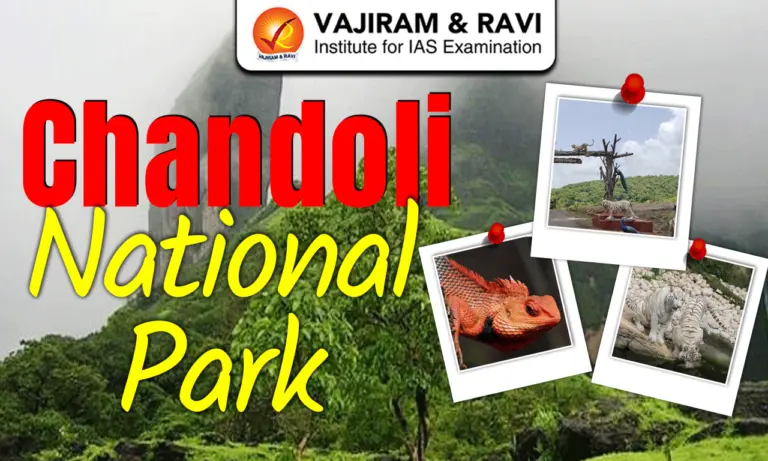
Chandoli National Park is a protected forest area located in the state of Maharashtra. It is known for its rich biodiversity, dense forests, and scenic natural landscapes. The park provides a safe habitat for various species of wildlife, including animals, birds, and plants. It is also part of the Western Ghats, a region famous for its ecological importance.
Chandoli National Park
- Chandoli National Park is an important protected forest area located in the state of Maharashtra, spread across Sangli, Satara, Kolhapur, and Ratnagiri districts, making it geographically diverse and ecologically significant.
- It lies along the Sahyadri Range (Western Ghats), which is a globally recognized biodiversity hotspot known for rich flora and fauna.
- The region was first declared a Wildlife Sanctuary in 1985 and later upgraded to a National Park in 2004, reflecting its growing ecological importance.
- The park covers an area of 317.67 sq. km, providing a large habitat for wildlife species.
- In 2007, it became part of the Sahyadri Tiger Reserve under the Project Tiger initiative by the National Tiger Conservation Authority (NTCA).
- Due to its ecological value, the park is also recognized under the UNESCO World Heritage framework of the Western Ghats.
Also Read : National Parks in India 2026
Chandoli National Park Geography and Physical Features
- The park is located in the northern Western Ghats and is characterized by rugged terrain, including flat-topped mountains, dense forests, and deep valleys.
- A unique feature of the region is the presence of lateritic plateaus called “Saddas”, which are rocky surfaces with minimal vegetation.
- The elevation ranges between 589 meters to 1,044 meters above sea level, contributing to varied climatic and ecological conditions.
- The Warna River is the main river flowing through the park, supported by several small streams, water channels, and reservoirs.
- Important water bodies like the Vasant Sagar Reservoir and natural water holes ensure year-round water availability for wildlife.
- The park is naturally protected by the Sahyadri mountain ridges, which act as a natural barrier and help preserve its ecosystem.


Chandoli National Park Climate
- Chandoli National Park experiences a semi-arid climate, with noticeable seasonal variations.
- The average temperature ranges between 19°C to 32°C, making it moderate for most of the year.
- During summer months (April-May), temperatures can rise above 42°C, making conditions harsh.
- In winter, temperatures may fall below 10°C, especially in higher altitudes.
- The park receives an average annual rainfall of around 762 mm, which supports forest growth and maintains water bodies.
Chandoli National Park History
- Historically, the region served as an open jail during the rule of Chhatrapati Shivaji Maharaj, where prisoners of war were kept during military campaigns.
- It was also used as a strategic and recreational location by the Maratha rulers.
- The forts of Prachitgad and Bhairavgad, built during the Maratha period, are located within the park and hold historical significance.
- These forts were actively used during the reign of Sambhaji Maharaj, son of Shivaji Maharaj, especially for observation and defense purposes.
- Over time, the ecological importance of the area led to its protection and eventual designation as a National Park.
Chandoli National Park Flora (Vegetation)
- The park mainly consists of moist deciduous forests, which support a wide variety of plant species.
- It also includes patches of dry evergreen vegetation, adding to its ecological diversity.
- Important plant species include ironwood trees and other native forest vegetation.
- Grass species such as Bluestem grass and Anjan grass are commonly found and play a role in supporting herbivores.
- Unique insectivorous plants like bladderworts are also present, highlighting the ecological uniqueness of the park.
- The vegetation provides essential support for wildlife and contributes to maintaining the ecosystem balance.
Chandoli National Park Fauna (Wildlife)
- Chandoli National Park is rich in biodiversity, with over 22 species of mammals, more than 120 species of birds, and several amphibians and reptiles.
- Major wildlife species include Tigers, Leopards, Panther cats, Gaur (Indian bison), and Sloth bears, making it an important conservation area.
- Various species of deer such as Sambar deer, Barking deer, and Mouse deer are commonly found.
- The park is also home to a large number of bird species (around 123), making it ideal for birdwatching.
- Recent camera-based wildlife censuses have shown a rise in tiger population, indicating successful conservation efforts.
Chandoli National Park Conservation Efforts
- Various conservation programs are being implemented by the Forest Department, government agencies, and wildlife organizations.
- The relocation of villages from the core area has reduced human interference, helping wildlife thrive.
- Continuous monitoring and protection have led to an increase in wildlife populations, especially big cats.
- These efforts aim to preserve the biodiversity and ecological balance of the park
Chandoli National Park Recent Developments
- Chandoli National Park is now fully included in the Sahyadri Tiger Reserve, strengthening its conservation status under Project Tiger.
- The Karadi-Bhogiv Hydroelectric Project has been proposed near the Warna River basin, involving surrounding areas.
- Villages have been rehabilitated outside the park, ensuring minimal disturbance to wildlife habitats.
- These developments aim to balance environmental conservation with regional development needs.

 Last updated on Oct, 2026
→ UPSC 2027 Notification will be released on 13 January 2027 at upsconline.nic.in.
→ Check Nobel Prize 2026 Winners List here.
→ Download PIB PRiSM Monthly Magazine 2026 here.
→ Check UPSC Monthly Current Affairs Magazine The Recitals here.
→ Check out the latest UPSC Syllabus here.
→ Download UPSC Model Answers for Mains 2026
→ UPSC Mains Question Paper 2026 is out now for Essay & GS Paper 1, 2, 3 & 4.
→ UPSC Calendar 2027 has been released.
→ Enroll in Vajiram & Ravi’s UPSC Mains Test Series 2027 for structured answer writing practice, expert evaluation, and exam-oriented feedback.
→ Join Vajiram & Ravi’s UPSC Mentorship Program 2027 for personalized guidance, strategy planning, and one-to-one support from experienced mentors.
→ Go through the UPSC Mains Previous Year Papers to enhance your preparation.
→ UPSC has released UPSC Toppers List 2025 with the Civil Services final result on its official website.
→ Also check Best UPSC Coaching in India
Chandoli National Park FAQs
Q1. What is Chandoli National Park famous for?+
Q2. Where is Chandoli National Park located?+
Q3. When was Chandoli National Park established?+
Q4. Is Chandoli National Park a Tiger Reserve?+
Q5. What animals are found in Chandoli National Park?+
Q6. Which river flows through Chandoli National Park?+
Q7. What type of vegetation is found in Chandoli National Park?+
Tags: chandoli national park environment environment notes