


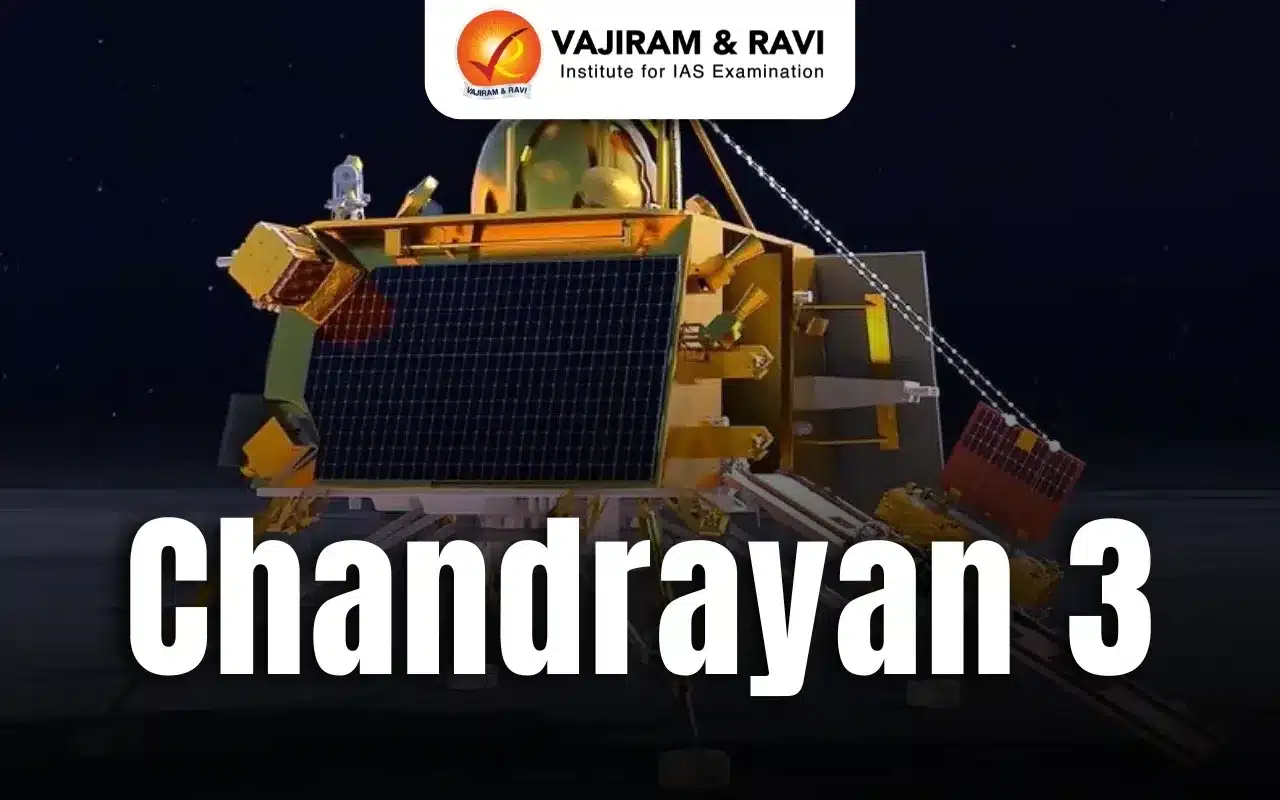
Chandrayaan-3 Latest News
New findings based on data from India’s Chandrayaan-3 mission suggest that water ice on the Moon may be present beyond its polar regions.
About Chandrayaan-3
- Chandrayaan-3 is the Indian Space Research Organisation’s (ISRO) second attempt, after Chandrayaan-2, to achieve a successful landing and rover operation on the Moon’s surface.
- Chandrayaan-3 was launched using ISRO’s LVM3 rocket, designed to place modules into the Geosynchronous Transfer Orbit (GTO) at a lower cost.
- LVM3 is a three-stage rocket with two solid strap-on boosters and a core liquid stage.
- The LVM3 M4 launcher positioned the integrated modules in an elliptical parking orbit of approximately 170 x 36,500 km.
- Objectives: The mission aims to explore the presence of water ice, which could support future lunar habitation and provide fuel for interplanetary missions. Key goals include:
- Achieving a safe and soft landing on the Moon.
- Conducting rover-based exploration of the lunar surface.
- Performing in-situ scientific experiments through the rover.
- Mission Components: Chandrayaan-3 consists of a Lander Module (LM), a Propulsion Module (PM), and a Rover designed to develop and demonstrate interplanetary mission technologies.


Chandrayaan-3 Recent Findings
- New data from Chandrayaan-3 indicates possible water-ice deposits beyond the Moon’s polar regions.
- A study by the Physical Research Laboratory (PRL), Ahmedabad, using data from Chandra’s Surface Thermophysical Experiment (ChaSTE) instrument, supports this finding.
- ChaSTE measured a 60°C temperature difference between the lunar surface and 10 cm below it, revealing that the Moon’s surface layer is highly non-conductive, providing insights into its composition and thermal properties.
Chandrayaan-3 FAQs
Q1. Is Chandrayaan-3 still working?
Ans. Chandrayaan-3’s lander and rover completed their mission after one lunar day; the propulsion module remains in Earth orbit.
Q2. When was Chandrayaan-3 landed?
Ans. Chandrayaan-3 successfully landed on the Moon’s South Pole on August 23, 2023.
Q3. Is Chandrayaan-3 a success or failure?
Ans. Chandrayaan-3 was a success, achieving a soft landing on the Moon’s South Pole and completing its scientific objectives.
Q4. What is the difference between Chandrayaan 2 and Chandrayaan-3?
Ans. Chandrayaan-3 lacks an orbiter, unlike Chandrayaan-2, and focuses on soft landing with improved lander and rover capabilities.
Source: FE

 Last updated on Oct, 2026
→ UPSC 2027 Notification will be released on 13 January 2027 at upsconline.nic.in.
→ Check Nobel Prize 2026 Winners List here.
→ Download PIB PRiSM Monthly Magazine 2026 here.
→ Check UPSC Monthly Current Affairs Magazine The Recitals here.
→ Check out the latest UPSC Syllabus here.
→ Download UPSC Model Answers for Mains 2026
→ UPSC Mains Question Paper 2026 is out now for Essay & GS Paper 1, 2, 3 & 4.
→ UPSC Calendar 2027 has been released.
→ Enroll in Vajiram & Ravi’s UPSC Mains Test Series 2027 for structured answer writing practice, expert evaluation, and exam-oriented feedback.
→ Join Vajiram & Ravi’s UPSC Mentorship Program 2027 for personalized guidance, strategy planning, and one-to-one support from experienced mentors.
→ Go through the UPSC Mains Previous Year Papers to enhance your preparation.
→ UPSC has released UPSC Toppers List 2025 with the Civil Services final result on its official website.
→ Also check Best UPSC Coaching in India








