


What’s in today’s article?
- Why in the News?
- Distribution of Coal Across the World
- India’s Coal Reserves
- Types of Coal in India
- Problems With Coal Found in India
- India’s Dependence on Coal for Energy Supply
- Revenue Sharing Model for Coal Plants
- News Summary
Why in the News?
- In an effort to bolster its revenue stream, national miner Coal India Ltd (CIL) has awarded its abandoned coal mines to private players on a revenue-sharing model.
- CIL had identified 23 coal mines — most of them underground ones — which were closed or discontinued for technical or financial reasons.
Distribution of Coal Across the World
- Coal is a widespread resource for energy and chemicals.
- The quantities of proven coal reserves in the world are typically shown in Millions of Tons of Coal Equivalent (MTCE).
- Nearly 75 per cent of the world’s recoverable coal resources are controlled by five countries:
- United States (~22 per cent)
- Russia (~15 per cent)
- Australia (~14 per cent)
- China (~13 per cent)
- India (~10 per cent)


India’s Coal Reserves
- Commercial coal-mining industry has been in operation since 1774, launched by the East India Company along the Damodar River in West Bengal.
- 70 per cent of India’s coal supply comes from the states of Jharkhand, Chhattisgarh, Odisha, West Bengal and Madhya Pradesh.
- State-owned Coal India Limited has a virtual monopoly on coal mines in India, which produce roughly 75 per cent of the coal burned in India’s coal-fired power stations.
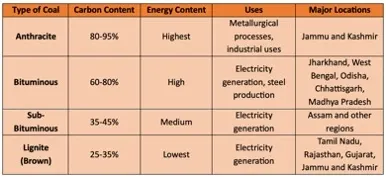
Types of Coal in India
Problems With Coal Found in India
- High Ash Content:
- Issue: Indian coal generally has high ash content, ranging from 20% to 45%.
- Impact: High ash content reduces the calorific value, increasing the cost of coal handling and transportation, and results in more waste and pollution.
- Lower Calorific Value:
- Issue: Indian coal has a lower calorific value compared to imported coal.
- Impact: This necessitates burning more coal to produce the same amount of energy, leading to higher emissions and inefficiencies in power generation.
- Limited Coking Coal:
- Issue: India has a shortage of high-quality coking coal, which is essential for steel production.
- Impact: This necessitates the import of coking coal, increasing costs and dependence on foreign sources.
- Environmental Concerns:
- Issue: Coal mining and combustion contribute significantly to air pollution, water contamination, and deforestation.
- Impact: These environmental issues have severe health implications and contribute to climate change, making coal less sustainable in the long term.
India’s Dependence on Coal for Energy Supply
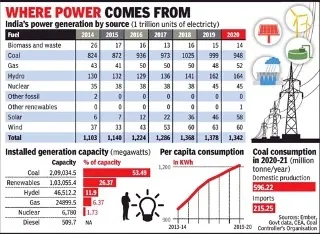
- While renewable energy capacity is dramatically increasing, coal still provides around 70 per cent of the country’s electricity.
- Coal is expected to account for at least 21 per cent of India’s electricity requirements even by 2050.
- Easily Available Source of Power:
- Alternatives like nuclear energy have been hampered by high costs and safety concerns.
- India’s Developmental Needs:
- The International Energy Agency (IEA) predicts that between 2020 and 2040, India will have the largest growth in energy demand of any country in the world.
- To meet this demand, India will need to rely on a variety of energy sources—both conventional and renewable.
- Source of Employment:
- Around 4 million people in India are employed either directly or indirectly in the coal sector.
- Other than active workers, another 500,000 Indians rely on the coal sector for their pensions.
- Source of Revenue for the Government:
- Coal India Limited is the largest coal mining company in the world.
- The coal sector is a major source of revenue for States and the Central Government.
Revenue Sharing Model for Coal Plants
- The revenue sharing model involves collaboration between Coal India Ltd (CIL) and private players.
- Revenue Sharing Framework:
- Structure: Private players are awarded contracts to operate abandoned or underutilized coal mines on a revenue-sharing basis with Coal India Ltd (CIL).
- Revenue Split: The revenue generated from coal sales is shared between CIL and the private operators based on agreed terms.
- Identification of Mines:
- Selected Mines: CIL identified 23 abandoned or discontinued mines, mostly underground, with a cumulative peak-rated capacity of 34.14 million tonnes per annum (MTPA) and estimated reserves of 635 million tonnes (MT).
- Operational Mechanism:
- Mine Developer and Operator (MDO): Private operators, also known as Mine Developer and Operators (MDOs), are responsible for the coal extraction and production process.
- Freedom in Operations: MDOs have the autonomy to choose their technology, methods, and machinery for coal extraction.
- Auction Process:
- Market-Driven Pricing: Coal mined from these sites is sold at market-driven prices through an auction process managed by the operators on behalf of the authority.
News Summary
- Coal India Ltd (CIL) has assigned its abandoned coal mines to private players on a revenue-sharing model to boost domestic production and reduce imports.
- Out of 23 identified mines, which have a combined capacity of 34.14 MTPA and reserves of 635 MT, most were closed for technical or financial reasons.
- This initiative, aimed at increasing industry participation, will see 75% of coal excavation outsourced to private operators, with a goal to reach 90% in five years.
- While the revenue impact is modest (10-12%), the focus is on quicker production turnaround and environmental benefits.
- These mines will sell coal at market prices through auctions and support coal gasification projects.
· CIL reported a 7.28% increase in coal production, reaching 160.25MT, and a 27% growth in production from captive and commercial mines.
Q1. What do you mean by Coal Gasification?
In industrial chemistry, coal gasification is the process of producing syngas—a mixture consisting primarily of carbon monoxide, hydrogen, carbon dioxide, methane, and water vapour —from coal and water, air and/or oxygen. Historically, coal was gasified to produce coal gas
Q2. What is Coalbed Methane?
Coalbed methane, coalbed gas, or coal seam gas is a form of natural gas extracted from coal beds. In recent decades it has become an important source of energy in the United States, Canada, Australia, and other countries. The term refers to methane absorbed into the solid matrix of the coal.
Source: CIL awards underground mines to private players to bolster revenue stream

 Last updated on Oct, 2026
→ UPSC 2027 Notification will be released on 13 January 2027 at upsconline.nic.in.
→ Check Nobel Prize 2026 Winners List here.
→ Download PIB PRiSM Monthly Magazine 2026 here.
→ Check UPSC Monthly Current Affairs Magazine The Recitals here.
→ Check out the latest UPSC Syllabus here.
→ Download UPSC Model Answers for Mains 2026
→ UPSC Mains Question Paper 2026 is out now for Essay & GS Paper 1, 2, 3 & 4.
→ UPSC Calendar 2027 has been released.
→ Enroll in Vajiram & Ravi’s UPSC Mains Test Series 2027 for structured answer writing practice, expert evaluation, and exam-oriented feedback.
→ Join Vajiram & Ravi’s UPSC Mentorship Program 2027 for personalized guidance, strategy planning, and one-to-one support from experienced mentors.
→ Go through the UPSC Mains Previous Year Papers to enhance your preparation.
→ UPSC has released UPSC Toppers List 2025 with the Civil Services final result on its official website.
→ Also check Best UPSC Coaching in India








