


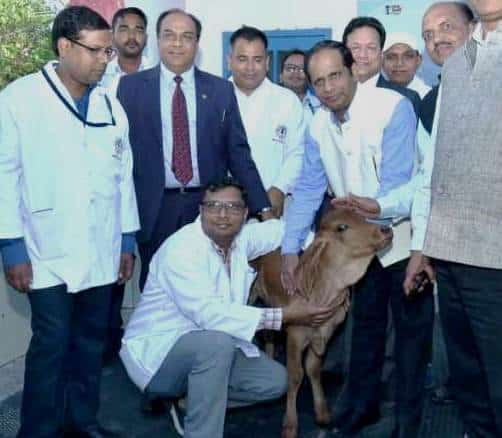
About Cloned Cow-calf:
- It is India’s first cloned Gir female calf named Ganga.
- To clone the Gir, oocytes are isolated from live animals using ultrasound-guided needles, and then, matured for 24 hours under control conditions.
- The somatic cells of elite cows are used as donor genomes, which are fused with OPU-derived enucleated oocytes. Following chemical activation and in-vitro culture, the developed blastocysts are transferred into recipient mothers to deliver the Gir calf.
What is cloning?
- The term cloning describes a number of different processes that can be used to produce genetically identical copies of a biological entity.
- Cloning can be natural or artificial. Examples of cloning that occur naturally are as follows:
- Vegetative reproduction in plants, e.g. water hyacinth producing multiple copies of genetically identical plants through apomixis
- Binary fission in bacteria.
- Clones can also be produced through artificial means. Biotechnological methods are employed to produce such clones.
- Molecular cloning, where copies of specific gene fragments are produced
- Cellular cloning, where single-celled organisms with the exact genetic content of the original cell are produced in cell cultures.
- Organism cloning, or reproductive cloning, where a multicellular clone is created generally through somatic cell nuclear transfer
What are somatic cells?
- The word “somatic” is derived from the Greek word soma, meaning “body”. Hence, all body cells of an organism – apart from the sperm and egg cells, the cells from which they arise (gametocytes) and undifferentiated stem cells – are somatic cell.
Q1) What is vegetative reproduction?
Vegetative reproduction is any form of asexual reproduction occurring in plants in which a new plant grows from a fragment of the parent plant or grows from a specialized reproductive structure (such as a stolon, rhizome, tuber, corm, or bulb).
Source: Haryana: India’s first cloned desi Gir female calf, Ganga produced at NDRI


 Last updated on Oct, 2026
→ UPSC 2027 Notification will be released on 13 January 2027 at upsconline.nic.in.
→ Check Nobel Prize 2026 Winners List here.
→ Download PIB PRiSM Monthly Magazine 2026 here.
→ Check UPSC Monthly Current Affairs Magazine The Recitals here.
→ Check out the latest UPSC Syllabus here.
→ Download UPSC Model Answers for Mains 2026
→ UPSC Mains Question Paper 2026 is out now for Essay & GS Paper 1, 2, 3 & 4.
→ UPSC Calendar 2027 has been released.
→ Enroll in Vajiram & Ravi’s UPSC Mains Test Series 2027 for structured answer writing practice, expert evaluation, and exam-oriented feedback.
→ Join Vajiram & Ravi’s UPSC Mentorship Program 2027 for personalized guidance, strategy planning, and one-to-one support from experienced mentors.
→ Go through the UPSC Mains Previous Year Papers to enhance your preparation.
→ UPSC has released UPSC Toppers List 2025 with the Civil Services final result on its official website.
→ Also check Best UPSC Coaching in India








