Comet Latest News
NASA’s Hubble Space Telescope has captured the first detailed images of interstellar comet 3I/ATLAS as it passes through our solar system, offering scientists a rare glimpse at a visitor from another star system.
About Comet
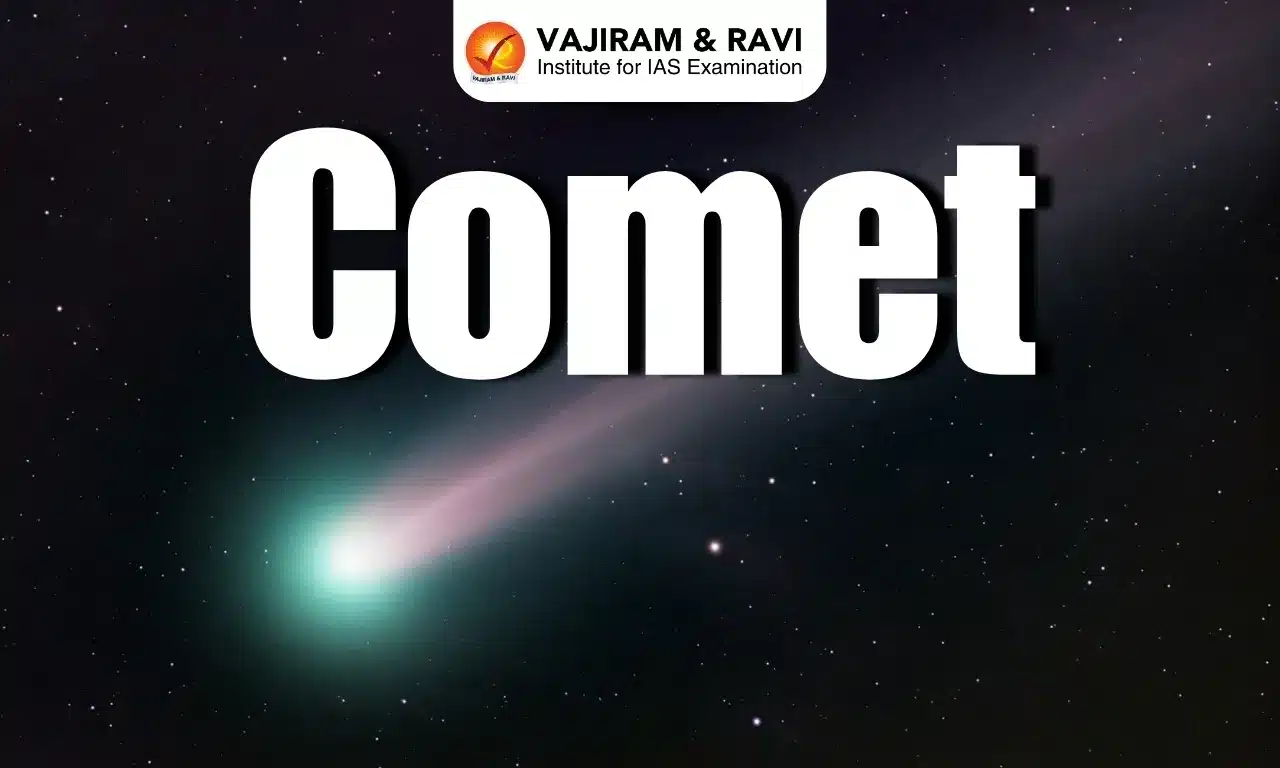
- Comets are large objects made of dust and ice that orbit the Sun.
- Best known for their long, streaming tails, these ancient objects are leftovers from the formation of the solar system 4.6 billion years ago.
- Comets are mostly found way out in the solar system.
- Some exist in a wide disk beyond the orbit of Neptune called the Kuiper Belt.
- We call these short-period comets. They take less than 200 years to orbit the Sun.
- Other comets live in the Oort Cloud, the sphere-shaped, outer edge of the solar system that is about 50 times farther away from the Sun than the Kuiper Belt.
- These are called long-period comets because they take much longer to orbit the Sun.
- The comet with the longest known orbit takes more than 250,000 years to make just one trip around the Sun.
- A comet is made up of four visible parts: the nucleus, the coma, the ion tail, and the dust tail.
- The nucleus is a solid body typically a few kilometres in diameter and made up of a mixture of volatile ices (predominantly water ice) and silicate and organic dust particles.
- The coma is the freely escaping atmosphere around the nucleus that forms when the comet comes close to the Sun and the volatile ices sublimate, carrying with them dust particles that are intimately mixed with the frozen ices in the nucleus.
- The dust tail forms from those dust particles and is blown back by solar radiation pressure to form a long curving tail that is typically white or yellow in colour.
- The ion tail forms from the volatile gases in the coma when they are ionized by ultraviolet photons from the Sun and blown away by the solar wind.
- Ion tails point almost exactly away from the Sun and glow bluish in colour because of the presence of CO+ ions.
Source: IT


 Last updated on Oct, 2026
→ UPSC 2027 Notification will be released on 13 January 2027 at upsconline.nic.in.
→ Check Nobel Prize 2026 Winners List here.
→ Download PIB PRiSM Monthly Magazine 2026 here.
→ Check UPSC Monthly Current Affairs Magazine The Recitals here.
→ Check out the latest UPSC Syllabus here.
→ Download UPSC Model Answers for Mains 2026
→ UPSC Mains Question Paper 2026 is out now for Essay & GS Paper 1, 2, 3 & 4.
→ UPSC Calendar 2027 has been released.
→ Enroll in Vajiram & Ravi’s UPSC Mains Test Series 2027 for structured answer writing practice, expert evaluation, and exam-oriented feedback.
→ Join Vajiram & Ravi’s UPSC Mentorship Program 2027 for personalized guidance, strategy planning, and one-to-one support from experienced mentors.
→ Go through the UPSC Mains Previous Year Papers to enhance your preparation.
→ UPSC has released UPSC Toppers List 2025 with the Civil Services final result on its official website.
→ Also check Best UPSC Coaching in India
Comet FAQs
Q1. What are comets primarily made of?+
Q2. Where are most comets found in the solar system?+
Q3. What is the bluish color of a comet's ion tail caused by?+
Q4. How old are comets estimated to be?+
Tags: comet prelims pointers upsc current affairs upsc prelims current affairs